Sunday, August 26, 2018

Book Review: Going Home

I’ve always been a fan of post-apocalyptic fiction, both in print and on film. I especially love the bloopers, the way even people who are happily predicting the end of the world as we know it still take for granted the technology with which we live. You know, someone scavenging through the pantry in a house that’s been abandoned for 10 or 20 years and finding canned goods that are still safe to eat – a scenario that’s particularly amusing when the setting is in a region that experiences extreme cold in the winter (home canned or commercial; freezing is going to destroy the seal) – or hopping into a car that was left by the side of the road a couple years previously but fires right up when the hero turns the key.

Sometimes it doesn’t even have to be that far into the future. Sometimes all it takes is a widespread power outage that’s lasting for weeks but mysteriously doesn’t stop the pumps or cash registers at a truck stop from working. Or turning on a faucet in a house that depends on a municipal water system and being able to fill a coffee pot or take a cold shower. Civilization has come to a crashing halt except at the local city park where the bubblers are still working. Right.

Granted, the water system is one thing that will keep working longer even if there is no power to run the pumps and filters at the plant – gravity will ensure that water pressure in the system won’t drop to zero as soon as the lights go out – but once the humongous tanks on hilltops and towers run dry they’re going to stay dry until the power comes back.

My latest dip into post-apocalyptic fiction was particularly amusing because it was Part One in a series written by a genuine prepper. You know, one of those paranoid loons who’s busy filling 5-gallon pails with ammunition and worrying about where he can bury his secret stashes of emergency supplies. Going Home was penned by A. American, a nom de plume that I find moderately annoying (“A” is the wrong article to use with American; it should be “an,” but maybe the publisher wouldn’t go for letting the dude be A. N. American. . . or maybe the author is just an ass) but it didn’t stop me from checking the book out from the library. The author’s bio at the back of the book describes him as a survivalist, someone who’s prepping for real and not just in print. Here’s hoping he’s doing a better job of it in real life than he did in print.

The protagonist in Going Home is a military veteran of some sort (as far as I can recall he never specifies his branch of service or his MOS [Army speak for Military Occupational Specialty; the other services have different terms]). Whatever he did, it was a while back. Now he’s a happily married man with three kids (all girls) living in southern Florida. He works with high tech, electronic stuff, and is fortunate enough to be able to do a lot of it from home. When the book opens, however, he’s not home. He’s up north, not far from the state line on I-75, returning from a day or two he had to spend at his employer’s headquarters. He’s about 200 miles from home when he hears the emergency alert tone on the car radio. Then the radio goes silent, the car dies. So does his cell phone.

My first thought was, okay, the author is about to do something similar to S. M. Stirling’s Dies the Fire which mixes in fantasy to explain why the fundamental laws of physics change in odd ways. But no, American is doing more straight-forward science fiction/end of life as we know (at least for a while). Electronics are fried; everything else (like guns) still work just fine. The combination of the recent model vehicle and his phone dying suggests to Our Hero that the planet (or at least his part of it) just got zapped by either an electromagnetic pulse (EMP) or a doozy of a solar flare, either of which would fry solid state electronics. (Side note: concern about weaponized EMPs were/are one reason the Soviet military kept using vacuum tubes in aircraft long after the United States had gone totally transistorized. The Soviets/Russians were/are big believers in redundancy – backup systems that are immune to various threats, which is why they’ve do a lot of their secret internal communications the old-fashioned way: on paper using typewriters. You can’t hack a typewriter.)

Our Hero knows his SUV is not going to run again without a total replacement of its onboard computers. Similarly, his phone is now effectively a paperweight. If he wants to get home, he’s going to have to do it on foot.

Being a prepper, he has a bug out bag with him. A bug out bag contains emergency supplies sufficient to last a person for several days (e.g., MREs, energy bars, basic camping gear like a survival blanket and a fire starter) as well as a weapon or two for protection. The one thing the paranoid preppers get right is that if there was a major system collapse, some people would quickly lose whatever civilized veneer they once had. Looting would happen, so would settling old scores and sexual assaults. The majority of people are decent human beings, but we all know at least one asshole where you’re pretty sure the only thing that’s preventing him or her from going on a psychotic rampage is fear of prison showers.

The fact Our Hero is a prepper isn’t apparent immediately. The book cover does note it’s Book One in The Survivalist series but it takes a couple paragraphs to make clear that the protagonist does indeed have a sort-of bunker set up back home – or at least a workshop behind his house full of canned goods and ammunition.

Our Hero figures out what he really needs to take with him, loads a backpack, and starts walking. He’s not too worried about the wife and kids because he’s got their place set up to go off grid (solar power, among other things), they’ve been stockpiling canned goods, and he actually trusts most of his neighbors. Nonetheless, he knows he should get moving ASAP. It might take awhile for other stranded motorists to figure out rescue isn’t going to come rolling down the road any time soon, but eventually they will. He wants to get as far as possible and off the Interstate before being forced to share the resources he has.

Suffice to say Our Hero has various predictable adventures along the way south. He defends himself from a group of lowlifes who mistakenly assume a 40-ish white guy traveling alone would be an easy target, he rescues a woman being assaulted by a local sleaze who had had the hots for her for awhile and decided she’d now be an easy target, he joins up with a couple other people who are walking home, and he encounters a group whose worst fears have been realized: the entire episode, the EMP attack, was a false flag operation spearheaded by the liberals in government who wanted an excuse to declare martial law and confiscate everyone’s guns. Naturally, he’s in agreement with them. After all, look at who’s in the White House? (Note: The book was published in 2016. I’m guessing A. American is another middle-aged white dude who’s terrified people of the wrong color may actually be gaining some political power.)

Our Hero declines the offer of some weed when he meets a group of hippies camping in the National Forest, but I got the distinct impression the author was not so shy. Just how ripped on drugs do you have to be to think that leftists/progressives/those damn socialists could ever cooperate long enough to plan a false flag operation, let alone actually pull one off? There are plot lines that make sense, and then there are plot lines that are laughable. Going Home wanders into the latter category. You can’t get a group of liberals to agree on who’s bringing which jello salad to a potluck; if it was possible to produce a leftist nanny-state administration bent on confiscating guns, it would have happened already. When you poll the public on various social welfare questions (paid family leave, Medicare for all, a higher minimum wage, a woman’s right to choose, cheaper college costs) most people agree with the “liberal” position as long as it’s not labeled as being something espoused by any particular political party or candidate. Label any idea either Democrat or Republican and it’s a different story, of course.

In addition to ascribing to the leftist liberal commie pinko types way more powers than they’d ever have a prayer of acquiring the author also falls into taking technology so much for granted that he black boxes too much of it. At one point, the power grid is still down, chaos reigns, but a character who found a truck old enough not to have electronic components pulls into a gas station and barters a fifth of vodka to get the tank filled. Okay. The coolers in the store are inoperable, but the electric-powered gas pumps are still working? Our Hero is real proud that his family is going to be able to cook without electricity, but what’s his solution? A stove that uses kerosene as a fuel. Good luck with that one unless you’ve got quite a few gallons stockpiled.

I am also amused by the survivalists who stockpile buckets and buckets of ammunition while giving no thought whatsoever to what’s going to happen when it runs out. I know some people are avid reloaders, but how many of them also know how to make decent gun powder? More of them should take a lesson or two from the characters in The Walking Dead. A crossbow may be slower than a rifle or hand gun, but you can recycle the bolts just by cleaning them. It’s also quiet.

I did, however, find it totally believable that many people working for Homeland Security would turn into total thugs as soon as they were given the green light to do so by their supervisors. We’ve got the stellar example of ICE having no qualms whatsoever now about putting babies in cages and terrorizing pregnant women and handicapped children.

So what’s the bottom line on this book? It’s readable. Stupid in places, but readable. It actually would have been a better book if the author had ditched the us-true-patriots vs. the-evil-liberal-government and kept it as more of a pure aftermath of a disaster. He could have still included the thuggish DHS types – we all know the most dreaded phrase in the English language is “We’re from the government and we’re here to help you” – without indulging in extreme right wing fantasies. Will I read the next book in the series if I stumble across it? Maybe. The author did include a cliff hanger at the end of this book so I might be curious enough to see where he goes with that.

Friday, August 24, 2018

Cold weather projects

Summer is winding down so I'm getting back into a sewing mood. Started a jeans quilt recently, one that's going to be a really simple pattern, and have found a mending project that should eat up a fair number of hours in front of the television this winter.


The jeans quilt will be approximately full-size. At this point I'm thinking I'll do a thin border using a bright corduroy around the brickwork and then will do an outer border using denim squares. I figured out it's going to take 28 rows of the rectangles; I've got 7 completed so far. Once it's done, it'll get ticked with embroidery floss. It will, of course, include at least one pocket. I'm probably going to give it to someone with kids, and little kids love having pockets they can hide stuff in.

The mending project is a fairly small square quilt I finished in the early 1980's. Not sure where I found the pinwheel pattern, but do recall it took forever to cut the pieces. Then I hauled them around in an ice cream pail for a couple years (from Michigan to unincorporated Snohomish County in Washington to Panorama City (California) to Tucson (Arizona) and finally to Reno before I finally started piecing it. I think we were still living in Reno when I finished it.

It's held up remarkably well overall, but exposure to light combined with normal wear and tear (when I make quilts, they're meant to be used and not hung on a wall as a decorative item) caused one specific fabric to dry rot. Depending on the dyes used, some fabrics break down remarkably fast. (I learned the hard way that black cotton blends are never a good choice for use in a quilt. They either fade to a truly ugly green or dry rot almost instantly.) Mending it will entail cutting pieces to fit the spaces where the original piece is now in shreds and then hand sewing the new pieces in place. Not sure just how long the process will take, but I know it's going to be fairly time consuming.

Sunday, August 12, 2018

Latency and its discontents

It’s been an odd summer. I know I haven’t done much with this blog for quite a few months now. My theoretical goal is to write something often enough to retain the ability to string more than two sentences together in a coherent thought, but it hasn’t been happening. No book reviews, no descriptions of national parks or forests visited, no nattering on about politics or current affairs, not even much about the fun and frustrations of volunteering at the county historical society’s museum. Nada. Zilch. Blank pages for weeks on end.

Why is a mystery. Sort of. I have had a mild case of ennui, but not enough to prevent me from doing other stuff. So I’m going to blame technology. We’ve been experiencing major Internet connection woes since returning from Arizona in April. It hadn’t been the world’s greatest service for awhile, but it got a lot worse this Spring. Pages refused to load – we kept getting the “aw, snap” message on Chrome saying a site was taking too long to respond – and connections would vanish before our eyes. I’d be on Facebook scrolling down to read my news feed, the device would do the electronic equivalent of blinking, and whichever browser I was in (Edge or Chrome) would shut down. The Intertubes weren’t just being slow. They were gone. I’d go from being in the middle of reading an article to staring at the icons on the desktop. When I reopened the browser I’d be treated to the “Chrome did not shut down properly. Would you like to restore?” message. Well, no shit it didn’t shut down properly. It totally closed without any human hands asking it to close, just a lousy Internet connection.

At first when weird stuff happened, I thought the problem was my notebook. It was cheap and I thought maybe it was simply dying. Then the S.O. got a new laptop (his old one gave up the ghost during the winter) and he had problems, too. So did  the  museum's smart phone when I happened to have it at home. Ergo, it wasn't my notebook. It was the ISP. Just to be sure, I took my notebook to a couple different locations where there was good public wifi. No issues whatsoever, no odd glitchy things happening.  The problems were worse with the notebook than with the S.O.'s laptop, but I figure it's because the notebook is the Microsoft version of a Chrome book. It's designed to sync with the cloud more or less continuously, and if access to the cloud vanishes the notebook gets more than a tad  erratic. 

By the time I  confirmed that it was not just the notebook's problem, we had already spent several frustrating months trying to get our service provider (Baraga Telephone, aka UP.net, which I’m figuring out is just another way of spelling Comcast because they’ve surely got the same model of customer service) to recognize that there was (and still is) a problem. The S.O. would call and complain. Whoever was on the other end always either sounded skeptical (“What do you mean you have a problem? Our readings don’t show a problem”) or lied (“I’ll put in a work order. Someone will call you back/come up to check things out/contact you soon."). No one called back, no one came up until I went ambling in to Baraga Tel’s office and complained in person. I brought my notebook along so I could show them screen shots of the weirdness that had been happening. And, yes, then they treated the complaints seriously but it shouldn’t have taken me standing in the lobby being an obnoxious old lady to get them to listen.

At about the same time, the S.O. discovered and installed an app that measures the data flow in both directions. What most people don’t realize because the Internet tends to get talked about using pipe analogies, like the flow of water through a hose, is that the data flow is a two-way thing. It doesn’t matter how fast data is reaching us if then it can’t bounce back quickly. The communication back to the server is called latency and is measured in milliseconds. The longer it takes to get back to the server, the worse your Internet service is going to be. Normal latency for DSL (which is what we have) is something like 40 to 50 milliseconds. The graph for latency should look like a fairly smooth line, definite ups and downs but nothing dramatic, you now, minor variations from maybe somewhere around 40 to up around 50 and then down again, but no huge spikes.

Well, we get spikes. We get dramatic spikes. The S.O. has been tracking those spikes. We’ve had some hit over 2,000. We also get bright red lines that last for anywhere from a blip to several minutes. The bright red line means no Internet service whatsoever. 

We did succeed in getting Baraga Telephone to come up and check things out. The first time they were up, they discovered the neighbor’s line had a section that lightning had fried. So they fixed it – I told the S.O. that the next time he sees Tom to tell him he can thank us for his improved service – but they didn’t find anything on our line. They did, however, concede there is a problem. So they came up again. This time the lineman found a short section on our line that had gotten fried. He came back to the house and was so proud of himself for replacing that piece. He was sure he’d cured the problem. Nope.

So where do things stand now? The lineman said the wires coming our way are old and of a type that is now considered obsolete. They should be replaced. Will they be replaced? If they are, that would no doubt fix our problem. Does Baraga Telephone management care enough about keeping three customers happy (the number of households on our road that use UP.net) to replace a mile of not-cheap wire? I doubt it.

The S.O. and I have been contemplating being snowbirds again this coming winter. We’re still debating whether to apply to be volunteers at a national park or elsewhere for at least part of the winter, but it’s looking more and more like the Guppy will be in warmer climes when snow falls up here. If we do spend the winter away, we’ll devote a good part of it exploring alternatives to the Internet service we have now. Either that, or we’ll spend enough time in locations where there is neither cell nor Internet service for us to figure out that it’s possible to live without it.

Minor digression, but yet another mystery: why did the font change for the last two paragraphs (this one and the one above) when I never went into HTML to change the code?  It really is magic. 

Saturday, July 21, 2018

Really good day at the museum

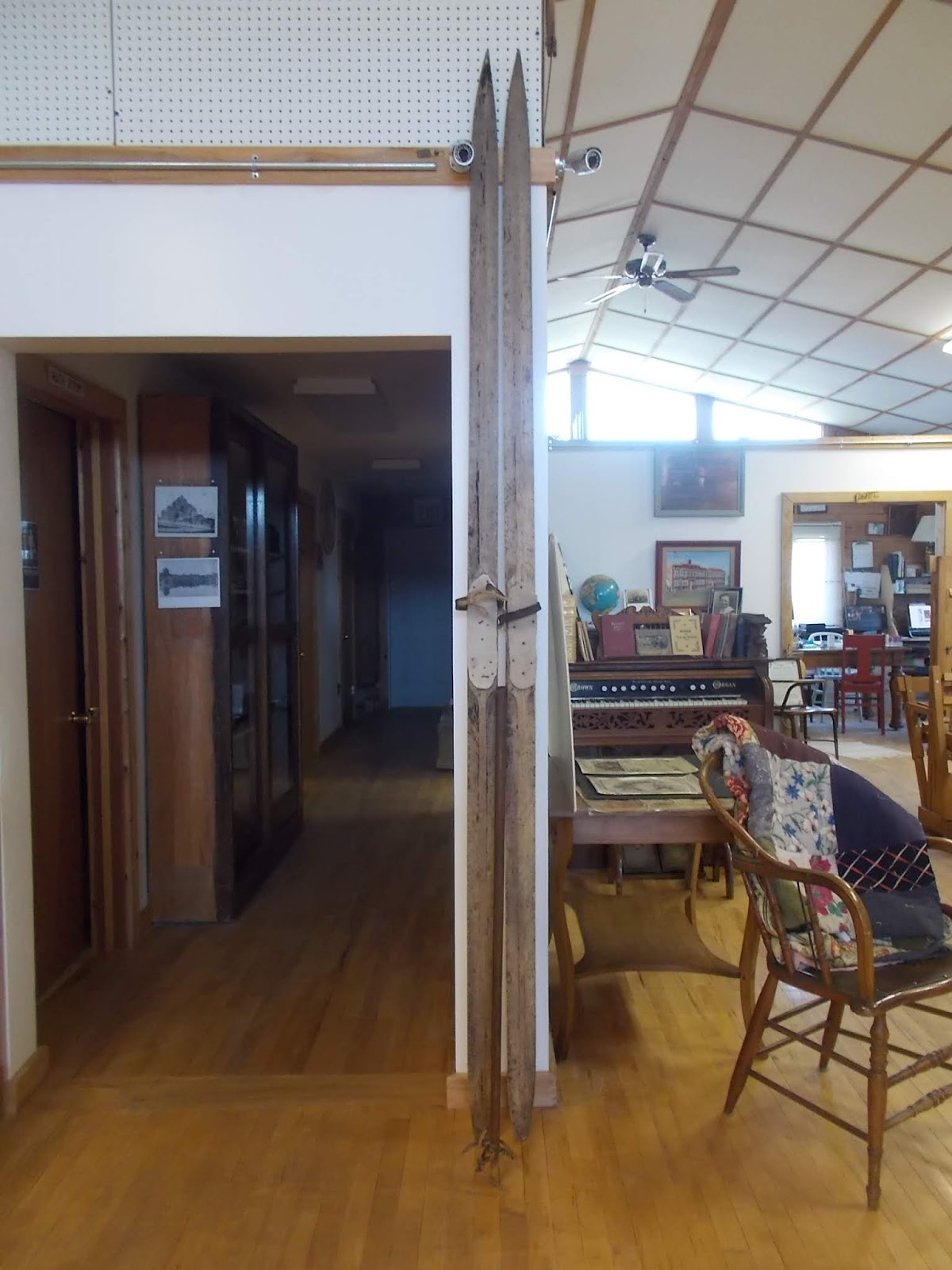
Hand-made skis that are 9 feet long.
It struck me the other day that I was having a really good day at the museum, and it wasn't just because there were no visitors. The public contact part is always the hardest for me so I'm automatically feeling a little more mellow when I'm the only person in the building.

No, it was a really good day because when I looked around the office I realized that I could actually see the tabletop. No piles of stuff needing to be sorted or dealt with, at least not on the table. The deck was, so to speak, clear. No correspondence waiting for a response, no weirdness, nothing.

Ditto the basket next to the computer. For months there has been a stack of stuff teetering there waiting to be scanned, cataloged, filed, whatever. That leaning pile of paper is gone. Oh, the basket isn't totally empty but the stuff that's at the bottom has been there for years and can probably stay there for a few more. It all relates to a part of an exhibit on collecting as hobby so it's not leaving the basket until the stuff that matches up with it is ready to go back to the person who lent the objects in the display case to us.

I know I will be rebuilding the leaning pile soon, but not immediately.

And it was a really good day because when I looked out in the exhibit area, everything I'm responsible for is basically done. There's always some minor tweaking that could happen, but all the major stuff is wrapped up. No more apologizing to visitors for the clutter or plaster dust, no explaining that the empty space on the wall will be filled soon. It actually feels a bit odd. Who knows? Maybe I'm finally going to manage to get outside and do some weeding in the native plants garden.

Sunday, July 8, 2018

I cling to the strangest things

I have days when I wonder if I qualify as a borderline hoarder. I hang on to the strangest stuff. Like most people these days (or so I assume) we have a plastic bags stash. In fact, we have two: one for the usual plastic bags you get from the local supermarket or Target and one for the slightly smaller and flimsier bags that come from Family Dollar or Dollar General. The small bags are good for the small wastebaskets in the house; the regular bags fit the bigger burnable trash can.

So after taking the trash out the other day I reach into the bag stash to get a fresh bag for the trash can. And then I discover I don't particularly want to use the bag that made it to the top of the pile, at least not yet. It's like in the world of throwaway plastic bags, it's a keeper. Why is it a keeper? Because I'm unlikely to ever get another. The bag, pictured above, is, of course, from Arizona, but not just any part of Arizona. It's from the Bashas' market in Chinle. How likely, I ask myself, are we to ever shop at that particular Bashas again?

Actually, the odds aren't that bad. Chinle falls almost exactly midway between where the Younger Daughter lives in southern Arizona and where my mother and sister live in Colorado and sits on the shortest, most logical route, US-191. We've been through Chinle three times in the past 18 months; odds are we'll be going through there again. And if we have the Guppy we'll be camping. If we're camping, we'll probably go to Bashas. Even if we're not, it would a logical place to stop to pick up snacks or drinks.

And if we go to that Bashas, I'll once again marvel at the meat case and wish I liked mutton. You know, in the typical supermarket if you find lamb or mutton, it's in small discrete pieces neatly sealed in plastic. Little tiny lamb chops that are almost too cute to cook. Leg of lamb that was shrink wrapped in New Zealand. At the Chinle Bashas, however, there is no doubt you're looking at disassembled sheep. Not surprising, given that the supermarket is in the heart of the Navajo Nation, but a little disconcerting when you're used to seeing meat that's been packaged in a way that makes it easier to ignore the fact it used to be a live animal.

As a side note, shortly after we'd been through Chinle with the Guppy and had camped at the Cottonwood campground that's inside Canyon de Chelly Natonal Monument I read a review of the campground on a website. The person had been there about the same time we had and laid it on thick about "if you come, be sure to stock up on groceries in Holbrook or Winslow because there is no supermarket in Chinle!" Holy wah. How does a person fail to find a close to brand new modern supermarket that sits right on the major north-south highway through town? When we were there we figured out pretty fast that any town big enough to have multiple major chain hotels (Holiday Inn Express, for example), chain restaurants (Denny's, Burger King), gas stations, and that sits next to a popular tourist attraction (Canyon de Chelly) is going to have a grocery store of some sort. And it did: Bashas.

So what's the moral of this rambling on about plastic bags and travel? I need to let the S.O. be the one who deals with putting a fresh bag in the trash can. He doesn't care where any of the bags came from as long as there are no holes in the bottom.

Saturday, June 30, 2018

Playing tourist in our own backyard

The S.O. and I went wandering around Arvon Township yesterday. I needed some photos for a display I'm slowly putting together at the museum and figured we could combine getting a shot of the Arvon Township School and other sites with getting a burger at the Finn's for the evening meal. It was interesting.

Killer jungle gym of everyone's 1950's childhoods turned into a grape arbor on the school grounds. The schools I attended had these, all set in hard pavement. 
Like much of the U.P. Arvon Township has done a decent job of rewilding. The pioneers who farmed there 100 years would be rolling in their graves if they knew that the fields they so laboriously cleared of stumps and turned into hay fields and orchards have totally reverted to woodland. There are still a few open areas, but not many. It's hard to tell where most of the historic farms and houses were because so much is now fairly dense mixed hardwood forest. 
Big Eric's. 
Drove out to Big Eric's bridge and falls and discovered the campground there was totally empty, which astounded me. The end of June and no campers? Granted, it is a "primitive" park (no hook-ups and pit privies) but it's lovely. Nice, level shady sites and the Huron River for fishing just a few feet away. And no cell service. When the S.O. checked his phone he had zero bars. Sounds great to me.

In contrast, the campground at Witz's Marina was looking pretty full. Understandable, I guess. Right on the Lake and with cold beverages for sale in the store. And if you're interested in getting out on Lake Superior more than you are fishing in inland waters? Witz's is perfect. 
Looking across to the harbor entrance. The crane visible is the one used 50 years ago to dredge the channel and create the marina. 

The crane close up I was amused to see that people on campsites close to it have stacked firewood on the track to keep the wood dry.
I'm kind of counting the days (years?) until Witz's hits the magic number for National Register eligibility. It's about 8 years shy now -- the store part of the building wasn't done until 1976, and unless something is of such obvious transcendent value that you don't need to wait 50 years it's hard to get a SHPO to agree to an early nomination. The house is older, but given that the significance would be primarily Criterion A for the marina's place in the development of recreation (pleasure boating) in the area it would be an easier case to make to be able to include everything. 

My photos don't really do the buildings justice. The house and store are faced with slate that's stacked in a definitely unconventional way. It's one of the niftier examples of vernacular architecture that I have seen. 

Last stop before hitting the Finn's for food was the Arvon Township Hall. It is a National Register structure. Oddly enough, though, there is no plaque or book on a stick commemorating that fact. Instead, there is a nice wayside about the Arvon slate quarry, a place that operated for only a few years and is of no real significance other than the fact that quarry contributed to the name of the township. The company mining the slate named the area after a region in Wales famous for its slate, Caernarfon, which naturally got shortened and Anglicized into Arvon. The quarry did well for a number of years, there was a decent sized company town, but it faded into obscurity pretty quickly. Slate was a popular choice for roofing buildings because it's fire proof, but fell out of favor as metal roofing became widely available in the late 19th century. I have never been to the slate quarry, which I hear basically just looks like a pond now as it did what abandoned quarries are wont to do: fill with water.
Arvon Township Hall
As for the Finn's. . . holy wah, the acoustics are horrible. Way too many hard surfaces on the interior of that place. It was busy, but not unusually so. Only a couple tables were occupied and there were empty stools at the bar, but the noise level? It was unreal. You could not have a normal conversation in there. How bad was it, you ask? Well, if we'd just stopped for a quick cold beverage we'd probably have left without finishing the drinks. As it was, given a choice between the air-conditioned but noisier than hell interior and venturing out into the 90+ degree heat with humidity to match, we told the server to bring our food outside. I guess the S.O. and I don't venture out into public enough because we could not handle those noise levels. 

Oh well.  At least the food was good. 

(And, yes, I will edit the photos before slapping prints on to poster board at the museum.)

Thursday, June 7, 2018

Pulitzer Project: A Confederacy of Dunces

A Confederacy of Dunces is an odd book. The author died nine years before it was published. His mother found the manuscript after John Kennedy Toole committed suicide and then devoted her life to making sure it found its way into print. The novel's rejection by multiple publishers was apparently one of the things that drove Toole to kill himself, which I'll confess strikes me as an odd reason to voluntarily check out. Authors get rejected all the time.

The novel's initial rejection doesn't surprise me. The novel is set in New Orleans in what seems to be the early 1960's. The various reviews and cover blurbs I've read all use phrases like "comic" and "rollicking masterpiece." I guess once it was actually in print no one wanted to use more accurate terms, like "weird" or "inchoate." This is another novel that reads more like a preliminary draft, maybe pass two or three the planned novel, but still a work in progress that's begging for a good copy editor. The various pieces are reasonably well written, there are flashes of whatever the equivalent of slapstick on paper might be, but it's uneven. The reader goes from being intrigued and amused to repelled and back again to amusement with fair amounts of befuddlement interspersed. There is a narrative thread, but it has some definite knots in it.

A Confederacy of Dunces follows the misadventures of a creature that is now familiar to us all, the man-child who refuses to grow up and apparently intends to sponge off an aging parent forever. The hero, such as he is, is one Ignatius Reilly, a character best described as a fat neurotic slob. Reilly is apparently really, really smart in one narrow area of expertise and a complete screw-up when it comes to life in general. H survived college, apparently even managed to acquire a Master's in something (history?), and then blew it when he had a chance to land a teaching job in Baton Rouge. He had a panic attack on the Greyhound, decided he could not survive outside New Orleans, and has spent several years doing the equivalent of living in a basement and eating Cheetos. He cultivates the air of an eccentric genius, but is absolutely lost when it comes to living in the real world. He also comes across as thoroughly physically repellent (morbidly obese, wears funny clothes, totally self-centered) so the fact he has an actual girlfriend, a bohemian New Yorker with money, seems more than a tad unbelievable.

But then, so is everything else in this novel, which is one of the reasons it qualifies as "rollicking" and "comic" instead of just odd. There's a police officer who keeps getting sent out dressed in very strange costumes so he can work undercover. A clothing factory that manages to keep muddling along despite the fact none of the employees seem to have a clue as to what they're doing or why. A bar owner who's making most of her money by selling pornographic photographs to high school students. Ignatius's alcoholic mother, who against all odds manages to snag a fiance.

In short, this is a novel that today might be described as "magical realism." Back when it was published I'm not sure what they called it, although the publishers managed to round up a slew of well-known authors and scholars to praise it. I will say that Toole manages to capture the seedy, slightly tawdry atmosphere one associates with New Orleans, especially the New Orleans of 60 years ago, really well. New Orleans always strikes me as being a city that has seen better days even when it was what qualified as "better days." It never was a shining city on a hill -- it's also one of those rare places where having seen it one time I have no desire to ever go there again. But I digress.

Where would I rank this book in the overall scheme of things for Pulitzer winners? I'm not sure. It might be unquantifiable. No number for it because in some ways it's up on the high end and in others it's down on the low side of the scale. You know, interesting lyrics but you can't dance. Would I recommend it to other readers? Again, I'm not sure. If you're the type of reader who likes a nice clean narrative and having everything make sense as you go along, this is not the book for you. Do you like a little eccentricity tossed in? Then maybe you'll like A Confederacy of Dunces. It's not a particularly easy read, but it's also not hard, just a tad choppy. I've read worse.

Next up on the list: Rabbit is Rich by John Updike. I probably won't get to it until sometime in the Fall when Interlibrary Loan resumes with the new school year. The L'Anse Public Library has several of Updike's novels, including one in the Rabbit series, but not the one I need.

Monday, May 28, 2018

Museum fundraising one EBay sale at a time

I may have mentioned that one of the revenue streams -- or, more accurately, feeble trickles -- for the museum where I volunteer is EBay sales. As we go through things, get stuff cataloged and organized, whether it's a box that's been hiding in the storage building for 15 years or a donation that walked in the door last week. we inevitably find things that do not fit the museum's mission. We also find items that are duplicates, like multiple wooden ironing boards or several sets of curtain stretchers. When that happens, the item in question meets one of three possible fates: we pass it on to another institution that can use it, we toss it, or we try to sell it. We sell used books through Amazon.com, we sell bulky stuff through a local Facebook group (Baraga County Stuff for Sale), and we sell miscellaneous collectibles on EBay.

Sometimes we get lucky with EBay items, like the time we stumbled across a first edition of an early William Faulkner novel that was in excellent condition. I think it set a record for the most we've ever gotten for one item. More typically we sell collectible postcards for a couple bucks each. As long as it sells, though, and we get more for it than it costs us to package and mail it, it's found money. Every little bit helps when our annual budget is just barely four figures.

Anyway, a few days ago I thought we might have gotten lucky. Another volunteer and I were looking around in the storage building for stuff that might be sellable on Baraga County Shit Stuff for Sale and pulled a folio-sized book off a shelf that had obviously been gathering dust for awhile. It was a huge volume, probably a good two inches thick, maybe more. I had glanced it before and knew it had art prints in it. (I had in fact been thinking about pulling those prints to sell individually.) This time we took a closer look. First, I got excited because the cover was embossed with a name, and year, Florence E. Jenkins 1895. My first thought was to remember the recent Meryl Streep movie and get hopeful it was connected in some way with that Florence Jenkins. Second thought was that maybe it would be worth something on its own if it turned out there was no connection.

So I did some Internet sleuthing this morning and discovered that sadly there is no connection between the Florence Jenkins on the cover of the book and the Florence Foster Jenkins portrayed in the film. So much for any value it might have had as a collectible curiosity.

Then I looked into the value of the book as it stands. Turns out it would be worth a shit ton of money if it was in good condition. Copies in good to excellent condition are listed at anywhere from $595.00 to $800 on ABE.com. Unfortunately, the one we have looks like it was tossed off a truck and run over a few times. Calling it "well read "is a bit of an understatement. Selling it on Ebay is probably not going to help the budget a whole lot.

Okay, so it doesn't really look like it's been run over by a truck, but the binding is shot, it has loose pages, and there are water stains on the margins of some of the art prints. But who knows? Maybe there's a passionate graduate student majoring in art history somewhere out there whose life will not be complete until he or she has a personal copy of Sheldon's Recent Ideals of American Art, especially when there's no way the typical grad student (or even struggling assistant professor) could afford to drop $600 or $700 on a copy that qualified as "good." Now all I have to do is figure what a fair price for it might be. Wish me luck.

I wonder what the media mail rate is for a book that weighs almost as much as a small car?

Tuesday, May 22, 2018

Girl? Boy? Shetland Pony? A few thoughts on the social construction of gender identity

An acquaintance was second guessing herself recently over the name she'd given her youngest child. The name is one that is usually associated with being female, but the child is currently "presenting as a boy."

Holy wah. I knew gender identification issues have gotten weird in the past few years, but we're talking about a preschooler, a kid that probably can't tie his? her? their? own shoelaces yet. If a 3 year old wants to refer to their self as one gender or another, fine. And if ten years later that child is still preferring one gender over another regardless of perceived biological sex, also fine. (I say perceived biological sex because physiological sex is a lot messier than the average person realizes, but that's a subject for a different post.*)

As a social scientist I know that gender is socially constructed, not biologically determined, and can be fluid. I personally believe that in this particular case there's been a whole lot of unconscious in-house social conditioning to make the child prefer being a boy (two older brothers extremely close to the child in age, for example), but when the parents are doing their best to let the child be who the child wants to be, also fine. I'd much rather see parents let kids dress in what the children prefer and play with what they like instead of doing the usual freak out that occurs when a little boy decides to play with dolls or a little girl announces she hates wearing dresses.

I am, however, curious as to how a 3 year old can "present as a boy." Clothing? Have clothes really become so gendered that it's now automatic that if a child with a girl's name is not in a princess dress or midget hooker outfit from Walmart the assumption is that only boys wear pants and tee shirts? Toy preference? Doing what I do and demanding the boy toy in Happy Meals at McDonald's? Unless there's a movie promotion going on, the boy toys are always more fun, more likely to be action toys than the cheesy midget Barbies girls get stuck with. It's pretty easy to see why some girls would much prefer to be boys -- boys get to wear the comfortable clothes and play with the fun stuff.

There was a time in our not so distant history when up to a certain age there was no real way to tell at a glance whether a child was a girl or a boy. All preschoolers wore dresses. The child in the photo above? That's future president Franklin Delano Roosevelt presenting, I guess, as a girl. (His mother reportedly cried when those curls got cut.) There were certain rituals associated with a child growing older. At some point little boys would suffer through their first real hair cut, the dresses would be lovingly packed away in a steamer trunk in the attic, and the little boy would find himself in short pants. Not long ones. Long pants were associated with getting closer to adulthood. Little girls stayed in dresses, albeit ones that with shorter hemlines than the ones adult women wore.

I'm not sure just when the unisex dresses for infants, toddlers, and preschoolers vanished, maybe around 1920 or so. We have family photos of men born in the 20th century wearing those cute little toddler dresses for formal portraits, so in historic terms it wasn't that long ago.

Anyway, I can understand why strangers seeing a child for the first time dressed in a non-princess outfit could mistake that child for a little boy. Both of my kids were treated to that assumption when they were 3 or 4 years old -- it's like we're such a patriarchal society that male is the default setting for everything. No cute pink headband on the infant? Has to be a boy. No ruffles or a unicorn on the tee shirt? Must be a boy. Short hair? Would rather be outside looking for bugs and snakes instead of inside playing with Barbies? Must be a boy. . . There was a time when toys were also relatively nongendered: girls played with hoops and sticks like the boys did, boys had no problem having tea parties and playing house with the girls. Now some adults are so trapped in toxic masculinity and homophobia they don't even want little boys to have stuffed animals because cuddly toys might turn the boy gay. Seriously.

But, circling back to the specific example of the child who got me thinking about gender fluidity, I tend to discount the fact the child who was assigned a biological sex of female is now declaring that he's a boy. There is a possibility the child will turn out to be genuinely transgender, but the odds are against it. Gender identity can be remarkably fluid in children; researchers have found that little kids can move back and forth between saying they're girls and self-identifying as boys several times before puberty hits and adds hormonal pressures to the societal ones. Given the rich imaginations of small children and also allowing for the fact that this particular self-identification has received a good bit of positive reinforcement (if only in the sense of the parents telling the child they can be whatever they want to be without trying to express a preference themselves), I tend to view it with the same bemusement I felt when my cousin, a preschooler at the time, insisted that she wasn't a girl, she was a pony. That particular obsession didn't last long -- it turns out ponies eat a rather boring diet (no ice cream, for example) -- but part of me thinks that if something similar happened today there would be earnest young parents so desperate to respect the child's autonomy and sense of self that they'd be cleaning out a stall for her and saying it was fine to sleep in the barn.

As for the name, that's the least of the worries for the parents. Between parents getting creative with spelling, following feminist advice to give girls traditional boys' names so the kids won't be discriminated against when they go job hunting, and just making stuff up for the heck of it, a name really isn't much of a gender signifier any more, if it ever was. Plus, of course, within a few years no matter what gender identity the child prefers long term, the kid is going to hate the name on the birth certificate. If it's a common name, it'll be hated because it's too common -- I'm still annoyed with my parents for naming me Nancy. Supposedly it was only the 7th most popular girl's name the year I was born, but I swear the statistics are wrong because any time there's a group of women close to me in age there will be at least one other Nancy. If it's not at all common, the child will hate it because it's too different. If it's not an unusual name but you got creative with the spelling, they'll hate it because they're always having to correct other people who want to spell Lynnda as Linda or DuWayne as Duane. There are some things where the parent is always going to be the loser, and naming the baby is one of them.

Thinking about the social construction of identity, the whole getting enculturated with the prevailing norms and role expectations package, reminded me of another case, a kid who, to use a contemporary buzz word, presented as a beagle. Or maybe a collie. I'm not sure what type of dog the family had. The child was the first born of an introverted couple, a pair of soft-spoken quiet people who apparently did not engage in much small talk at home and had never been told there's a reason people "baby talk" to infants. Language development in the child was a tad slow -- and it turned out his first words were barks. When the child barked at the doctor during a routine check-up it became obvious  the family pet spent more time talking to the baby than the parents did.

*Perceived biological sex, aka the sex you're assigned at birth, is based on the external appearance of genitalia. Definite vulva, you're a girl. Definite penis, you're a boy. If you have ambiguous genitalia, you can be assigned a sex that does not match up with reality as you get older. Back when I was reading academic journals, I read an interesting report on intersex issues that posited that there might be as many as six distinct sexes based on endocrinology and genetics in addition to external physical appearance. Biology is messy.

Friday, May 4, 2018

Will the weirdness ever end?

I've been volunteering at the local county historical museum for about six years now. Shortly after I began volunteering back in 2012, I asked the historical society president if it would be okay for me to work on organizing the archives a little. The museum didn't have any finding aids for the documents in its archives, and a finding aid -- or even a simple index -- is always useful for researchers. Being able to see at a glance whether or not the collections include material relating to the researcher's interest saves everyone a lot of time.

So I got started on figuring out the filing system. Turned out there wasn't one. There were five filing cabinets in the file room. One 4-drawer cabinet had a couple empty drawers, even though they were labeled "scrapbooks," and a couple drawers with some odd stuff in it (a softball scoring book, a couple unlabeled photo albums). Two 4-drawer cabinets appeared to duplicate each other. Lots of folders with similar names and similar material. One of the other volunteers explained that one cabinet was "Jim's stuff." Jim was the Society president. Okay, so I wouldn't touch Jim's stuff. The last two cabinets, a 2-drawer sitting on top of a 3-drawer, were also an odd mishmash of papers, books, and stuff that made little or no sense. But I got started, and gradually it all came together, more or less. It is definitely still a work in progress.  On the other hand, at least now things are generally in alphabetical order.

Of course, the archives keep growing because it turned out the filing cabinets probably contained less than 20% of the documents hiding in the museum or the storage building. As time passed, after we were able to purchase a new computer and I began inventorying the objects that were in the various display cases, more archival material started crawling out from odd spaces. We had a display devoted to Bishop Baraga: the bottom area of the case had several framed items (a lithograph of Baraga on his deathbed, a matted letter from Baraga to Captain Bendry, a portrait of Baraga as a young man) leaning against a shelf positioned maybe 8 inches up in the case. When I opened the case, I discovered the area under that shelf was stuffed full of documents of various types -- and when I say packed full, I mean stuffed to the point of practically bulging. There was enough stuff crammed into the space to fill a banker's box. And it was all material that anyone coming in to the museum hoping to use our archives to do some research on Bishop Baraga (a local high school student, for example) would have found extremely useful.

Banker's box: 24"x15"x10"
In the meantime, our "file" on Baraga in the filing cabinets, the actual physical archive, was maybe 1/4 inch thick. We had a treasure trove of Baraga material, but odds are that anyone coming in to ask about it would never know.

Now take that Baraga experience and multiply it. A lot. I opened a drawer on the Bendry desk and discovered every drawer was stuffed full of material, some of which related to Captain Bendry and most of which didn't. Stepped behind the railroads exhibit and found a Rubbermaid tote crammed full of material about railroads. Checked the storage area under a display case and found another stash of archival material. It took a few years, but I had finally reached a point where I figured all the unaccounted-for weirdness had been found. Oh, there are still boxes in the museum that need to be gone through, like that tote filled with railroads material, and for sure the storage building still has a couple dozen mystery boxes, but I was confident there were no more surprises lurking in the exhibit area.

I was wrong.

Does it look like it would have a secret compartment? 
As part of the ongoing painting project, we had to move a display case that contains items relating to schools and education in Baraga County. As long as we were moving it, I told the S.O. we should pivot it so it's oriented right. For some odd reason, maybe for ease of access, it was sitting backwards. What should have been up against the wall -- the side with the unlockable sliding doors -- was positioned as the front. Pivoting it meant taking out the objects in it so they would be turned around. The case had one shelf about two-thirds of the way up and one shelf sitting, for some odd reason, almost on the bottom. It was propped up by a couple inches but not much.

I get the case emptied and go to move the bottom shelf back to where it needed to be if we were going to pivot the whole thing. Oh f. . . .

You got it. That tiny space, that section that was less than 10 inches wide and only a couple inches high, was full of stuff.

Shoot me. Just shoot me now. The weirdness is never going to end.

On the positive side, such as it is, the weirdness this time included a nice 1903 8th grade diploma.