Showing posts with label economics. Show all posts

Wednesday, February 26, 2014

This does not surprise me

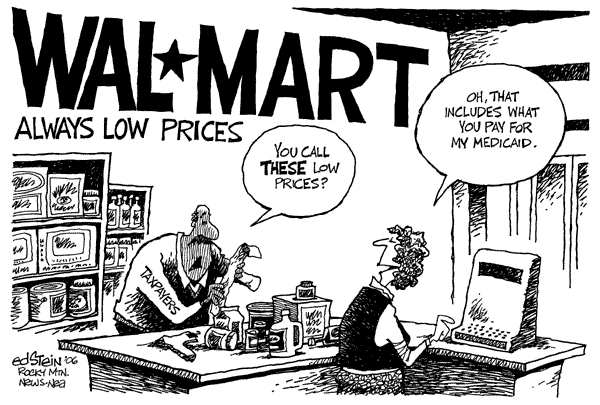
Heard a report on NPR last night that Walmart is in trouble. Earnings are down, share prices are dropping. Why? More and more people are discovering it's not worth the hassle to drive out to wherever the House of Satan has located its latest Super Center. This doesn't surprise me. Walmart's been notorious for years for constantly shuffling store locations, moving them farther and farther out as the corporation pursues new tax breaks and subsidies from state and local government.

Back when the Younger Daughter was still living in Texas, on one of our last visits, we noticed the Many, Louisiana, Walmart had moved. At the time, she worked in Hemphill so would run over to Louisiana to shop occasionally. We'd been to Many before when we'd visited. Anyway, the Many Walmart used to be fairly close to downtown (such as it is; Many's not a real huge town); the last time we were there we discovered the Evil Empire had moved itself up the highway far enough that you pass a fair amount of farm fields and not much of anything else before you get there. This move was no doubt right over a legal boundary of some sort, like the city limits, so they could talk the parish into giving them tax breaks because the deal they'd cut with the town had run out.

It struck me then that it I lived right in Many, I'd be shopping at Dollar General, Family Dollar, and Brookshire Brothers more often rather than hop in the car to run several miles out to Walmart for cheap toilet paper. I'm not kidding -- when we headed north on US-171 out of Many, it was starting to feel like we'd hit Shreveport before we found the Walmart.* Once you make the drive long enough, the prices at the end had better be pretty damn low to justify burning the gas. According to the report, more and more people are concluding that they're not.

This is just common sense on the part of consumers, although sometimes it takes awhile to sink in. When the Houghton Walmart first opened, we did shop there a lot. Gas was a lot cheaper, there was a novelty effect, and it was back when Sam Walton was still alive and the company hadn't turned into the Evil Empire it is today. But you know, I don't think we'd shop there today even if it wasn't the Evil Empire unless we happened to be in Houghton for other reasons. It feels too far now to make it worth the trip on its own.

I do know a few people who will drive from L'Anse up to Houghton to shop at Walmart, but I really wonder why. It's got to be at least a 30 mile drive, maybe more like 40 or even 50 (it's about 45 for us, but we live about 10 miles east of L'Anse). Even with my fuel-efficient Focus, I'd be burning 3 to 4 gallons of gas every time I drove up there and back. That's (at current local gas prices) anywhere from $10 to $15 gone and for what? The opportunity to save a few cents on a package of toilet paper? What's the point? It's fairly simple math. Maybe my groceries are going to cost me a couple dollars more when I shop in L'Anse and Baraga, but I'm burning less gas. In the end I've saved more by shopping locally than if I gone up the highway pursuing bargains. Now multiply us by a whole lot of other [former] Walmart customers, add in the drop in revenue when Food Stamp benefits got cut (not surprisingly, quite a few Walmart customers rely on SNAP), and it starts becoming obvious why Walmart's got problems that go way beyond its public relations headaches over the company's personnel policies and reliance on third world sweatshops for its products.

*Walmart was the Younger Daughter's preferred source for dog chow. At the time, she thought The House of Satan had the best price on 50-lb bags (which is now a 42.5 lb. bag as pet food suppliers shrink the size of the packages to avoid raising.prices in a more obvious fashion, but that's a subject for a different post). 

Sunday, November 23, 2008

A collective action problem, aka sustainability

A couple days ago I made the rather libertarian assertion that people should be free to spend their own money on whatever stupid thing they felt like spending it on, including humongous gas guzzling SUVs (e.g., that triumph of marketing over common sense, the Hummer) and sports car pecker extenders like Vipers. I just don't want to hear any whining from the buyers about the cost of fueling those vehicles once they've got them. Then Lisa administered a dope slap in a comment and reminded me about the elephant in the room, the thing we materialistic, shopping mall worshipping Americans keep trying to ignore: Sustainability.

The cold hard truth is that the typical American lifestyle is not sustainable. Collectively we're resource hogs. We live in houses that are too big, drive cars we don't need, eat foods that are farmed in ways that are destroying the planet, and do most of it in blissful ignorance. We've managed to convince ourselves that if we just switch our incandescent lightbulbs to fluorescents, haul newspapers to a recycling bin, and occasionally shop at a thrift store instead of Dillard's we're doing our part to save the planet. We're kidding ourselves.

In fact, in one of the great ironies of our times, we buy magazines like Real Simple that tell us that the way to simplify our lives (and, by implication, live more environmentally sustainable lives) is to buy more stuff to organize the stuff you've already got. Places like the Container Store exist solely to sell us containers in which to stash the stuff we don't need and never use but seem to believe we have to have anyway. If alien archeologists exist they're going to have a field day picking through the ruins of our society.

In philosophical terms, what we have is a collective action problem. If I ignore a do not walk on the grass sign one time, my foot prints on the lawn have minimal impact. If I walk across the lawn the same way every day, over time a path develops. If dozens of people ignore the sign, the social path shows up faster, the soil is compacted, the grass dies, the path widens, becomes a rut, encourages run-off and soil erosion. In short, my individual selfishness may not have much of an impact, but multiply it by a zillion other people cruising along in their own bubbles, all ignoring the world around them and thinking environmental awareness consists of buying a free range heritage turkey at Whole Paycheck and using a stainless steel water bottle instead of a plastic one, and we've got a planet that's in a death spiral.

Would it make a difference if we all switched to fluorescents? Yes. Will that difference will be totally negated if we then turn around and get a 50-inch plasma television for the "media" room? Can you say understatement? We all keep saying we need to use less energy while adding gadget after gadget that eats more. And I'm as guilty and short-sighted as everyone else. What keeps my life relatively simple and low impact (smallish carbon footprint) isn't heightened awareness; it's lack of money.

I could go on, but I'll just suggest you take a look at the November/December issue of Mother Jones. It's devoted to the economy and the environment. Read it, especially the piece by Bill McKibben, and weep.

Monday, November 3, 2008

Reagan economics

There's a great post up on Brilliant at Breakfast. Here's a taste:

But this is where we are today, thanks to the Bush family and their cronies, who ALWAYS believed that the world was a private fiefdom for the benefit of their family members and friends, to John McCain, who supported policies that fed this notion and became one of those friends so he could benefit, and to spineless Democrats who have been too lazy or too frightened to articulate the reality that Ronald Reagan was wrong -- you can't have everything you want and it's all free if you just give the already wealthy even more.