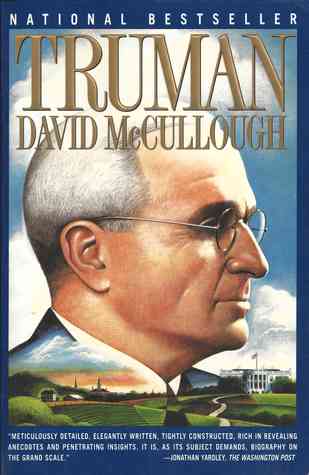
"The more things change, the more they stay the same." I just finished reading David McCullough's massive biography of Harry S. Truman, the 33rd president of the United States. I had the same reaction to the Truman biography as I did to the biography of Andrew Jackson a year or two ago: the only things that change in politics are the names of the players.
Truman is probably best remembered now for the saying "the buck stops here," meaning it was up to the President to take responsibility for anything happening in his administration. Picked by the Democratic Party to be the vice presidential candidate in 1944, Truman became President when Franklin Delano Roosevelt died less than 3 months after being sworn in for a 4th term. Truman got tapped for the slot because everyone close to Roosevelt was convinced FDR was not going to live much longer and Truman seemed like the only possible candidate that (a) was semi-competent, (b) Roosevelt would accept, and (c) might be willing to take the job. Roosevelt's third term VP, Henry Wallace, was widely admired but viewed as too much of a pacifist and isolationist to deal realistically with threats like Germany and Japan.
Truman, a second term Senator from Missouri, didn't particularly want the job. He was good friends with John Nance Garner, who was Roosevelt's first vice president, and had heard Garner's thoughts on the frustrations of being vice president many times. Garner was responsible for the famous description as the office of vice president "not being worth a bucket of warm piss." Still, when party leaders approached Truman, he couldn't say no. Truman had impressed both fellow legislators and the general public as chairman of the Senate Special Committee to Investigate the National Defense Program. We were obviously heading into World War II at the time Truman pushed for investigating national preparedness programs and defense contractors; it didn't take the committee long to find numerous examples of fraud and waste. His relentlessness in holding contractors responsible raised his public profile. It also demonstrated there was more to Truman than people who didn't know him well assumed.
A small digression: one thing that is worth noting about the Truman committee is that when they found fraud, people actually wound up going to jail. The hearings had real consequences, something that no longer seems to hold true today.
In any case, Truman's image when he arrived in the Senate was that he was a tool of the Pendergast machine and therefore probably thoroughly corrupt. The Pendergast family had run Kansas City politics for several generations, they were also linked to organized crime and vice -- the Pendergast money originated with saloons and brothels built at the end of the 19th century. Truman was indeed a product of that machine but he was also that rarity, a specimen so rare that the term is practically an oxymoron, an honest politician. He could not be bought. In an era and an environment that encouraged graft, he refused kickbacks. Early in his political career as a county judge, which at the time was the equivalent of a county supervisor or commissioner, Truman pushed for several public works programs (construction of a new courthouse in Independence, improved highways in the county) that could have proven financially lucrative both for him and the Pendergasts. He flatly rejected any thing that would have suggested he or members of his family were benefiting from the projects. So why did the Pendergasts back him when he was so clean compared to the typical politician? Probably because they had figured out that you always knew where you stood with Truman. If he said he was going to do something, he did, and if he said he couldn't support something, you knew that was true, too. He wasn't going to make promises he didn't think he could keep.
In any case, Truman was first elected to the Senate in 1934. He became known as a reliable party man -- he could be counted on to support the President's various New Deal programs -- but also as someone who could work across party lines. He made friends on both sides of the aisle despite the skepticism with which he was initially viewed. Re-elected in 1940, if it hadn't been for World War II he probably would have had a respectable if not particularly high profile Senate career. As it was, when Roosevelt died in April 1945, Truman found himself filling an office he had never aspired to.
Even worse, he entered the office about as unprepared as it was possible to be. Roosevelt, depsite his poor health, had never bothered to have a substantive meeting with Truman. According to McCullough they'd met perhaps two times following the election. Each meeting had fallen more into the category of photo opportunity than actual meeting and neither had lasted long. Truman walked away from each meeting feeling, as he noted in letters to Bess, terrified that Roosevelt was not going to live much longer. The President was in such poor health that he had difficulty holding a coffee cup without spilling it. He could put on a good front for the press, but in private it was obvious how quickly he was deteriorating.
Thus, when Roosevelt died, Truman found himself having to learn on the fly -- the war was in its final months (although no one could be sure of that), decisions had to be made about the use of the atomic bomb, Truman had to meet with Stalin and Churchill, and at the same time he had to deal with a White House staff and an administration that resented the hell out of the fact that Truman was now President. Several cabinet members, persons who knew Truman only by his reputation as being part of the Pendergast machine, were openly uncooperative. In a sane world, he would have fired them. As it was, with the war still in progress and the country in mourning for Roosevelt, Truman decided the appearance of a smooth transition was more important than getting rid of a few people who were hard to work with. It was not until he was elected to the presidency in his own right in 1948 that Truman felt free to do a thorough housecleaning.
Anyway, before my comments on this massive book turn into a post that's equally massive, the reason I say that the more things change, the more they stay the same, Truman had all the same headaches Andrew Jackson did over 100 years before and that Barack Obama is having now: the political opponents who are for something until the President supports it, too, and then suddenly it's the worst idea on the planet and is going to destroy democracy as we know it. The conspiracy theorists who are convinced the President is planning a dictatorship or is going to sell the country out -- Obama has the tinfoil hat types who are convinced he was born in Kenya and is a secret Muslim plotting to establish a caliphate; Truman had to deal with the anti-Communist hysteria that saw the Red Menace as a credible threat and were convinced the government was staffed with Stalinists. There were the elitist snobs, the people who were quite vocal about the way the Trumans brought down the tone of the White House, who mocked Margaret Truman's attempts at a career as a professional singer, and who sneered at Truman himself as being a "failed haberdasher." It was interesting to (again) see the parallels.
Truman himself loved history. He occasionally said that if he had had the opportunity to go to college, he would have liked to have been a history teacher. When he ordered a complete restoration of the White House (a project begun after Margaret's piano went through the floor), he was adamant that the result should be a building that was historically accurate. (The Truman restoration was a gut job to end all gut jobs; not only were the first two floors of the structure completely removed, the project involved excavating multiple new basement levels, all without changing the exterior.) He had to be aware that vilification came with the job, but he probably was a little naive about just how it would feel to be on the receiving end. In any case, having been elected to one term on his own merits, he decided that was enough. He announced early in 1952 that he would not run again and began planning his return to Independence.
One of the more interesting bits in this book was Truman's departure from the White House. I had never pictured Dwight Eisenhower as being a vindictive, small-minded petty bastard but apparently he was. He and Mamie were openly rude to the Trumans when the time for the transition. This was another case of the more things change, the more they stay the same. When Bill Clinton left the White House, his administration reached out to George W. Bush and his incoming administration to try to ensure a smooth transition. The Bush team was invited to briefings, given background information, and ignored it all -- and less than a year later, having scoffed at all the Clinton briefings, on September 11 they got to deal with the aftermath of an extremely preventable tragedy. In defense of Bush, it does appear the scoffing and dismissal were more by Bush's minions than by Bush himself; the tragedy is that early in his administration Bush relied way too much on those minions. G. W. and Laura never personally snubbed the Clintons the way Eisenhowers did the Trumans.
In Eisenhower's case, he ignored Truman's offers of meetings to share intelligence, refused invitations for him and Mamie to tour the White House to see the living quarters and meet the staff, and even (and this has to be the ultimate in being an ill-mannered prick) refused to step into the White House on Inauguration Day to have the traditional light lunch with the President and First Lady before riding together to the Capitol for the swearing-in ceremony. Instead, the Eisenhowers sat in the car until the Trumans came out. Truman viewed this as an insult to Bess, not just him, and seethed about it for years. Whatever Eisenhower's intent, it certainly was a remarkably small-minded, mean way to behave.
So would I recommend this book to anyone else? Good question. Like all of McCullough's books, it's thoroughly researched and has extensive end notes and bibliography. It is not, however, as readable as Mornings on Horseback (biography of Theodore Roosevelt) or A Path Between the Seas (history of the Panama Canal). It's as though McCullough had so much information to work with he couldn't figure out how to cull some of it. This is one case where a better choice by the author might have been to do it as a two-volume work: Truman before the presidency, and Truman as President and then in retirement. So much happened during his presidency -- the atomic bomb, the Marshall Plan, the Korean War, seeing all the "experts" proved spectacularly wrong when Truman beat Dewey in 1948 -- that it could easily have been a book by itself.
On the other hand,by packing it all into one book McCullough ensured his readers that not only would readers learn a tremendous amount about Truman, they'd also give their arm muscles a good workout. Definitely not a fast or an easy read, but for anyone interested in politics and the Presidency, well worth the effort.
Random thoughts about roadside art, National Parks, historic preservation, philosophy of technology, and whatever else happens to cross my mind.
Sunday, January 4, 2015
Thursday, January 1, 2015
Sunday, December 28, 2014
And how was your holiday?
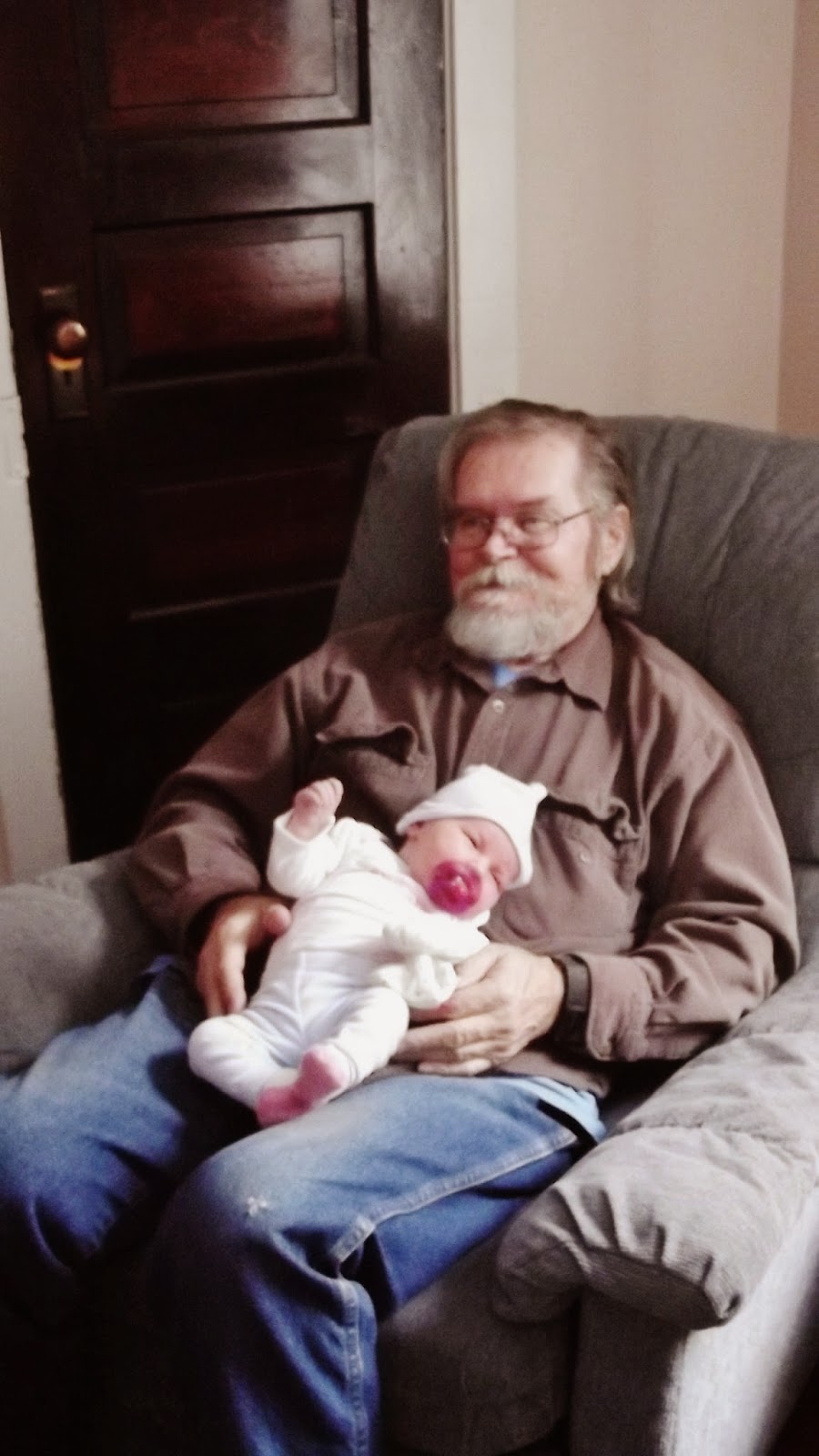
Ours wasn't bad. Among other things, I got to watch The Baby Whisperer in action. The S.O. is one of those people who small children and dogs love. If an infant is crying, hand it to him and it will usually decide it has better things to do. Not always, of course, but a lot more consistently than if someone is foolish enough to hand the grub to me. I've never been particularly fond of babies -- they're generally a tad too unfinished looking, not to mention the being wet at both ends and emitting unpleasant discharges. And, just like dogs can smell fear, infants can usually sense that I'm not comfortable holding them. Pass an infant to the S.O., though, and the child takes about 2 seconds to make a couple odd little "life is good" contented grunting noises and then falls asleep.
Anyway, the photo is of the S.O. and the latest twig on the family tree, Piper, born December 11 and definitely still in the grub stage. She was all of eleven days old at the time the photo was taken. We made two trips to the older grandson's house this past week, one just before Christmas to drop things off in case we couldn't get there again for awhile due to bad weather, and one yesterday to have a belated Christmas dinner. It was nice. The grandson is now 24 and seems to have turned out reasonably well -- he's gainfully employed and he's happy being a dad. This was the second year we've done Christmas at his house; he was talking about making switching things up a little next year and coming here to the farm. Which would be nice, except this house is much too small and the guest quarters are not winterized. Although with a little bit of advance planning it would be do-able -- there are motels in L'Anse and Baraga. There is no rule that says planning to have Christmas dinner at our house would also entail everyone staying here overnight. (In fact, that's what the S.O. and I did last year -- booked a motel room in Ironwood to avoid the possibility of driving the 100 miles home in a snowstorm at night. This year we did it as a day trip, although we went prepared for an overnight stay if the weather turned nasty after we got there.)
Justin did suggest an alternate plan. Instead of celebrating the holidays here in the U.P. we could all descend on his aunt Tammi for a week. I wonder how much advance warning we should give her?
Wednesday, December 24, 2014
'tis the season of useless gifts
I was wandering around one of the local retail establishments recently and it struck me (as it does every year) that December has become the month when several aisles in all the stores fill up with bizarre crap you never see during any other season. It is truly the season of useless gifts, i.e., the gadgets that no one in their right mind would ever buy for themselves.
Take, for example, this little gem, the hot dog toaster. Who on earth would ever consider spending money on a device that cooks two, count 'em two hot dogs at a shot? Why would anyone want something like this cluttering up cabinet or countertop space in their home? If you're a person living alone, perhaps an argument could made that it would be ideal for you. On the other hand, why bother with a device like this that's going to require cleaning (all that grease that drips off a hot dog has to go somewhere) when if you just want one or two hot dogs you can cook them in under two minutes in a microwave -- or grill them on a fork over the burner on a gas kitchen range. No one needs a special appliance for cooking minuscule amounts of hot dogs; this is a device that was developed solely to occupy retail shelf space during the Christmas season. It is a desperation gift, something a person buys when they feel obligated to give something -- anything!! -- to another person but is too lazy or (I'll be charitable) too stressed to put much thought into it.
The classic desperation gifts used to be potentially practical items like scarves and mittens and monogrammed handkerchiefs. I'm not sure just when the switch to cheap crap made in China occurred or why. Although the why probably has to do with profit margins -- you can sell a POS hot dog toaster for a lot more than you can sell a scarf even if the actual production costs might not be much different. You know, no one's going to want to pay much for a scarf (unless you're buying it at Nieman Marcus and they're claiming it's made from some obscure exotic fiber), but come up with a "retro" design for a useless appliance and suddenly you're talking actual money.
I know, I know. There are people who will say that giving someone a useless POS gift shows that you "care." I've got to call bullshit on that one. How can anyone say "It's the thought that counts" when they hand you a gift that demonstrates that they didn't think at all? When you give someone a gift that they have no use for, that doesn't fit their lifestyle or their personality, what you're actually saying is "I care so little that I'm giving to grab the first thing I spot on sale on an end cap at Shopko and call it good." Is it really that difficult to remember enough about a person to make it possible to give him or her a gift that says you were thinking specifically about that person when you bought it or made it?
Of course, it could be worse. I once knew a person who was a shill for Mary Kay. When Christmas rolled around, she gave everyone the rejects from her sample kit. Nothing says someone cares like that person giftwrapping slightly used lipsticks in the colors no one liked when she tried selling them and then handing those lipsticks to people who don't wear make-up.
Sunday, December 21, 2014
Saturday, December 20, 2014
Speaking of sweeteners
This what I'm using in my coffee now. The post about agave nectar reminded me this can of pure cane syrup was sitting in the cabinet. The Younger Daughter gave it to us while she was living in Texas. I've had old-fashioned cane syrup before -- I bought a pint jar at the Jarrell Plantation in Georgia (a really nifty state park, incidentally) a few years ago -- and knew that it had a stronger flavor than most commercial syrups. Cane syrup is what you get when you crush sugar cane and boil down the juice. In commercial sugar production, the juice is centrifuged -- the lighter-colored sugar rises to the top and eventually becomes refined sugar. The darker solids that sink end up as molasses. Cane syrup is what happens when you boil cane juice to evaporate liquids and stabilize the sugars without using a centrifuge. You end up with a product that tastes vaguely like molasses, but is lighter in color and doesn't have as strong a taste. The Jarrell Plantation, incidentally, does living history demonstrations of how sugar cane was crushed and processed in the antebellum South. I'm not sure if that's the source of the bottled cane syrup in their gift shop, but it could be. The process for making cane syrup is remarkably simple: you need something to crush the cane, something to catch the juice as it runs off, and a huge cast iron kettle in which to boil that juice down.
In any case, we'd been gifted with the can of cane syrup, it had migrated to the back of the cabinet and forgotten, and then I had the agave experience. So now I'm using cane syrup in my morning coffee. How does it compare with other sweeteners? Not surprisingly, the calorie count is about the same. The Helm Farms syrup does have a vague molasses-like flavor, but it's just a hint. It's not as strong as the flavor of the Jarrell syrup.
When I was Googling cane syrup, I found a New York Times article that quoted cane syrup aficionados who claimed old-fashioned ribbon cane syrup was much, much better than refined sugar. According to one person, sugar has a bitter taste compared to cane syrup. He also claimed to be able to tell exactly which field sugar cane had been harvested from by the taste of the syrup, kind of like wine snobs who swear they can tell which hillside in Burgundy produced a certain vintage. Apparently, if you want to use an authentic sweetener down South, you should be using cane syrup in your tea, your baking, and anything else that requires a form of sugar. I don't know if I'd go that far. At this point, I'm feeling the same way about the cane syrup as I did about the agave: it's working in the coffee, but am I going to actively seek more out once the current supply runs out? Probably not. I know there are still commercial cane mills out there that produce ribbon cane syrup -- you can buy Steen's cane syrup through Amazon if you don't live in the South -- but why bother, especially once the cane syrup is gone, I've got an industrial size jug of Sysco honey the Older Daughter gave us a few months ago.*
Although what I should probably work on is eliminating both the sweetener and the coffee from my diet. I don't need the empty calories and the caffeine is not good for my SVT. Oh well. I managed to break my Dr. Pepper addiction. Maybe someday I'll manage to step away from caffeine completely. (And the proverbial pigs will fly.)
*A slight digression: I know people who would freak if they heard me talk about using cane syrup that was more than a year or two old or honey that's been sitting in a cabinet for god knows how long. News flash, people, sugar doesn't rot. Neither does honey. They're what gets used to preserve other things. Honey is the only food that for sure never rots. Archeologists have found jars in Egyptian tombs where the honey was 3,000 years old and still good. I'm not sure if pure sugar falls into that same category, but I'm willing to bet that it does. If archeologists someday find a sugar canister that's thousands of years old, the sugar in it may have turned into a rock from absorbing moisture, but it's still going to be perfectly edible sugar.
![]() |
| Mule-powered cane crusher |
When I was Googling cane syrup, I found a New York Times article that quoted cane syrup aficionados who claimed old-fashioned ribbon cane syrup was much, much better than refined sugar. According to one person, sugar has a bitter taste compared to cane syrup. He also claimed to be able to tell exactly which field sugar cane had been harvested from by the taste of the syrup, kind of like wine snobs who swear they can tell which hillside in Burgundy produced a certain vintage. Apparently, if you want to use an authentic sweetener down South, you should be using cane syrup in your tea, your baking, and anything else that requires a form of sugar. I don't know if I'd go that far. At this point, I'm feeling the same way about the cane syrup as I did about the agave: it's working in the coffee, but am I going to actively seek more out once the current supply runs out? Probably not. I know there are still commercial cane mills out there that produce ribbon cane syrup -- you can buy Steen's cane syrup through Amazon if you don't live in the South -- but why bother, especially once the cane syrup is gone, I've got an industrial size jug of Sysco honey the Older Daughter gave us a few months ago.*
Although what I should probably work on is eliminating both the sweetener and the coffee from my diet. I don't need the empty calories and the caffeine is not good for my SVT. Oh well. I managed to break my Dr. Pepper addiction. Maybe someday I'll manage to step away from caffeine completely. (And the proverbial pigs will fly.)
*A slight digression: I know people who would freak if they heard me talk about using cane syrup that was more than a year or two old or honey that's been sitting in a cabinet for god knows how long. News flash, people, sugar doesn't rot. Neither does honey. They're what gets used to preserve other things. Honey is the only food that for sure never rots. Archeologists have found jars in Egyptian tombs where the honey was 3,000 years old and still good. I'm not sure if pure sugar falls into that same category, but I'm willing to bet that it does. If archeologists someday find a sugar canister that's thousands of years old, the sugar in it may have turned into a rock from absorbing moisture, but it's still going to be perfectly edible sugar.
Friday, December 19, 2014
It was a Harlan Ellison sort of day
I spent the afternoon at the museum alternating between cursing the Internal Revenue Service and muttering about now-deceased members of the historical society. For various reasons, known (as far as I can tell) only to some desk monkey at the IRS, the historical society has gotten stuck with the task of completing a 990-EZ. The 990-EZ is five pages long and asks for so much information that I can't help but wonder just what else they could possibly ask for on the regular 990. I hope I never get to find out because the 990-EZ is enough of a nightmare on its own.
Among other things, in addition to the five pages of questions, it asks for two attachments: Schedule A and Schedule O. Schedule A is where a nonprofit gets to break down its finances for the past five years; Schedule O is basically a sheet of lined paper where you get to lie about anything that doesn't fit neatly into predetermined categories. And when I say break down I mean exactly that: how much income did we receive in the form of grants, donations, membership dues; how much came from fund-raising efforts; how much was interest or dividends? How much in-kind support did we get from local government or other entities? How much did we spend on maintenance, rent, whatever. And lots lots more, all the way back to 2009. I really, really hate detail work, especially when I'm sure there's some sort of deadline (which I've probably missed) hanging over my head.
I have to say in all honesty that the forms would not actually be that hard to deal with if the data existed to plug into the appropriate blank spaces. Long and boring, yes, but technically difficult? No, assuming, of course, that one has actual financial records to refer to while filling in the blanks.
I managed to come up with some numbers for 2013, 2012, 2011, and 2010. The easiest year to do was the most recent -- 2013. That's the year I became treasurer and set up the Excel spreadsheet. 2012, 2011, and 2010 weren't bad either. My predecessor was well-organized. She didn't use an old-fashioned ledger or do a spreadsheet, but her monthly hard copy reports are nice and clear. The biggest problem I had with the those years it was sometimes impossible to separate out donations from other income -- the monthly treasurer's reports would occasionally do a lump sum (Sales & Donations) that aggregated data that should have been kept separate.
Keeping income streams separate, incidentally, is an issue that I've brought up at numerous meetings -- we need to draw nice sharp lines between the money we take in as admission fees, the money that gets spent in the gift shop, and the money people are nice enough to drop in the donations jar. These are distinctions that the IRS definitely draws but most of the society members have trouble recognizing. I'd been obsessing about it because I'd like us to have a nice firm visitor count but maybe if I bring it up at a meeting in the context of retaining our nonprofit status it'll sink in. But that's a minor quibble in the overall scheme of things, considering I hit a blank wall when I got 5 years back in the files.
2009 is a black hole. I can't find any treasurer's reports. Ditto bank statements. Nothing. Nada. Someone mentioned a few months back that one of the sons of the society's deceased president had a bunch of stuff he'd found in his father's house that he was planning to bring to the museum. He never did. I have this rather sick feeling that there were a whole lot of historical society records that had been sitting at the dead guy's home office and have since gone to the landfill in Ontonagon County. This is the shoe that I've been waiting to hear drop for the past 22 months. It finally dropped. I knew it was going to happen sooner or later. The deceased president had a really hard time drawing lines between the various areas of his life. He was involved in a lot of different things in the community, and they all overlapped. It didn't help that he'd been president of the historical society for so many years that to him the museum had become an extension of his own home and vice versa. I figured that out when I was going through the vertical files last year. And the more I saw of that, the more I worried that sooner or later it was going to end up biting us in the butt.
Well, it's now later, we've been bitten, and it's not fun to deal with. We're a 501(c)3. We should have been keeping meticulous records. We didn't, and as the current treasurer I get to untangle the mess. I don't think the IRS is going to do anything nasty to us, but you never know. After all, they cursed us with the 990-EZ because the 990-N (an electronic post card that basically says, hey, we still exist) got filed a couple weeks late. Maybe I should stop referring to the professional paper pushers as desk monkeys. Either that, I need to remember that even desk monkeys can bite.
It did occur to me (again) that the Tea Party types who were fulminating about the IRS the other year really had nothing to bitch about. The IRS drives everyone crazy; they're an equal opportunity annoyance.
Thursday, December 18, 2014
Tuesday, December 16, 2014
What if they gave a war and no one cared?
Now, I did know a few odd bits of trivia about the War of 1812. Thanks to an August Derleth book, The Captive Island, my grandmother gave me when I was in about 5th grade, I knew the British had taken Mackinac Island back from the Americans. The Derleth book is a young adult historical novel about an American youth who escapes from the island to bring information to the Americans at Detroit, which the British also took away from the United States, at least briefly. Having worked for the Park Service, I knew about the huge honking monument at Put In Bay, Ohio, dedicated to Oliver Hazard Perry and his fleet's victory over the British back in 1813. And I had been to Fort Ontario in Oswego, New York, back in the 1980s and saw the poor saps doing their re-enactments on a hot July day while dressed in the heavy wool uniforms common in the early 19th century. I have a vague recollection of kind of scoffing at the idea of a fort being built on Lake Ontario to protect us all from Canadian invaders even though the interpretive material at the time no doubt mentioned there had been an actual battle at Oswego.
In any event, when I thought about the War of 1812 at all I remembered Fort McHenry, the origins of "The Star Spangled Banner," the White House getting torched, and the fact the Battle of New Orleans was fought after a peace accord had already been signed in Europe. Does it still count as a victory if the war ended before the battle took place? What never crossed my mind was the fact that the active front of the war, the main line of battle, so to speak, was the United States-Canadian border. There was a fair amount of naval action on the Atlantic Ocean in the form of British warships blocking access to American ports with American privateers retaliating by harassing British merchant ships, but Hitsman makes it clear that the major military operations, both naval and land-based, took place along the northern border of the United States. This could be a function of the author's obviously pro-Canadian bias, but it does seem to match up with the facts. Both countries worked frantically in their Great Lakes ports to construct more warships, from small gunboats to frigates that came close to qualifying as ships of the line, because both sides recognized that whoever controlled the Lakes had the upper hand in the war.
Actually, I shouldn't describe the concerns in such sweeping terms. It would be more accurate to say that the guys doing the actual fighting recognized that whoever controlled the Lakes would have the upper hand. No one else seemed to care very much. In North America, despite the war there was a lot of cross border commercial activity: the Canadians bought supplies of various types from the merchants in New York and New England,and vice versa. Ports that were supposedly blockaded actually weren't because so many special exceptions and passes were issued that the blockades and trade embargoes were essentially meaningless. The War of 1812 was a war no one really wanted -- everyone recognized that it was hurting business, citizens in both countries realized that there was always the danger the Indian allies on either side could be hard to control and tended to have a take no prisoners approach, and none of the men in the state and provincial militias particularly wanted to fight. In fact, members of the New York state militia flat out refused to cross the border when ordered to pursue British troops into Canada, saying that it was illegal to make them fight on foreign soil (and wouldn't it be nice if American troops would do that now? Just say hell, no, I'm not getting on a plane to BFE to fight people who don't even know where the U.S. is?)
Adding to the complicated mix was the fact that many of the settlers in Canada were people who had been living in what was now the United States and decided to move following the Revolutionary War, some for economic reasons and some because they viewed Canada as just another frontier that the U.S. was going to eventually cross. Instead of going west to settle in what is now Ohio or Illinois, they opted to go north to what is now the province of Ontario. Some were loyal to Great Britain, some were loyal to the United States, and no doubt a fair number shifted their allegiance based on what they perceived to benefit themselves the most.
Over in Europe, Great Britain had no choice but to focus most of its attention on the Napoleonic wars. Thus, when the War of 1812 began, there were no British troops to spare to send to Canada. By the time there were troops and supplies available that could be diverted to North America, peace negotiations had ended the conflict. The war itself had effectively been a draw. Neither side gained any territory, but neither side lost any. The United States had invaded and seized sites in Upper Canada; the British had invaded and seized sites in the United States (e.g., Fort Michilimackinac, Detroit). Both had retreated from those sites so neither was in possession at the time of negotiations, hence, an argument could not be made for retention of conquered territory.
The Incredible War of 1812 was an interesting book. I had no idea there'd ever been a Battle of Plattsburgh or that the British government issued medals for something called the Battle of Crysler's Farm. I did know there had been a battle at the River Raisin near Detroit -- the site is, if memory serves me right, the nation's most recently created National Battlefield park -- but was struck by just how low the numbers were of the combatants and others involved. By contemporary (or even Civil War) standards, it wasn't much of a battle. It's also hard to believe that, as the park's website puts it, the phrase "Remember the Raisin!" served as a rallying cry, especially when what seems to have swung the battle in the British favor was the complete incompetence of the U.S. commanders. First, General William Hull had surrendered all of Michigan Territory to the British in 1812. Then, in January 1813 the Americans found themselves surrendering to the British for a second time. In the aftermath of that battle, Native Americans allied with the British raided the Frenchtown settlement, burning houses, carrying off prisoners, and killing about half a dozen civilians. In a logical world, "Remember the Raisin!" would have been the rallying cry for a couple of courts martial. But apparently not in frontier America. Although Winchester did quietly slink away later in the year -- he had had a checkered, apparently rather sleazy career, and apparently figured out that (a) there was no money to be made on the battlelines in the Northwest Territories and (b) he might end up dead by accident. He didn't exactly resign, but he did get replaced.
Minor digression: considering that almost 200 years had passed before that battlefield park had been created and it is in the southeast corner of the Downer Peninsula, an area that's seen wave after wave of development, what exactly was left there that made it merit park status? It does seem like the site could have been adequately commemorated with one of those book on a stick historic markers the State of Michigan erects if there's sufficient public pressure. Oh well. . . the Park Service can always use a few punishment parks, places to shuffle incompetent superintendents off to when they're not yet eligible for retirement but need to maintain the illusion of still being gainfully employed.
There were numerous other skirmishes on both sides of the border on the shores of Lake Ontario, Lake Erie, and the banks of the Niagara River. Both sides engaged in behavior the other side condemned as barbaric, e.g., the Americans burned the government buildings at York (the capital of Upper Canada). In fact, when the British were condemned for later trying to burn down the President's house in Washington, their response was they were simply giving the Americans a taste of what they had done in York. And so it went for two years, seesawing back and forth across the border and neither side gaining much of an advantage for very long. In the end, the border remained where it had been, the British continued their impressment policies on the high seas, and, other than for the guys who died, the war didn't change much of anything.
Would I recommend The Incredible War of 1812 to other readers? Only if military history fascinates you. Overall, I thought it was worth reading but have to confess there were sections where Hitsman really got into minutiae and I had a hard time staying focused. On the other hand, it is well-written and meticulously footnoted. There is a treasure trove of fascinating trivia hiding in the notes, so I guess I'd recommend it to historians. All historians love good footnotes.
Monday, December 15, 2014
Subscribe to:
Posts (Atom)