Showing posts with label it's a mystery. Show all posts

Saturday, June 24, 2017

Is the insurance industry working on making itself extinct?

I've been following -- sort of -- the discussions about repealing most of the provisions of the Affordable Care Act. The one thing that seems guaranteed no matter what version of a montrosity of a bill eventually wends its way over to the White House for The Donald's signature is that the end result will be that health insurance costs will climb even more.

Economists have been saying for quite awhile that the current system isn't sustainable. There's a simple reason why: The more costs climb for a product, the fewer people there are going to be who can afford to buy it. It doesn't matter what the product is -- unless you're giving it away, there will always be people who can't afford it. We all know there will alwys be a lot more people around who can afford to wear Faded Glory* than to wear Versace. In a rational world, if you want to make money you've got basically two choices: sell a lot of widgets at the lowest possible price that still allows you to make a reasonable profit, i.e., go for quantity and make your money based on volume of sales, or sell just a few at a super high price. Mass production versus artisanal.

For various reasons, all predicated in some way on the fact that trying to buy good health is a lot less of a discretionary purchase than picking up some new tee-shirts or even a new car, the healthcare industry -- insurance companies, pharmaceuticals, doctors and hospitals -- have been busily jacking up prices to the point where fewer and fewer people can actually afford them. Back when the Affordable Care Act passed, the insurance companies viewed it as a giant gift. So do Big Pharma,. most doctors, and almost all hospitals. It provided them with guaranteed customers. Even better, the ACA included guaranteed payments -- to ensure that people could actually buy the insurance they were being mandated to acquire, the ACA includes subsidies.

So what has the Republican Congress decided to do? Jerk out the financial props for the ACA. People are still going to be told to buy insurance, but they're not going to get much help doing so. And you know something? Despite the fantasies of some politicians on the right, telling people they're going to be fined if they don't buy insurance or punished in some other fashion isn't going to make a bit of difference. Premiums are going to climb, fewer people will be able to afford them, and the customer base for private insurance is going to shrink. You know why? Because if you don't have the money, you don't have the money. Some people will give up on the idea of health insurance reluctantly; some will struggle to find a way to buy it; and some will just run the numbers and realize they're screwed so they might as well learn to live with uncertainty.

I'm not going to get into moral issues or the healthcare is a right debate or even the obvious need for a universal government-funded and managed system ("Medicare for all"). Nope. I'm just wondering why no one in any of the walnut-panelled office suites for Big Pharma or Aetna or any of the others has sufficient brain power to realize their customer base is shrinking. Instead of pushing for ever-higher prices, they should be working hard on trying to lower costs. Their short term greed has blinded them to the reality that the system they've created is doomed to implode. It's not going to happen any time soon, unfortunately, but give it a few more years and the fecal matter will hit the fan. I just hope things don't get too unpleasantly dystopian before the paradigm shifts.

*And isn't it a sad commentary on my life that the Walmart store brand is what immediately sprang to mind when thinking about something cheap? So much for my posturing that I never shop at the Evil Empire. 

Tuesday, May 3, 2016

Another mystery solved

During the month we spent at Johnson's Shut-Ins we found ourselves wondering why a fair number of campers never bothered going to the check station to register even when the station was open. People would come in, set up on the site they had reserved, spend a couple days camping, and never bother to check in. We  had a couple campers tell us they thought we'd come to them when we reminded them to go to the check station because that's where the computer was. It made no sense at the time, but then when I was going through some random photos I'd taken at the park I noticed the sign to the right. It's at the entrance to the campground and as of a week ago still had an "off" season message up on it. That line saying "Your Site to Attendant" is removable; it should have come off on April 1 to indicate you're supposed to register at the check station. (It's also a contradiction of what's on the Vacant tags that get placed on available sites, but that's a different issue.)

Oh well. Not my circus, not my monkeys. Just a general feeling of relief that we're never going back to that particular park, or maybe any park in Missouri. I'm still interested in trying other places, but the S.O. says he's not sure he's up to being actively shunned again. But then he's more of an extrovert than I am. Being treated like Invisible People bothered him a lot more than it did me. Although I will concede that it was pretty weird that when one of the maintenance guys dropped off a shovel and bucket he basically just dropped the items and ran. He didn't exactly just do a rolling stop and toss them, but he came pretty close.

Saturday, March 26, 2016

Life's little mysteries

I've always kind of wondered what the point was of tracking the number of "followers" a blog has. Unless a person is blogging for money, i.e., someone is actually paying you to share your most profound thoughts and deathless prose, why would anyone care? Does it make any difference in the overall scheme of things, the course of a person's life, if they have a handful of people who actually read their blog, hundreds, thousands, or none at all?

I am musing on this topic because I happened to notice when I first logged in to the blog this morning that once again the number for my followers had fluctuated. I am moderately intrigued by the way that number goes up or down for no apparent reason. Did I pan someone's favorite author enough to tick them off? Did a casual follower suddenly realize that, holy wah, that woman is so far left on the political spectrum she makes Bernie Sanders look like a Goldwater Republican? Or did someone stumble across a blog post I did on a visit to a National Park and erroneously assume that everything I wrote was going to be part of a travelogue? The numbers dipping up or down seem unrelated to the frequency or subjects of blog posts and also don't seem to correlate with the occasional comment from someone who suggests that if I follow him or her, that person will follow me. Reciprocity in action. Or mutual ritualistic counting coup, depending, I suppose, on one's cultural frame of reference. It's another of life's little mysteries.
Skunk egg, Pizza House, West, Texas

Maybe if I'd monetized my blog or had started it because I had fantasies of it leading to bigger and somehow better things the concept of "followers" would mean more. As it is, the blog's  primary function has always been as a place to metaphorically doodle, to jot down thoughts that don't fit in letters and that I might stick in a journal, assuming I kept one. The fact it's allowed me to connect with some interesting, funny, and nice people both online and out there in the real world was a happy accident. After all, if I hadn't started blogging, the S.O. and I would probably never have encountered skunk eggs. I'm not sure just what the secret ingredients in that thing are, but for sure that is food you don't find on the average Upper Peninsula menu.

Thursday, May 14, 2015

Predator-prey relationships

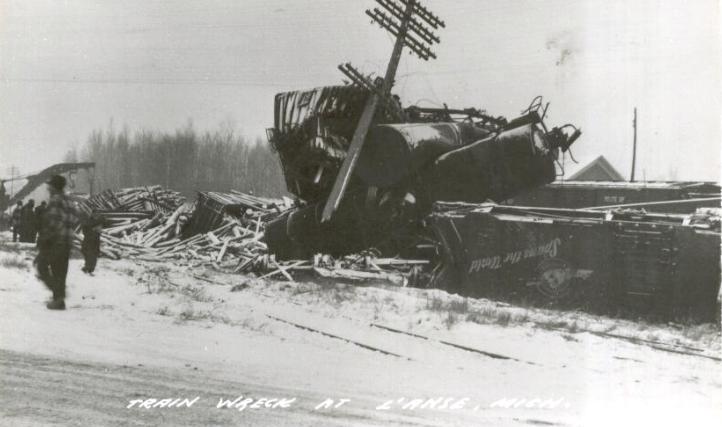
There are apparently wolves roaming the streets of L'Anse. A friend had a status update on Facebook yesterday that noted wolves had been spotted at the upper end of the street she lives on, and the comments thread quickly filled with reminiscences and opinions from other town folk about the carnivores they'd seen recently (i.e., within the past year) right in town. One person mentioned seeing a wolf stroll between her mother's house and the next door neighbor's; another recalled seeing wolves ambling down the street not long ago. WTF?!

As I've no doubt mentioned a number of times, the S.O. and I dwell out in what our kids used to refer to as BFE, which is another way of saying the middle of nowhere. We've got 40 acres, more or less (mostly less, because the CN right of way eats up a little over 3 acres), of brush and swamp. In the many years we've lived here, I have never seen a wolf. I know there was a pack that included our area in its territory, but I've never seen any of them. The Younger Daughter said that she was always hoping to spot them during her morning commute back when she was duty-stationed nearby. She'd been told the pack included a white wolf -- and she really wanted to see that particular wolf. Never happened.

I assume that pack is still around and still utilizing basically the same territory, although the membership would have changed. Wolves in the wild can live to a fairly ripe old age for a canid (13 years or more), but most are going to die younger than that. If they are, though, I've never seen them. The closest I've come is seeing a few humongous paw prints in the sand in the driveway. So what are we doing wrong? If people sitting out on their decks in town quietly enjoying a cup of coffee are seeing gray wolves strolling through the neighborhood, why don't I ever get to see any out here in the boonies? Just what the heck are they doing in town that attracts these fairly savvy predators enough that they're ambling down Tuttle Street in broad daylight? And, secondary question, why aren't those people in town who see these wolves doing stuff to make the not-so-wee beasties stay away?

I can understand why some people would freak out at the sight of a wolf, or multiple wolves, right in town. I think I can even understand why wolves might wander through town occasionally. Whitetail deer are a  major nuisance in town; we know people who have given up trying to have vegetable gardens because they couldn't keep the deer out. If there are a lot of deer around, it follows that you're likely to have wolves. What I don't understand is why people are responding to the sight of a wolf by freaking out and dashing indoors immediately. Apparently no one is familiar with the concept of aversive conditioning.

What, you may ask, is aversive conditioning? It's a technique for changing predator behavior so they decide to go elsewhere looking for lunch. U.S. Fish & Wildlife and state conservation departments have been experimenting with aversive conditioning for quite a few years now. Wildlife biologists know that predators learn to hunt from other predators. Kittens are taught to hunt mice by their mothers, for example. In the Arctic, polar bears have been known to starve to death during the summer months because for thousands of years they've lived primarily on seals; they've never been taught that berries and fish are edible. Similarly, wolves learn what's edible, what isn't, and where to find food by observing the behavior of the alpha female in their pack. Teach the alpha female to avoid an area or not to go after certain types of animals (e.g., cattle) and it becomes a lot easier for farmers and ranchers to co-exist with wolves.

Wildlife biologists use shock collars for aversive conditioning out West. It's a little bizarre -- it's kind of like training dogs to recognize invisible fences, except they just radio collar the alpha female in a wolf pack and train her. That's obviously not an option for anyone living in town. But how about making the neighborhood a little less inviting? When you see a wolf, don't slink quietly into your house. Stand up, make yourself look as big as possible (the idea is to have your profile resemble that of a pissed off bear), and do a bunch of yelling while you back through your patio door. If it's really close, throw stuff at it. Invest in some spud guns. I have a hunch that if wolves hear an impressively loud noise accompanied by getting hit by a nice solid potato or golf ball they're going to rethink the route for their morning constitutional.

One of the commenters yesterday said he preferred actual bullets to spuds. Three problems with that solution, in addition to the obvious one of getting your ass tossed in jail for discharging a firearm in a residential area. First, it's always a really bad idea to use something that could potentially accidentally kill one of the neighbors when you're just dealing with a nuisance. Doesn't matter if you're the best shot on the planet -- there's always the risk of the bullet passing right through the animal and into something you didn't intend to shoot. Second, you've eliminated one animal. The lesson it's learned isn't going to get passed on. It's not going to be around to tell the other pack members that it's a bad idea to go into town. Predators are smart, but they're generally not smart enough to make the connection between being in a particular location and one of their packmates dropping dead.

The third problem is that way too many people have no clue what a wolf actually looks like. There is a fair amount of paranoia and hysteria about gray wolves since their numbers have increased in the past few years, and some people now see wolves everywhere. They think they're seeing a wolf when it's actually someone's German shepherd or husky running loose. If you Google "dog mistaken for wolf" you get hits from all over the northern part of the U.S. of incidents where someone shot someone's pet because they were sure it was a wolf. There have even been cases of people walking or skiing with a pet dog and having some idiot freak out and decide it was a wolf despite the presence of a human right next to it. IIRC, there was a case not long ago where the dog was actually on a leash and some moron shot it. So the question naturally arises of whether the people reporting seeing wolves in town are actually seeing wolves or if the critter (or critters) are merely dogs that bear a strong resemblance to wolves (malamutes, for example) and their idiot owner is letting them run loose? Just how stupid would someone feel if they do what they think is the manly thing and shoot a dangerous wolf and it turns out to be a Norwegian elk hound belonging to someone who lives a couple blocks away?

I will give my town friends the benefit of the doubt and assume they are indeed seeing gray wolves in their front yards. I am really curious, though, as to what makes the outskirts of L'Anse so attractive to wolves that they'll amble around there in daylight. Wolves are primarily nocturnal (it was the middle of the night when they ate the neighbor's pit bull), so why are they strolling around at a time of day when people are actually awake to see them? It's a mystery.

Friday, May 8, 2015

How many videos is it going to take?

I keep wondering just which century some cops are living in. Did they sleep right through the invention of videotape? Digital cameras? Smart phones? Seems like about once a week, maybe more often, we're treated to viral videos that show police misbehavior or to news stories with headlines like "Video Shows White Cop Kicking Black Man in Face." That was one of today's headlines that came up when I closed Hotmail and the MSN page magically appeared.

In this most recent case, which actually isn't that recent -- the incident in question occurred back in 2013 -- the beating was recorded by a cop car dashboard cam. That raises two different, albeit related, questions. First, just when are law enforcement officers going to figure out that anything they do might be recorded? Back when the Rodney King beating happened, the recording was a fluke. Someone happened to have a video camera. It was back in the days when recording devices were still relatively bulky and took tape cartridges. That was over 20 years ago, though. Recording devices have become much, much smaller. They're also everywhere. Even my cheap little Tracfone, a bottom of the line dumb phone, can do video. Granted, only about 30 seconds worth, but video none the less. Smart phones have a lot more recording capacity, and more and more people have smart phones. In addition, the courts have ruled that the public has a right to film anything they see the police doing. For awhile, cops were trying to keep a lid on things by confiscating cameras and erasing videos. Not surprisingly, the courts found they couldn't legally do that.

In addition to the most obvious source of video evidence, there are more and more surveillance-type cameras out there: the police dash cams, security systems in place at various businesses, red light cameras, traffic cameras, and so on. We aren't under quite as complete a security net of surveillance cameras as the British, but we're getting close.

So with cameras potentially everywhere and stories of bad behavior making the news on a regular basis, why do the police still behave as though no one is watching? I know part of the answer -- because even with video evidence showing some rogue LEO behaving like a sociopath prosecutors almost never bring charges and police departments are reluctant to discipline anyone -- but that's not always true. The cop in this most recent video, for example, has been indicted for second degree assault. So if it's becoming more common for there to be actual consequences, why do some cops behave as though they're still living in the last century, not current one? Good question. Maybe it just takes awhile for some people to get the message times have changed.

Side note: in one of those weird coincidences that make a person wonder if Jung was right about collective consciousness, just as I was finishing typing the above paragraph, NPR did a brief report on a new app for smart phones. It was developed by the ACLU in California specifically for use in filming police misconduct. So far over 40,000 people have downloaded the application. That in itself is rather troubling news because for sure it's evidence that there are a whole lot of people out there who are expecting the cops to do something Bad. It definitely shows whatever trust the public once had in law enforcement is rapidly eroding. Which brings me to the second question: when the institution of law enforcement going to realize they need to clean up their act? More and more ordinary people are starting to view law enforcement as The Enemy. That solid blue line that tends to behave as though no cop anywhere ever did anything bad had better start crumbling a bit and start to police itself better. As long as they keep mouthing the line that "Officer Sadistic Asshat did nothing wrong" when the video shows Officer Asshat beating someone to death (or close to it), the public's confidence in law enforcement is going to keep shrinking.

Of course, considering just how many cops (male and female) I've met over the years who apparently went into law enforcement specifically because they were sadistic asshats and got off on power tripping, I doubt  things will get better any time soon.

Friday, February 6, 2015

Another of life's little mysteries

Just how many old railroad ties are there?

Yesterday the S.O. and I happened to be heading home just as the CN freight train decided to start backing up from a railroad crossing. You can't see it in the photo, but the exposed rail stops before it actually gets to the crossing -- the train had gotten that far in heading down the hill to L'Anse before the engineer decided for some reason to throw it into reverse. Did he suddenly remember he'd forgotten to pick up his mandatory four empty cars at Nestoria and decided to back up to get them? Maybe he noticed brake pressure wasn't what it should be and decided to back up to Summit Siding to drop off a few loaded cars?

But why he decided to start back up isn't what intrigues me in looking at the photo. It's all those gondolas. He's heading downhill so that means every one of those cars is loaded with old railroad ties. He's hauling them to the J. H. Warden Generating Station in L'Anse. The powerplant converted to burning biomass a few years ago. Ever since then, it's been receiving gondolas full of old railroad ties that get shredded and burnt. The Warden plant also burns a lot of raw wood chips, which is what I think most people assumed would be its primary fuel source when the plant went through the conversion process. You know, when someone says "biomass" you don't anticipate getting to live with the smell of burning creosote.

Anyway, when a friend who lives in town was complaining about the plant's odor problems a year or two ago, I made comforting noises and said, "Don't worry. Sooner or later they'll run out of old railroad ties." Now I'm beginning to wonder. We see these long, long trains heading down the hill full of old railroad ties on an almost daily basis. The woodyard for the Warden plant has mountains of them. And they keep coming. Just how endless is the supply? It's a mystery.

As for the mandatory four empty cars, they're to supply more braking power. It's a continuous grade from Summit down to L'Anse, including the section in the photo -- it looks flat, but it's not. It's sloping. And not much farther along, it slopes a lot more, up to 3.5 percent, which is pretty steep for a railroad grade. The train is actually sitting right about at the point where 50-some years ago another freight, one that was going uphill, ran out of power, couldn't get the brakes to hold, and started rolling backwards. End result?

Wednesday, February 4, 2015

Why I don't bother watching the "news" channels

Last night I was in kind of an odd, let's see what's happening out in the world mood so I suggested to the S.O. that we watch MSNBC while waiting for it to get late enough to link to the With-Luck-You-See TV local news live stream. Since  WLUC out of Marquette started streaming the local news, we've started watching it primarily to catch Karl Bohnak's weather forecasts. That, and to see how excited he gets when there's snow predicted -- the man is a snow junkie.

Anyway, every so often I get curious about what's happening out there in pundit land. What is the topic du jour? Are they still obsessing about Ferguson? Are the chattering classes willing to concede any Democrats other than Hillary Clinton exist? What's the latest dumb thing to pop out of some politician's head?

The answer to the Hillary question is, of course, that no, the media is still thoroughly obsessed with Mrs. Clinton. They're wondering why no other Democratic candidates are emerging without ever stopping to reflect that maybe, just maybe, if they actually talked about a few of them (e.g., Jim Webb) the public in general would figure out there are other possibilities. I'd hate to see the Democrats degenerate into the sort of clown car spectacle going on among the Republicans at the moment, but it would be nice to hear about someone other than the former Secretary of State.

So what else is happening in the world? What topic is worth eating up air time on "Politics Nation"? Holy wah, Bruce Jenner has come out as transgender. The bad plastic surgery finally makes sense: he's transitioning to being a woman.

Question: why does anyone care? It's been a long time since he was on a Wheaties box. There have been plenty of other well-known people deciding they'd been born in the wrong body (Chaz Bono, for example) so why should any of us take any interest in Bruce Jenner?  You'd think the public would have collectively seen enough of him on reality tv, thanks to his being the stepfather of several Kardashians. But according to the panel dishing on Jenner's transition, the public is fascinated. Jenner has become tabloid fodder, and the tabloids have not been kind. (Or so they say; I don't recall seeing anything particularly dramatic screaming at me from the covers of the tabloids when I've been standing in the check-out line at Larry's Market lately.)

I will concede that having heard this news, I had some not particularly kind thoughts myself, like "Is the man insane? Is this a symptom of dementia?" But then I have that same reaction whenever I hear about any man deciding he should actually have been a woman. I am a woman. I've had a pretty good look at the downsides of being born female. Back in the '90s I thought economist Deidre McCloskey was totally insane when she announced she identified as a woman. I'd met McCloskey, I'd heard her speak back when she was still Donald. Donald was a balding, bearded man -- it was, to say the least, difficult to imagine that person as a woman.

I have no doubt that there are persons born, so to speak, into the wrong bodies. Gender identity is a lot more fluid than many of us want to admit. I also know there are persons born with ambiguous identity based on genitalia and get labelled as female when male would have been more accurate and vice versa. And I can totally understand why adolescents and young adults would struggle with this. But once you hit your 50s (McCloskey was 53 when she publicly became Deidre) or 60s (Jenner is 65)? What man in his right mind would want to be a post-menopausal woman in modern day America? I know feminists do a lot of blathering about the wisdom of crones, but the reality is that it is not particularly easy being an old lady. You're effectively invisble. You have no power. No one takes you seriously unless your name is Hillary, and even then half the time you get mocked by the media.

Still, setting aside questions about why Jenner felt compelled to do this so late in life, what makes Jenner's transition newsworthy? Why eat up broadcast minutes over something so banal?  I have no clue. I just have a hunch that somewhere on this planet, somewhere that was definitely outside the borders of the United States, there were people tuning into "news" programs and seeing actual news.

Bottom line? Next time I'll suggest streaming Al Jazeera.

Saturday, November 15, 2014

Food fads and the gullible

I have written before about food fads, things that are promoted as being better than whatever it is we're used to eating and of course cost a whole lot more. I've found another one. Agave nectar.

Back when I still worked at the Centers for Disease Control, one of my colleagues began pushing agave nectar as a substitute for sugar. I'm not sure why. Supposedly because the agave nectar is sweeter than sugar, you'll use less of it. If the reason for using agave nectar is to cut back on calories, you'd better hope that to your taste buds it seems a whole lot sweeter because when you start comparing calories on a teaspoon to teaspoon basis sugar wins. Sugar has 16 calories in a teaspoon; agave nectar has 20. Anyway, at the time the agave nectar was being pushed by my colleague, I humored her, used it in my coffee, and thought to myself, "Okay. Not bad." So the next time I was at Publix I looked for agave nectar.

Remember the quinoa experience? Well, agave wasn't quite as much of a sticker shock eye opener, but at the time it struck me as fairly pricey for the amount the bottle contained. However, back then (this was about five years ago), agave was a recent arrival on supermarket shelves and Dr. Oz (who's apparently never met a food fad he didn't love) was pushing it on his show. He has since back peddled. For various reasons (market forces? economy of scale?) the price has dropped; it is now cheaper ounce for ounce than honey. It is, of course, still a lot more expensive than cane sugar.

Like the quinoa, the agave nectar was a gift. I have a friend who works at a summer camp that caters to rich kids from Chicago; every year when the camp shuts down at the end of the season the staff have to completely empty the kitchen. Anything that is perishable, might attract varmints (e.g., raccoons), or would be ruined by freezing is removed. Some of it goes to area food pantries and some goes home with the maintenance guys who in turn pass some on to friends and family. Last year I was the recipient of several boxes of quinoa, probably because I actually knew what the stuff was (or was the only one who was willing to try it). This year it was a bottle of agave nectar.*

Unlike the quinoa, the agave nectar is actually edible. It's nicely innocuous. When I dump it in my coffee or tea, I can't tell the difference between using it and using ordinary sugar. Am I using less in terms of total amounts than I would if it was the usual teaspoon of sugar? Who knows. It's hard to do a side by side comparison when agave is a liquid and sugar is a solid. Is there an advantage to using agave instead of sugar? I'm not sure. I've heard some people tout it as being more "natural," but from what I've read the process most commonly used for extracting it from the agave plant is as highly industrialized as the process involved in making high fructose corn syrup. There's a lot more involved than just crushing the plant and boiling the resulting sap. There is a type of traditional agave nectar that comes much closer to the type of processing used for traditional cane syrup, but that's not the agave nectar you're going to find on the shelves at a typical Kroger.

In any case, whether traditionally produced or cranked out in an industrial refinery, the sugars in agave are primarily fructose, which, as other writers have pointed out, puts agave a whole lot closer to being just another form of high fructose corn syrup than it does to anything that's actually good for you. High fructose corn syrup has gotten a bad reputation for a reason: research has shown that the human body does process fructose differently than it does sucrose. High amounts of fructose in a person's diet can contribute to the development of metabolic syndrome, i.e., that lethal combination of weight gain and type II diabetes. So why on earth would anyone think agave nectar would be a healthy alternative to ordinary sugar?

I have heard that hard core vegans like agave nectar because it doesn't involve animals in any way, shape, or form. They substitute it for honey because they apparently view honey as off limits because it's bee vomit and therefore an animal product. Well, cane sugar, beet sugar, maple syrup, and Karo syrup have always been 100% non-animal products, so why agave would suddenly look more appealing than any of the non-fructose loaded alternatives baffles me. It has to be yet another triumph of marketing cancelling out common sense.

Of maybe it's just that magic "organic" seal on the bottles. Who knows. It's a mystery.

*I get other stuff, too, but it's not as much fun to write about a giant unopened bag of Kellogg's Froot Loops or the institutional-size jug of stir fry sauce. Unlike the quinoa, the Froot loops did not end up in a bird feeder.  

Thursday, August 28, 2014

More blogger weirdness

A photo completely unrelated to the contents of this post.
For some inexplicable reason, no doubt known only to the Powers That Be at blogger.com, my blog rolls are doing strange things. They're alternating between displaying the way they should with the most recently updated being at the top of the list and showing the title of the most recent post and displaying as a randomized list with no information about recent posts. In the latter configuration, if I click on any of the links the result is a display that's solid HTML. Very, very strange -- not to mention hard to read.

I'm going to take this as a sign to walk away from the computer for the rest of the day.

Sunday, August 24, 2014

A genre to avoid

Mystery/romance. Or romance/mystery. I'm not sure just what to call a genre that crosses Harlequins with what is supposed to be a thriller, but apparently it's a genre that is Carla Neggers's forte. Too bad she is, at best, a thoroughly mediocre writer.

I just finished a book called Cold Pursuit. It's apparently the first in a trilogy of books about a female Secret Service agent and her love interest, a former Special Forces soldier. I assume it's a trilogy because the L'Anse Public Library tries to label books that are part of a series, and when I plucked this gem off the shelf it had a number 1 label on the spine. The next two books on the shelf were marked 2 and 3 so it's probably safe to assume that agent Jo Harper and ex-Sgt. Cameron will continue to have hot and steamy sex while investigating a suspected ring of international assassins that for some bizarre reason are apparently based in rural Vermont. 

You know, I am continually being surprised by the places that I find lady porn. What I can't help but think of as the Jean Auel model keeps popping up all over the place. I call it the Jean Auel model because, so far as I can recall, Clan of the Cave Bear is the first place I encountered the formula: a certain number of pages of narrative to move the plot forward, then a couple pages of hot hetero sex, then back to so many pages of narrative, more hot hetero sex scenes, all tastefully written but making it pretty damn clear what was happening, then more narrative. It took awhile to get going in the first book in the series, but after that it was pretty much guaranteed that every 70 pages or so Jondalar was going down on Ayla. Apparently Cro-Magnans were big making women happy with lots of cunnilingus, "worshipping the goddess" so to speak, because Ayla seemed to be on the receiving end a lot more than Jondalar was. Auel really knew how to tap into women's fantasies.

Anyway, since then the lady porn has evolved. It's gone from being tasteful and intermittent in fiction targeting women to being basically the whole book (e.g., 50 Shades of Gray). It's also gone from euphemistic to blunt (in the Outlander series Claire Beacham wraps her hand around Jamie Fraser's cock and describes the organ in affectionate detail; she doesn't just admire his manhood). Cold Pursuit falls kind in the middle on the descriptive scale -- lots of "plunging" that makes intercourse sound a lot like trying to fix a stopped up sink drain -- which could be one reason it felt so much like a Harlequin.

Now, I know that there are a lot of "mysteries" out there that fall into mutant genres, too. Janet Evanovich's books all mix romance, mystery, and humor. J. D. Robb (aka Nora Roberts) mixes romance, mystery, and science fiction. Laurel K. Hamilton mixes horror, romance, and mystery, although the biggest mystery with her Anita Blake series is why Anita is still capable of walking after banging half the population of the western hemisphere. Some are more readable than others. So why have I singled out Neggers? I have no clue. Maybe it's because after I finished the book I found myself thinking, well, there went another 90 minutes of my life I'll never get back.  Maybe it was because the attempt to blend two different themes (romance and mystery) was so clumsily done.It felt like she wrote two separate books and then did some cutting and pasting to merge the two. And maybe it's because it's Sunday morning, I'm  bored, and I don't feel like doing anything more productive than whine about mediocre books.  

It's a mystery.

Monday, August 18, 2014

Another mystery

Why does my underwear have a pocket in the crotch? You know, there are some areas I normally would not go near, like discussing anything remotely related to an intimate knowledge of me, but this item is just too bizarre not to share. I recently purchased a package of undies that I assumed were perfectly normal women's undergarments -- there was certainly nothing on the packaging to indicate they had any special features -- and, lo and behold, there's a pocket in the crotch.

Now I know there are some unmentionables that are manufactured with pockets in the crotch for specific reasons. The adult entertainment industry sells sexy lace panties that include a pocket in which the lucky wearer can insert a vibrator and spend the day (or however long the battery lasts) walking around smiling mysteriously. But these undies did not come from an Adam & Eve catalog; they came off the rack at Kmart. Are these crotch pockets some new and improved feature I wasn't aware of? Have I been missing out on trends in women's undergarments? Is this pocket supposed to be the ultimate place to stash your keys while jogging or serve as a handy place to tuck a credit card or some cash just in case someone snatches your purse? It's a mystery.

What isn't a mystery is what Google is going to be doing to me for a while after I spent way too much time doing an image search that included the phrase "panties crotch pocket." The next time I visit a monetized blog, I'm going to see some really strange ads.

Friday, April 11, 2014

What's amusing me this week

The Stephen Colbert freak-out on the right. Who would have thought that the conservatives in this country would care so much about who replaces David Letterman? Based on the clips I'm seeing, Rush Limbaugh, Sean Hannity, and other right-wing talking heads have apparently never watched Letterman's show. They seem to think that Colbert will be bringing some radical left-wing agenda to CBS in an attempted liberal take-over of popular culture in a way that has never been seen before in the hallowed space of the Ed Sullivan Theater. From the way they're freaking out you'd think that it had been Dennis Miller sitting at that desk and bantering with Paul Shaffer for the past 20+ years. It's bizarre. Letterman has been taking shots at the conservative side of American politics for a long, long time. He was merciless in mocking George Bush, he's targeted Rush Limbaugh in the past, and he's been consistently irreverent when it comes to going after people in positions of power. In short, Colbert isn't going to be saying or doing anything that Letterman hasn't already said or done, albeit in a slightly different style.

In any case, it is definitely weird that the right-wing pundits would worry at all about who's going to host a late night television program. Why do they care? Is Rush really that insecure about his growing irrelevancy and shrinking (dying?) audience that he feels obligated to rant about Colbert? Does Hannity actually believe that Colbert succeeding Letterman is still more proof of growing decadence in American life? It's all very strange. Amusing, yes, but still strange.

Thursday, March 27, 2014

Ethical qualms, moral dilemmas, counterfactuals

In the long tale of the world most of us are the recipients of stolen goods and the fruits of murder, just by happening to be alive after they happened, and atrocities cannot be undone later.  – John Barnes
I did a blog post the other day on one of the things we denizens of the United States seem to have gotten right: as a general rule, we don't go around trying to figure out ways to kill each based on where someone's great grandmother was born or what language some distant ancestors spoke. We've got various alliances, networks, cliques, and cults that might despise each other, but if we accuse each other of not being true Americans it's not going to be because someone's great grandparents spoke Hungarian or Tagalog when they got off the boat 100 years ago. There's a reason for this: assimilation. Some of it was voluntary, but quite a bit was forced. 

Which brings up the issue of ethical qualms and moral dilemmas. I once read a statement attributed to Lenin in which he said that in order for the end to justify the means, you have to have an end you can justify. Which strikes me as being a tad tautological, but it does make sense. If you're going to break eggs, you better be planning on ending up with an edible omelet. So today we Americans are the fortunate beneficiaries of a policies instituted decades or centuries ago that in retrospect do not seem to pass the smell test. Taking Native American kids away from their parents and shipping them off to boarding schools where they were forbidden to speak their native language was barbaric. Punishing the children of immigrants for speaking Italian or German or Slovenian in an American public school was almost as cruel. People were stigmatized, treated horribly, for displaying any signs of foreignness. The end result was a populace unified by a language and common culture, but obtained at the cost of losing their past. Was this a good thing or a bad thing?  And was it necessary to use force? Would assimilation and adoption of a common language have occurred as rapidly if official policies hadn't pushed for both? Is there even a way to decide questions like that decades later?

As for counterfactuals, there is the intriguing question of whether or not assimilation, forced or otherwise, would have occurred among the non-Native groups if they had all felt like they had someplace to go back to, i.e., that there was a motherland just waiting to be reclaimed. Although some immigrants came with the intention of just working for a few years, making a fortune, and going back to the old country to buy a farm or start a business, the majority recognized this was it. There was no going back. Once they got off the boat from Europe, Africa, or Asia, most were here to stay. 

In contrast, in the Soviet Union, Stalin tried shuffling various population groups around in an attempt to Russianize everyone (which was, come to think of it, pretty bizarre, given that he wasn't Russian himself) and eliminate non-Russian languages within the borders of the Soviet Union. It didn't work. Once the Soviet Union fell, the former Soviet republics discarded using Russian as a language pretty rapidly and different ethnic groups that had been sent off to colonize in eastern Siberia started moving back to where their grandparents had lived. It's a lot easier to keep the idea of repatriation alive when you know you can walk there if you're determined enough. 

Would the Russianization have worked given a few more generations to oppress and coerce people? Again, an unanswerable question. Borders have shifted numerous times, nation-states have risen and fallen, and populations have shifted in response to wars, famines, and plagues. Some cultures and people vanish as though they had never existed; others endure. 

Saturday, March 1, 2014

Another author I cannot read

Joyce Carol Oates. The woman is one of the most prolific American authors around. She's published a gazillion short stories, been featured on Oprah's Book Club, and received multiple awards. I'm not sure how I had managed to avoid knowingly reading anything by her until this week, but I had. So the last time I was at the library I decided it was time to remedy that deficiency. I checked out a recent collection of her short stories, Dear Husband.

Okay. She can write. She is really good with a pen, a master wordsmith. But depressing? Words fail me. I don't expect every book I read to be super upbeat or have a formulaic happy ending. After all, I like Russian novels. I read the short stories in The New Yorker. I even have a subscription to The Sun. But there are limits. The characters in the stories in Dear Husband don't lead lives of quiet desperation. They lead lives of such total despair that the reader finds herself wanting to join them in a warm bath while chugging a whole lot of Xanax and Jack Daniels with a nice old-fashioned cut-throat razor on the side.

You know, this baffles me. "This" being the gazillion publications. If Dear Husband is typical Joyce Carol Oates, why on earth would any reader ever buy more than one of her books? Do people think that if a book makes them feel horrible it is somehow great literature? Do they view reading as punishment, some sort of penance they endure to prove to themselves they're smart? Are they trying to impress the librarian or the Barnes and Noble cashiers when they pick up something by Joyce Carol Oates instead of Janet Evanovich? It's a mystery.

Okay. It's time to go read something light and escapist to purge the memory the Oates book. Maybe I'll re-read Crime and Punishment. After reading Oates, Dostoevsky will seem like P. G. Wodehouse in comparison.

Friday, February 21, 2014

Odd thoughts in the middle of the night

Sometimes I wake up thinking about the most inconsequential things. Why? With everything that's going on in the world, why on earth would I wake up wondering how the parents in large families manage to come up with names for their children?

One of the things I do as part of volunteering with the local historical society is dabble a bit in genealogical research. People contact the museum asking for our help in tracking down death certificates, marriage licenses, and other records. Sometimes I'm able to find what they need; sometimes there's nothing. But in any case I have been noticing just how large some of the families were. We've had a couple requests come in for information on one of the local well-known pioneer families, a family that stands out for multiple reasons, but that I find particularly notable for the remarkably good health of the matriarch of the clan. The woman had at least seventeen children who survived into adulthood, or close to it. The matriarch herself was probably in her nineties when she died.

So do I wonder about how she managed that? Good genes, clean living, sheer dumb luck? Do I think about the changes she witnessed over her lifetime, which spanned approximately 1820 to 1910? No. I wake up wondering just how the heck she and her husband came up with names for the kids. The first couple of little barracudas would be easy. As good Catholics, they'd just do the usual Apostles and a Mary or two. But once they hit the 10th or 12th they'd be starting to run out of the better known saints. And by the 17th? I can't see a priest being willing to baptize "Jesus Christ Not Again."

Then again, by the time they hit the 17th, the older kids would be leaving home, so maybe they just started over from the top of the list.

This particular family was so large that the descendants who are several generations away from the original pioneer couple do not realize that their great-great-grandparent was one of 17 siblings. I don't know why that surprises me -- with one exception, I have no idea how many siblings three of my grandparents had, and I actually knew one grandmother -- but it always does. Maybe it's because the family is so well known in local history that it always seems odd that more information didn't get passed down in family folklore after the descendants moved away.

I've always kind of wondered about naming traditions in general. I've known people who were determined that each child have the same first initial, there are others where one particular name seems to get repeated over and over, and of course we've all seen the sorry influence of soap operas, movies, pop stars, and cultural icons. One of my friends was named Mercedes, and, yes, it was the car that was the inspiration. Even better, the family mispronounced it.

I can't get too judgmental, though. Both my kids have names inspired by books, and relatively obscure books at that. My older daughter is still annoyed that I happened to read Zuleika Dobson when I did, and the younger daughter has spent half her life telling people that no, Tamar isn't Biblical, it's a river in a Victoria Holt novel. I keep telling them to count their blessings. I could have been reading Podkayne of Mars when the nurse asked me what to put on the birth certificate.

Monday, February 17, 2014

The persistence of binary thinking

I was watching "Real Time" the other night and it hit me again how trapped we all seem to be in thinking that for every problem there are only two answers: The Right Answer and the Wrong Answer. The panel was discussing the Obama administration's use of drones for targeted assassinations of possible terrorists. There are huge problems this whole notion, of course, ranging from violations of international law and the moral repugnance of planning to kill multiple innocents ("collateral damage") in an attempt to take out just one mastermind, but those aren't the subject of this post.

No, what struck me was Bill Maher's persistence in framing the discussion as an Either/Or question. You know, we either use drones to blow up someone's house or we do nothing. In Maher's world view there was only one Right Answer. It was like Maher was trapped thinking in Basic: for him everything was either a 1 or a 0; there were no other numbers. Dylan Ratigan kept pointing out that there were alternatives to drone strikes, such as special operations teams (e.g., Seal Team Six), that could be sent in to extract high profile human targets. Jeremy Scahill was being quite persistent in reminding everyone that drone strikes are not particularly effective. Among other things, they do a really nice job of recruiting new persons into supporting anti-U.S. terrorism. Blowing apart a wedding party or a gathering at the local coffee shop with a U.S. drone strike is a really good way to persuade the survivors they want to sign up with Al Qaeda or the Taliban after all. A more effective strategy might be to come up with ways to reduce support for terrorism, not bolster it. Maher wasn't having any of it. In his mind, there were two possibilities: doing nothing or using drones.

This is a situation we encounter all the time in our every day lives. We all know people who can't seem to figure out that for any situation there can be multiple responses. They decide that there is one Right Answer, and if for some reason that answer doesn't work out, they're paralyzed. The idea that there can be multiple right answers never sinks in. I'm not sure where this tendency comes from. It is the end result of being told over and over in school that there's only one right answer for any homework or test question? Have we been brainwashed by too many generations of politicians who insist publicly that there's only one policy solution to any particular problem? Are we humans just naturally lazy thinkers? We're always exhorting each other to "think outside the box" but we almost never do. It's a mystery.

Wednesday, February 5, 2014

Why do you think they call it work?


My mother used to say some people would bitch if they were hanged with a silk rope.* I think she was talking about Republicans.

I was listening to the news this morning and learned that a report from the Congressional Budget Office indicates that one of the consequences of the Affordable Care Act (aka Obamacare) is that the number of people working may drop. Apparently the statisticians are predicting that some people will leave the work force or reduce their hours because their income is no longer needed to pay for health insurance. For example, a person who is currently working multiple part-time jobs may realize he or she only needs to work one. Or perhaps a two-income couple will realize they can get by on one income now that they're no longer saddled with $1000 a month in health insurance premiums. In short, the Affordable Care Act could lead to more people experiencing less stress and financial pressure, i.e., some people are going to be able to enjoy more leisure time. This possibility is generating all sorts of sound bites from the right about what a horrible, horrible outcome this is and how it's yet another example of the rolling train wreck that is Obamacare.

I don't get it. How is people having to work fewer hours to survive a bad thing? Work is something people do because they have to. For most people on the planet, it's a necessary evil, a means to an end and not the end in itself. Even people who genuinely like their jobs would probably prefer to spend less time at the job and more time doing other things. If work was fun, you wouldn't see bumper stickers telling the world "The worst day fishing beats the best day at work" or "Retired - every day is Saturday!" So if the Affordable Care Act means more people get to enjoy time having fun instead of staring at a computer screen or flipping burgers it strikes me as being one more thing to be happy about.

Then again, the S.O.'s ultra-conservative teabagger cousin recently hurled what he thought was the ultimate insult against the S.O.: "He only worked when he had no other choice." WTF? Isn't that what all of us do? If we didn't have to do it, it wouldn't be called work.

[*It always struck me as an odd saying. I think I'd complain no matter what type of fiber was used. What's the point? Silk doesn't chafe so the rope burn will be less dramatic? You're still dead.]

Monday, January 6, 2014

Snow days? We never had snow days

Got up this morning to below zero temperatures outdoors. According to the indoor/outdoor thermometer, it was minus 13.9 and dropping at 6 a.m. Today's predicted high is slightly warmer; it's supposed to climb all the way up to minus 6. Fahrenheit, of course, I don't want to think about what it would be in Celsius because Celsius always sounds colder.

What intrigues me about this particular cold snap is the way people are reacting to it. Below zero temperatures aren't exactly new here in the U.P. I can recall many winters where the lows would be down around minus 30 or even 40 below, especially toward the end of January and the beginning of February. I can remember waking up one morning at my parents' house, a structure that relied on one pathetic oil-burning space heater to prevent frostbite and hypothermia in its residents, and finding ice had formed in the water glass on the nightstand. And how did we all respond to this bitter cold? We got up, got dressed, ate breakfast, and then headed out the door to walk to school through waist deep snow. Uphill. Both ways.

Well, maybe no waist deep snow and there was a school bus, but nonetheless we went to school. No one panicked because it was, holy fuck, cold. It was northern Wisconsin in the winter. You expected cold, you dealt with it and quietly hoped for an early spring. Didn't matter just how many brass monkeys were shedding testicles, unless that cold was accompanied by blizzard-like snow conditions, you went to school.

Even 20 years ago bitter cold didn't inspire entire states to close their school systems. Back in 1993-1994 we had a record cold winter. Temperatures were minus 20 or colder in the middle of the day for what seemed like weeks on end. Municipal water pipes froze that hadn't frozen since they were put in a hundred years earlier. But people bundled up, kids kept getting on school buses, and life went on.

So what's different this time? Is this yet another phenomenon that we can blame on the Internet and/or social media? Or is it simply the result of the traditional mainstream media flogging a story to death because nothing else has been happening in the world lately and they're tired of talking about the Winter Olympics and Russian homophobia? Why are people freaking out now over single digit below zero temperatures predicted to last for only a couple days when not long ago all it would have merited was parents reminding kids to dress in layers. I don't know. I do know that the local TV station put up a list on Facebook of schools that are closed today, and it seemed to cover just about every district in the Upper Peninsula. Just because Minnesota panicked we're supposed to, too? Unreal.

Saturday, November 30, 2013

Weirdness in the spam folder

Like everyone who blogs, every so often I'll have a comment show up that at first blush appears to be from someone saying something nice about a recent post but is in fact spam. You know, it'll have a line or two complimenting the post and then a "this may interest you" with a link. If you click on the link, you discover you're at a site advertising something you have absolutely no interest in -- male enhancement products, office space in Bangalore -- but usually the spam comment is at least directly linked to something you wrote. Granted, sometimes the post in question is a really, really old one, but you did at least write it.

Well, I got one the other day that was stranger than usual. It referenced a post I'd supposedly done on a topic I vaguely recalled but had done so long ago it might as well have been on a different planet. I've never had a spam comment that reached back 2 or 3 years in time, so that made me curious. I went looking for the original post. I could not find it. The link in the comment that included the post's title was a dead link. Very strange. So then I did several searches of the blog archive using terms that one would think would either be used as labels or would show up in the text. No luck. So then I decided to read my blog backwards. I learned a few things that weren't exactly news -- among other things, I used to have a serious addiction to C-SPAN -- but I never did find a post with the title the commenter had used. Very, very strange.

Monday, March 18, 2013

But does it run?

The S.O. and I have been Leviathan shopping lately, looking for a motor home similar in size and amenities to the one his brother owned but available for much, much less money. For some reason, shopping for an RV is starting to remind me of politics. We've been hearing a lot of promises from sellers -- it runs like a charm, never had any problems with the generator, etc. -- but with no evidence to back those promises up. Yesterday we looked at a vintage Georgie Boy that had me thinking of Paul Ryan's budget plan: Ryan swears it'll solve the country's deficit problems, get the economy back on track, and be a general boon to everyone, but there's no evidence to support his claims. He's promising the equivalent of a brand-new, fresh off the assembly line vehicle while you're busy looking around and seeing the 30+ years of grease in the kitchenette, sagging cabinet doors, holes punched in the paneling, threadbare shag carpeting, and cracked windshield. Then you ask, "but how does it run?" This is the point where the prospective buyer expects the seller to whip out a key and fire the beast up. Instead, the response is, "Trust me. It runs great."

I don't think so. If it ran great, it would be running when the buyer went to look at it. Just like with Ryan's proposed budget; if he really believed it would work, it would contain specifics instead of indulging in platitudes, vagaries, and direct contradictions. Ryan's current budget plan is the same one he's been trotting out for several years now. About all he does is change the title and maybe the color of the comb binding on the printouts.

As for our motor home search, this business with the beasts sitting there inert when the prospective buyer arrives to examine them has me baffled. We've looked at two used RVs this month. One was immaculate on the inside; it was a 1989 Winnebago but the carpeting and upholstery looked new. It was spotless. It was also basically exactly what we were looking for when it came to size and interior layout. The other one was an ancient Georgie Boy; it looked like something Randy Quaid would drive -- the interior layout wasn't bad, but was thoroughly obscured by years of having been used by a family with multiple teenage boys. It was, in a word, disgusting.

In both cases, though, the interior was irrelevant. What mattered was the engine. Did the beast run? Who knows. In both cases, the seller swore that there were no mechanical issues, the thing ran like a charm, it might need a minor tune up after sitting all winter, but no big deal. It would have been a lot easier to believe the sellers if the vehicles had actually been running while we were there.

Despite the squalor, I am still a little tempted by the Georgie Boy. It would require a lot of elbow grease, but it does have several things going for it, chief of which is an incredibly low price tag. Now if we could only be sure it actually runs. . .