Showing posts with label poverty. Show all posts

Wednesday, January 8, 2020

Tired of winning yet?

A few months ago the S.O. decided to try applying for assistance from the local Community Action Agency. He was hoping for heating assistance or maybe weatherization, but turns out the waiting list for weatherization is remarkably long unless your circumstances are dire, and heating is now processed through Michigan's state social services department. Our circumstances aren't dire and we have no interest in ever dealing with DHS. Our combined income isn't much, but we do fall above the official poverty line. We are, however, sufficiently low income to qualify for the semi-regular Community Action food bank distributions.

We debated whether or not we should do it. We're not exactly starving; we'd been managing just fine without standing in line on Donald Day (it was known as Obama Day under the previous administration, and no doubt was W. Day before that). But what the heck -- we qualified, we might as well go pick up our lifetime supplies of lentils and kidney beans. Who knows. Maybe it would turn into a trip down Nostalgia Lane and there'd be buffalo meat (aka canned beef) or a few blocks of processed cheese food. Anyone who ever lived in a household where there was commodity cheese 30 or 40 years ago tends to wax nostalgic about it. It was really good cheese. But I digress.

We have not made it to every food pantry distribution day, but we did get to one yesterday. The Baraga-Houghton-Keweenaw Community Action Agency uses an old supermarket building in Houghton as a warehouse and for the distribution they do there. Remember, you don't have to fall below the poverty line for this one. The cutoff is something like 200% of poverty using a sliding scale (the same one the government does) based on family size. Income that puts people under the poverty line if you have a family of 4, for example, is a higher cut off than for a family of 2. Not that family size matters at the actual distribution: everyone goes down the line with a container (we use a laundry basket) and gets the same stuff placed in the basket.

CAA does two other food pantry distributions. One is held once every 3 months and is also one where you can be slightly above poverty to qualify; the other is monthly and for low-income (as in really low income) senior citizens only. For that one they use a truck to go to the different senior citizen housing complexes in the 3-county area.

Every time we've gone there have been literally hundreds of people lining up to get their laundry basket of whatever. Yesterday was no exception. Temperatures were down in the teens, it was snowing like the proverbial son of a bitch, roads were treacherous (we were having second thoughts, but we also needed to go to Auto Zone to get a core charge refund), wind was blowing, and there were still hundreds of people queuing up in the parking lot, boxes and baskets in hand. Looking at the crowd, it was like a cross section of American society. Young, old, dressed extremely well and dressed in thoroughly worn and faded clothing. Relatively homogeneous ethnically because this is the U.P. (translation: close to 100% white, although not totally).

And because people are prone to chat a bit, even notoriously taciturn Yoopers will engage in some small talk to pass the time. A favorite topic, of course, was if the economy is doing so well, the stock market is booming, and everything is going as good as The Donald claims, why are we all standing in line hoping that this time we'll get some peanut butter? Somehow hundreds of people risking frostbite to wait patiently to fill a basket with random groceries doesn't look much like winning.

Because inquiring minds no doubt want to know just what type of wonderful free stuff the poors are being given, here's the inventory for yesterday. Sadly, there was no peanut butter.
  1. Three 15 ounce cans Royal unsweetened applesauce
  2. Four 10.75 ounce cans Prima Qualita low sodium tomato soup
  3. One 15 ounce can Mission Pride unpeeled apricot halves
  4. Three 22 ounce cartons Granby Farms reduced sodium Cream of Chicken soup
  5. Three 15 ounce cans Hart Brand low sodium mixed vegetables
  6. Three 16 ounce bags Kings unsalted roasted peanuts
  7. Four 7.25 ounces boxes Pasta USA macaroni & cheese dinner
  8. One 12.8 ounce bag of Mountain Maid powdered milk (makes 4 quarts)
  9. One 16 ounce bag Betty Baker extra wide egg noodles
  10. One 16 ounce box Lil Dutch Maid unsalted Saltines (aren't unsalted Saltines theoretically impossible? How can any cracker be a Saltine with no salt on it?)
  11. One 16 ounce Basic American Foods instant mashed potato flakes
  12. Two 24 ounce bags Market Street Premium beef stew 
  13. One 10.5 ounce can Venice Maid vegetarian vegetable soup
  14. Three 8 ounce boxes Gosner Farms liquid 1% milk 
  15. One 5 pound of The Stafford County Flour Mills Co. bleached all-purpose flour
  16. One 24 ounce can Crider fully cooked ground pork with juices (I am, quite frankly, a little afraid of what I'm going to find when I open this can, although I'm thinking that it might be edible as sloppy joes)
  17. One 64-ounce bottle Fruit Patch apple juice
  18. Two 18-ounce boxes Malto Meal corn flakes
  19. One 15-ounce Del Monte lite sliced pears
  20. One 64-ounce bottle tomato juice
  21. Two pounds Dinner Bell Creamery salted butter
  22. Two packages frozen cooked pork patties (they look like hamburger but are ground pork), no visible brand name labeling on package, 12 patties in a package 
  23. Two frozen shrink-wrapped packages of mystery meat, possibly ham, each weighing about 2 pounds. 
  24. One 5 pound bag of potatoes
  25. One 3 pound bag of oranges
Offered and rejected: two large boxes of Kellogg's S'more flavored Pop Tarts. Made the mistake of accepting them a couple months ago. Never touching that nasty crap again. 

There is some good stuff on the list, like the butter. There's also some weird stuff, e.g., the ground pork. There is stuff we're not too enthusiastic about (unsalted peanuts?) but every thing in the basket is something we'll eventually eat. The FEMA meals (stew in bags) can't be any worse than Dinty Moore, and we used to eat that. Other than the fact the brand names are ones you're more likely to see at Dollar General than at Safeway, it wasn't a bad mix. No lifetime supply of dried beans (just what do people do with kidney beans besides use them in chili a couple times annually?), no truly strange stuff.

Now all I have to do is figure out where to stash it all in the Guppy.

Saturday, October 1, 2016

Define waste

While wandering the Intertubes yesterday, or, more precisely, floundering through the swamp that Facebook can be, I happened to see Robert Reich's video promoting the concept of a Universal Basic Income (UBI). This is an old idea -- the notion that every citizen would receive a monetary stipend, no means testing or a bunch of bureaucratic hoops to jump through, that would be sufficient to pay for basic needs. If that basic income wasn't affected by a person also working, it could be a way to eliminate poverty.

To clarify, right now if you're poor and receive assistance, you get penalized for working. The modern welfare system (at least in the United States) has a number of disincentives for work built into it. If, for example, your family qualifies for SNAP benefits (aka Food Stamps), if your income goes up your SNAP benefit goes down, often dramatically and long before your income has climbed to the point where you truly do not need the assistance. Even worse, in some cases you not only don't gain anything, you actually go backwards, e.g., your income climbs by $25 and you lose $50 in SNAP benefits. (You're experiencing the raise after taxes; the system calculates the benefit as though you were getting the full amount before taxes are deducted. And, yes, the working poor pay taxes.) There's no reason to work more hours if all you're doing is screwing yourself.

If, on the other hand, you received a benefit such as the UBI that did not change no matter what you did, you would have an incentive to try to improve your situation. Make more money and you have more money to spend. More money to spend and the multiplier effect kicks in -- you're living better, and so are other people because more money is going into the economy. It's no longer a zero sum game where adding something on one end eliminates it on the other.

In the video, Reich starts with the premise that it's getting to where there are fewer and fewer jobs to go around. Thanks to improvements in robotics and cybernetics, fewer humans are required to do work in a wide variety of industries. So what happens when there are more people than there are opportunities for work of any sort? Do we continue to insist that everyone work or starve? Or do we admit reality and start providing for a way for people to lead halfway decent lives without forcing them to jump through meaningless hoops? In a more humane society, more employers would be like Kellogg once was: 100 years ago the Kellogg cereal company made a conscious decision to have the standard work shift be only 6 hours (this was at a time when 10 or 12 hour work days were common) but to pay enough in wages that workers could live comfortably on that short a shift. Kellogg wanted people to be able to spend time with their families or to, as Reich mentions in the video, feel free to pursue other interests. The 6-hour work day vanished during the 1930s, IIRC. But I digress.

Reich makes some good points, but I'm not optimistic we'll see anything remotely resembling a Universal Basic Income any time soon. As a society, we Americans have been steadily turning meaner and less charitable. Too many people live in absolute fear that someone somewhere is getting something for nothing. Spend any time in a supermarket checkout line, for example, and you're sure to see the Food Police in action: the people who seem to think it's their job to make loud nasty comments if someone with an EBT card (which is how Food Stamps are distributed these days) has the nerve to buy something - anything! - that doesn't meet with their approval. If the poor sap with the EBT card has his or her cart full of cheap pasta, the slam will be about the lack of a balanced diet and no fresh vegetables or protein. If the EBT user does have fresh fruit or maybe a pot roast in the cart, the slam is then about the benefits must be really generous if the user can afford to get a few bananas. And god forbid there's a "luxury" item like a tub of ice cream or a bag of chips -- after all, one of the rules for being poor is that you never get to indulge in any treats no matter how small or innocuous.  You're supposed to visibly suffer if you're poor, as if poverty wasn't enough of a punishment in itself.

In any case, the equivalent of the Food Police left a comment when I shared the Reich video on Facebook. The commenter expressed the concern that a person receiving a cash benefit would "waste" it, spend it unwisely on foolish items. Well, one person's perception of waste is another person's idea of a necessity -- or at least of a worthwhile diversion. You know, if you're on a fixed income and you can't afford much in the way of entertainment, maybe from a purely practical point of view it is a waste of money for you to go to Bingo once a week. But if that's your only indulgence why the fuck should anyone care? It's your money, not theirs.

If you give someone a gift card to Kohl's, you don't get any say in what they spend it on so what gives anyone the right to get judgemental about how other people are spending their disability checks or EBT benefits? In both cases you can claim it's your money, either directly or through taxes, but oddly enough people will act pissier about what total strangers do with an EBT card than they do about what someone they actually know does with a gift card they purchased directly.

And here's another thought, courtesy of the S.O. Instead of bitching about how people are using their EBT benefits, maybe we should be happy to see some tax money coming back into the local community instead of being pissed away on a $1.5 billion ship that this country didn't need and the Pentagon never asked for.

The commenter also mentioned knowing people who are on disability or Social Security who run out of money before the month ends. When that happens, they then hit up friends and acquaintances for loans or do stuff like go to the local food bank. I have three thoughts:
  • If people are going to a food bank or trying to get other assistance (e.g., a utilities voucher), they probably need to. Most people don't stand in line on Obama Day or go talk to the folks at St. Vincent de Paul unless they actually need the help. If someone on Social Security is also relying on food bank assistance, this is a pretty good sign their budget it pretty tight. I know there are exceptions -- we had an elderly relative who went to every commodities distribution and food bank giveaway she heard about and hauled home tons of food she never used, but then she had lived through the Great Depression so her hoarding made a weird kind of sense. Most people aren't interested in getting canned mystery meat or multiple bags of lentils. Even the cheese isn't as good as it used to be.
  • The fact someone is getting a disability (SSDI) check or Supplemental Security Income (SSI) check does not mean they are getting a ton of money. In 2016, for example, the minimum benefit payment is $733. Quite a few people on SSDI or SSI get that minimum benefit or not much above it. If your monthly income is that low, odds are that the money will indeed run out before the month does. So maybe instead of bitching about how poor those people are with money, as a society we should be thinking about increasing the amount of the benefits.
  • If someone is asking you for a loan because they need some cash for beer or cigarettes or something else you view as foolish, there's a simple solution. Just say No. You don't want to support their bad habits? Then don't. Maybe they should learn to budget better or maybe they have expenses you don't know about, but if they're asking for money for stuff you consider a waste you don't have to give them anything. Just don't lecture them about their bad choices. You're not their Mom. Just like you're not under any obligation to give them an allowance for the candy store, you're not in a position to tell them how to live their lives. Not your circus, not your monkey.

Friday, April 25, 2014

The list continues to grow

The List of Things Poor People Aren't Allowed to Have continues to grow. Over the years I have noticed the list of things that poor people aren't supposed to be allowed to have or activities they aren't supposed to do is constantly growing. It's as though being down and out and worrying about simply surviving from day to day isn't enough punishment for being poor, the poor have also have to be deprived of anything that might make life a little more bearable or shed a few rays of hope that someday things will get better.

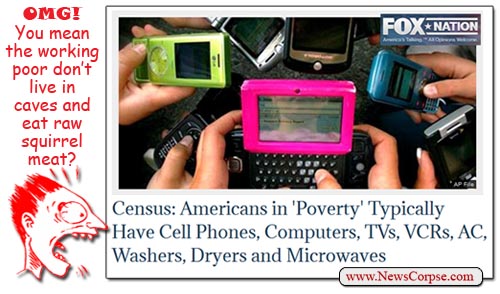
I've commented before on some of the more obvious hardships and deprivations of being poor. For example, being poor often means your family has to forego the pleasures of pet ownership. If you're poor you're more likely to be living in rental housing; landlords are more likely to restrict pet ownership when tenants are on the low end of the income scale than on the high. I've also noted that some people tend to flip out whenever they see someone who is ostensibly poor, like clients sitting in the state unemployment office or folks lined up at a food bank, using a cell phone. If we're to believe the Heritage Institute, poor people aren't really poor if they have access to a functioning refrigerator, a microwave, or air conditioning. I could go on, but I think you all get it. Name a material item -- nice clothes, a cheap cell phone, a car that actually runs, a pet rabbit, and the odds are someone on the right will pontificate about why the poor shouldn't have it.

Well, we can add another one to the zum unteren Klassen verboten list: relaxing with your family. Noted rightwing nutjob Cliven Bundy recently rambled on in a New York Times interview about how appalled he was when he drove through "the projects" in Las Vegas and saw small children just hanging out with old people (presumably their grandparents) and sitting around doing "nothing" on the front porches of their homes. Who woulda thunk that hanging out with Grandma and listening to her talk about the good old days would fall into the forbidden to poor people zone?  But apparently it does. To quote Mr. Bundy, "and in front of that government house the door was usually open and the older people and the kids — and there is always at least a half a dozen people sitting on the porch — they didn’t have nothing to do. They didn’t have nothing for their kids to do. They didn’t have nothing for their young girls to do." It's a balmy Nevada afternoon, you hang out on the front porch with the kids, and suddenly you're a symptom of everything that's wrong with America today.

We live in interesting times.

Monday, April 7, 2014

While I'm on the subject of idiots

I was wandering around Facebook recently and made the mistake of dipping into the Comments thread under the graphic shown to the right. What the Maddow quote does is state the obvious: there are structural reasons why most poor people are poor. No one is poor because they want to be; they're poor because they're stuck somewhere that's hard to escape from. That's not to say it can't be done; there are exceptional people in every strata of society.

Naturally, the usual libertarian-free-market-people-are-poor-by-choice trolls came slithering out of the woodwork. We'd all be just fine if we just got rid of those pesky government regulations that are keeping us all from becoming entrepreneurs and making a fortune operating our own small businesses. And the proverbial pigs will fly. Does it ever occur to any of those people that starting a business takes money? If you're down and out to begin with, where do you get your start up funds? Doesn't matter if there's a ton of regulations or none whatsoever; if you don't have enough money to keep gas in your car or to buy a Happy Meal at McDonald's, you're not likely to have the cash to start any business other than one involving your own underpaid labor (house cleaning, childcare, detailing cars, house painting, etc.). Even there you run into the issue of working capital. The lowest upfront investment would probably be childcare, especially if you're doing it in someone else's home. Everything else you have to buy some basic equipment. Painters need ladders, a van or truck to haul them, good quality brushes, drop cloths, etc. House cleaners need vacuum cleaners, dusters, various cleaning solutions, buckets, rubber gloves. In every case, you need reliable transportation. So where is that money to get started going to come from? And who are your customers going to be?

Those quibbles aside, do these libertarian idiots actually believe that everyone in this country could actually be an independent entrepreneur? Have any of them stepped into a typical business lately? If they had, they might have noticed that there's the owner and/or manager and there are the employees who do the actual work. The people who can run a one-man operation of any sort are rather rare. If your entrepreneurial spirit cries out for you to be the next Paula Deen, you're going to need kitchen staff, wait staff, and cleaning staff -- unless, of course, you plan to be content with a neighborhood diner with an extremely limited menu and the staff consisting of yourself and maybe your spouse or kids. You have a wonderful idea for a new type of widget? If you set up any sort of manufacturing enterprise, if it takes off you're going to need employees. Where are they supposed to come from if everyone else is also being entrepreneurial and going into business for themselves?

Of course, if a person could do a little digging and find out what's going on in the lives of the trolls who are so keen on the idea of everyone pulling themselves up by their bootstraps and going into business for themselves, it would no doubt turn out that the most vocal trolls are cubicle rats working for an hourly wage in the bowels of some mega-corporation. The libertarian fantasists might exhort the poor to take personal responsibility and become entrepreneurs, but it's not a path they ever plan to explore themselves. Why should they? It's so much easier to sit back, collect a paycheck, and waste time on the company's computer.

Saturday, December 31, 2011

Cui bono?

The S.O. did a post yesterday on drug testing politicians. His point was that from the perspective of harm reduction it would do society more good to make sure the lawmakers aren't stoned than it would to go after some poor sap applying for food stamps. That was, after all, the original argument for drug testing: harm reduction. Protect the public by keeping stoned long-haul truckers off the highways, chemically impaired pilots out of cockpits, and so on. I don't think most people have much of an objection to trying to ensure that someone flying a 747 or driving a school bus isn't high.

Of course, the rationale now for piss testing isn't to protect the public -- it's ostensibly to save taxpayer dollars by making sure lowlifes aren't swapping their food stamps (or the equivalent thereof) for doobies or meth. The folks peddling this particular brand of snake oil (criminalizing poverty and punishing the poor for being poor) always make it sound like huge savings are going to accrue to the taxpayers, which is bull. I couldn't find any recent data, but in 2006 the average welfare benefit per household in the United States was under $400 a month. Somehow I doubt that the potential savings from booting a tiny percentage of applicants out of the system is going to offset the cost of administering the tests. So the question what's the real motivation behind the push for drug testing? Cui bono? Who benefits?

Well, it's not the American public. The underlying motivation isn't austerity or saving the public money. It's to create more customers for the companies that manufacture and/or administer the drug tests. If you look at the history of drug testing -- from a few persons in sensitive jobs to company-wide or agency-wide pre-employment testing of everyone and anyone on the payroll, regardless of type of work done -- you see the sad history of products and processes in search of a market. People poor enough to qualify for welfare or unlucky enough to need to apply for unemployment compensation don't hire high dollar Washington lobbyists; the drug testing industry does.

Even more interestingly, quite a few politicians have financial interests in the testing companies. Why am I not surprised? With almost any social problem, when some politician proposes a solution, ask yourself "Who benefits?" and then follow the money. You won't have to flip over many rocks to find corruption oozing out. Classic example: Rick Scott, governor of Florida, pushed hard for drug testing people applying for welfare. Rick Scott, millionaire, had a major financial interest in the urgent care clinics that would perform that testing.

Of course, demonizing the poor and suggesting that anyone who is unlucky enough to need welfare is probably some drug-sucking lowlife also plays nicely into the right-wing's goal of keeping lower-income voters divided and marginalized, but I'm never quite sure which comes first: the political strategy or seeing a fresh opportunity for graft.

Thursday, September 29, 2011

The two-cent solution

Dealing with my fat cat's health problems reminded me again of just how lucky I am to have a decent job. I was talking with the Younger Daughter last night, and she mentioned that where she lives in rural east Texas, most of her co-workers would say the solution to Cleo's diabetes would involve a walk in the woods and cost a mere two cents. Twenty-two shells are cheap.

The lead pill cure isn't one either the Y.D. or I would consider for one of our pets unless the beast was clearly suffering and euthanasia was justified, but it occurred to me that if I wasn't working for Large Nameless Agency, Cleo's options would be much more limited. What would have happened if, after looking the cat over and doing the lab work, the veterinarian handed me the bill and I couldn't pay it?  For that matter, would I have brought her to the veterinarian at all? I knew walking in the clinic door that I was about to drop at least $100 because they were going to have to do lab work of some sort. I can see where if my budget was tighter, I would have worried about her -- why is she drinking all that water? And what's with the polyuria? -- but unless she acted a lot sicker, I would have just waited and hoped that whatever was wrong would cure itself on its own.

In short, I would have treated the cat the same way I would have treated myself back in the days when the budget was a lot tighter and I didn't have health insurance. I would have waited and worried and hoped that whatever the problem was went away on its own. People who can't afford to take care of themselves sure as heck can't afford medical care for their pets -- which is another one of those hidden costs of poverty that most of us never think about. Things that the comfortable middle class (assuming such a thing still exists) take for granted, like the ability of your kids or yourself to have pets, become unaffordable luxuries when your income drops. Not only does the companion animal itself cost money (food, various supplies like collars, leashes, litterboxes, etc.), the lower your income is, the harder it becomes to find a place to live that will allow you to have one. One of the side effects of the economy tanking and foreclosures climbing was that animal shelters became overloaded with abandoned pets as people made the disheartening discovery that when they went from being homeowners to tenants, there were no rentals available that would allow them to keep the family dog.

In the larger scheme of things, when people are worried about keeping a roof over their heads or managing to feed the family for another month, I suppose thinking about poverty being a barrier to pet ownership is rather trivial. On the other hand, considering the numerous well-known benefits, both psychological and physical, of having companion animals, it is a shame that pets are just one more thing that poor people aren't supposed to have.

Saturday, December 11, 2010

Food stamps

I mentioned food stamps in passing in the previous post, and by coincidence Slate has an interesting essay up on the program's history.  As the article notes:
Of all the numbers quantifying this recession, few can match the grim precision of 42,911,042. That's the number of Americans, mostly children and the elderly, who used food stamps in September—521,428 more than in August, itself a record month, and 12 million more than in September 2008. In the past year, according to the Department of Agriculture, every state has seen its rolls swell—with increases ranging from 5.1 percent in West Virginia to 28.7 percent in Nevada.
It's an interesting piece -- the food stamps program is apparently one of the few social safety network items that conservatives actually like.  There are still a few who rail about it encouraging dependency, but the program is well-run with low administrative costs, it serves a direct need, and (although the article doesn't mention it) corporate giants like Archer Daniel Midlands and Cargill love it because it's basically an agriculture subsidy.   

I was happy to see in the article that USDA and state goverrnments are working hard at removing the stigma surrounding the the use of food stamps.  Back when the program started, Food Stamps were paper -- funny money that came in coupon books.  It was like going grocery shopping using Monopoly money.  It was also before the advent of smart cash registers, so shoppers had to carefully separate eligible from noneligible items, let the cashier ring the eligible up first, pay with Food Stamps, and then pay for the noneligible (anything not edible, like toilet paper and soap) stuff with cash. The paper funny money made it obvious to the whole world you were using Food Stamps, and also  provided ample time and opportunity for onlookers to editorialize about your grocery choices ("I can't believe she's buying Trix* for her kids with food stamps." [just give the urchins another bowl of gruel]) and perceived lifestyle ("She should get a job instead of leeching off the taxpayers.").  

Today, thanks to the combination of computerized checkout systems and the introduction of electronic benefit transfer cards, the public stigma is minimized, which in turn makes it lot more likely that the people who need the help food stamps provide will actually apply to receive them.  It's a government program that works.

The numbers do give reason to pause and wonder just how miserable conditions in this country are becoming:  14% of the populace is using Food Stamps, but it's pretty much accepted as fact that many people who are eligible will never apply to get them.  They're intimidated by the process, they don't want to be seen as taking a handout, they don't realize they're eligible, they don't want the visible stigma of using an EBT card at the grocery store. . .  

[*Another thing the poor aren't allowed to buy:  brand names. If you're poor, you must be content with generics or store brands.]

Thursday, December 9, 2010

Let them eat cake

Just how fucking destitute do people have to be to qualify as "the deserving poor"?  I made the mistake of reading comments in the AJC not long ago, and learned that if you've got enough money to own a cell phone, you're obviously not impoverished.  Readers were outraged, absolutely outraged by images of people standing in line to apply for heating assistance while holding cell phones to their ears. 

Two words, morons:  Trac Fone. 

The reality today is that it's cheaper to own a Trac Fone than it is to have a landline.  You're a lot more limited in the number of calls you can make when you're buying your minutes in 60-minute bundles, but the upfront investment is a lot lower.  The image below is from the Trac Fone website, but I've seen them at Family Dollar for $14.95. 

But I guess even a $14.95 phone is a little too much luxury for poor folks to deserve.  Let's hope the haters never find out about Safelink or they'll really freak out.

[Over the years I've learned that other things the poor are not allowed to possess include automobiles that are not rolling death traps, digital tvs, clothing that doesn't look like it came from Goodwill, and decent shoes. They must also never ever allow any red meat other than the cheapest form of hamburger to cross their lips, they're not allowed to waste their money on soft drinks or ice cream, and god forbid they should ever use their EBT card ("food stamps") to buy potato chips.] 

Wednesday, February 11, 2009

Down and out and under the bridge

Think I've mentioned before that my walk to and from work includes crossing Peachtree Creek. The creek crossing is a four-lane bridge, sidewalks on each side, built in 1967 (if I'm remembering the date on one end correctly, with the creek itself maybe 20 feet below the span midway across. I'm not real sure just what the terrain is like immediately under the bridge, but it's become obvious that more and more people are living there. And I'm not talking camping out for a day or two -- I'm talking something that's starting to resemble the shanty towns you see in Save the Children commercials. Residents have even put up wind chimes.

I saw an estimate a few months ago that there were approximately 6,000 homeless people in the Atlanta area. I find myself wondering what the actual numbers are. There are a lot of bridges in this city, as well as abandoned buildings and other odd corners. How many squats are out there that no one knows about?

If government -- federal, state, or local -- is looking for projects to stimulate the economy, maybe some low income housing would be a good place to start.