Showing posts with label hometown history. Show all posts

Friday, February 12, 2016

I'm not into genealogy but

finding this yesterday was kind of cool.


I was at the county clerk's office to do research for the historical society. I've mentioned before people pay us to go check the various indexes for births, deaths, marriages, whatever. I had no luck whatsoever with the research request that sent me to the county administrative building, but when I asked the deputy clerk about divorce records, we started looking at the various indexes shelved in the room. She noticed the Declaration of Intention book and had no idea what it was. Neither did I. So we pulled it off the shelf and started flipping through it.

It didn't actually tell me anything I didn't already know, i.e., I knew the date when my grandfather arrived in Baraga County. It didn't come as a surprise to see evidence he was still here a year or two after he got off the train in Summit. At this point in time he was probably still working for his uncle, although at some point he decided to go up to the Copper Country and get a mining job instead.

One thing that did intrigue me was the existence of the form itself. Wherever the Declaration of Intention fell in the bureaucratic scheme of things, it wasn't used very long. The book they're in is the usual humongous volume that's a couple inches thick. The forms start sometime in the early 1900s (I did not look to see when the first one is dated) and go up to about 1905 and that's it. It's a huge book, but less than one-fourth of the forms got used. The deputy clerk and I were speculating (and laughing) about the verbiage on the form. It basically asks resident foreigners to declare that they're not anarchists. I have a hunch this was part of the U.S. Congress's reaction to Leon Czolgosz's assassination of William McKinley in 1901. In any case, we agreed that asking anarchists to swear that they're not would be about as useful as asking members of Al Qaeda to say they were radical terrorists if they happen to try coming into the country. If your intentions are evil, you're certainly not going to be honest about it when you're asked to complete some paperwork. It appears going through the motions, making it look like you're trying to do something even when it's obvious it won't work, has a long tradition in politics.

As for divorces, it turns out there is no index. You need to have a good idea of the date and then just start working your way through them, something I had no interest in doing yesterday. Maybe next week.

A slight digression: I'm never sure if I should be grateful or unhappy that the former historical society president set a firm precedent with the clerk's office of allowing us (the historical society/museum) serve as a proxy for people wanting genealogical information. Under Michigan law, the only index I should be allowed to search is the death index; marriage and birth are both restricted to family members. Thanks to Jim, however, we're able to continue doing the type of research he did for years. There are days (like yesterday) when it's fun to do the work, and other days when I'm totally convinced we need to make our fees much, much higher. And for sure there are days when I silently wish the County Clerk would tell me we can't do it anymore.

And another slight digression: Once again I was blown away by how perfect Martin Voetsch's handwriting was. Of all the county clerks, I think he wrote the best cursive. A couple of his successors also had great handwriting, but he's the only one who wrote in more of a copperplate style than Palmer penmanship. (This is the type of minutiae a person ends up focusing on when they're stuck doing research for money on topics that don't really interest them.)

Friday, February 6, 2015

Another of life's little mysteries

Just how many old railroad ties are there?

Yesterday the S.O. and I happened to be heading home just as the CN freight train decided to start backing up from a railroad crossing. You can't see it in the photo, but the exposed rail stops before it actually gets to the crossing -- the train had gotten that far in heading down the hill to L'Anse before the engineer decided for some reason to throw it into reverse. Did he suddenly remember he'd forgotten to pick up his mandatory four empty cars at Nestoria and decided to back up to get them? Maybe he noticed brake pressure wasn't what it should be and decided to back up to Summit Siding to drop off a few loaded cars?

But why he decided to start back up isn't what intrigues me in looking at the photo. It's all those gondolas. He's heading downhill so that means every one of those cars is loaded with old railroad ties. He's hauling them to the J. H. Warden Generating Station in L'Anse. The powerplant converted to burning biomass a few years ago. Ever since then, it's been receiving gondolas full of old railroad ties that get shredded and burnt. The Warden plant also burns a lot of raw wood chips, which is what I think most people assumed would be its primary fuel source when the plant went through the conversion process. You know, when someone says "biomass" you don't anticipate getting to live with the smell of burning creosote.

Anyway, when a friend who lives in town was complaining about the plant's odor problems a year or two ago, I made comforting noises and said, "Don't worry. Sooner or later they'll run out of old railroad ties." Now I'm beginning to wonder. We see these long, long trains heading down the hill full of old railroad ties on an almost daily basis. The woodyard for the Warden plant has mountains of them. And they keep coming. Just how endless is the supply? It's a mystery.

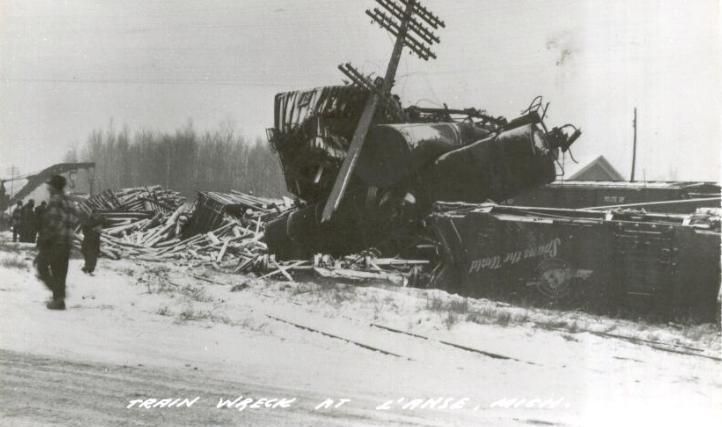
As for the mandatory four empty cars, they're to supply more braking power. It's a continuous grade from Summit down to L'Anse, including the section in the photo -- it looks flat, but it's not. It's sloping. And not much farther along, it slopes a lot more, up to 3.5 percent, which is pretty steep for a railroad grade. The train is actually sitting right about at the point where 50-some years ago another freight, one that was going uphill, ran out of power, couldn't get the brakes to hold, and started rolling backwards. End result?

Wednesday, July 2, 2014

Story telling: ghost trains of Baraga County?

The local state park reached out to the museum recently with a request for a speaker for their Friday evening program series. Our original intention was to say No, that none of us were really up to it, but somehow, when I stopped by the park to tell them that in person, it turned into a Yes. I really need to learn how to say No more with conviction.

In any case, I looked over the topics other people were scheduled to cover and decided that the history of railroads in Baraga County would be a good one. There is another historian speaking this summer, but she's from the sawmill museum in Alberta so odds are her topic is going to be Henry Ford and logging. Logging is normally my topic, but railroads will do, especially when I can so easily slide over the line from straight forward history to speculating about paranormal phenomena, ghost trains, and mysterious noises in the night. The CN railroad tracks run right behind the park, although there's rarely any traffic on them (they dead end about a mile farther north in the Baraga Industrial Park), so it makes perfect sense to talk about railroading. As for ghost stories, isn't that what every kid wants to hear when camping?

There have been some spectacular derailments -- a number of trains had problems with the long grade down to L'Anse. For a railroad, the grade is steep, it's continuous for about 7 miles, and it ends with a sharp curve just before the Falls River. There have been multiple derailments on or close to that curve. In one case, the derailed train smashed into the L'Anse depot. In another incident, there were multiple fatalities. There's a lot of potential drama without having to indulge in any embellishments.

On the other hand, speculating about ghostly train whistles at midnight does sound a tad more interesting than simply telling people that it used to be possible to take a passenger train all the way to the tip of the Keweenaw Peninsula. Having done straight forward history for so long, it is really tempting to go wandering down the supernatural path for a change. Michigan Tech students managed (or have almost managed) to eliminate the ghost stories explaining the Paulding Light; maybe it's time for a dead fireman to start haunting L'Anse. I've got over a month to put the talk together -- it'll be interesting to see just how much embroidery I do when the time comes.

Friday, March 7, 2014

Anyone know any corrupt election board officials?

I have a voting machine I need to break into.

First, though, I need to clean off a remarkably thick layer of diesel oil smut. The machine was donated to the museum yesterday. It came, if I've got the provenance straight, from L'Anse Township, although I could be wrong. It could also have been the Village. I need to do a little more research before formally accessioning it.

In any case, it's been stored for quite a few years in the same building the local tourist and recreation association uses for housing the snowmobile trail groomer. It's been exposed to a lot of diesel fumes. When the guys first wheeled it in yesterday, I thought it was black. After I started cleaning the device I discovered it's actually a pale gray color on the top part and a darker color on the bottom. The black was just built-up diesel smoke. I stopped cleaning after going through half a roll of paper towels -- I'll bring in a bag of rags from home to finish it rather than burn through our paper towel allotment for the year. As far as I can tell, the machine has been closed up tight enough that there isn't too much dirt on the inside, but so far all I've been able to see is a compartment at the top in the back. That part doesn't lock; it flips open so you can get at the storage space for the crank that raises and lowers the machine.

I cranked it up to confirm that the main lock, the one on the front, was indeed locked. It was. So are the other locks. It's still got the seal on it from the last time it was used in an election, which is kind of neat. It's also kind of a nuisance. The key to the machine and the machine itself apparently parted company over a decade ago. I'm not sure when L'Anse Township switched to using optical scan machines, but I have a vague memory of using one in 2000. We either need to track down a locksmith (aka spend real money) or drill the locks out. I'd rather not destroy the locks if we can avoid it.

I did email the township clerk to ask if he had any keys kicking around the Township Hall that might fit the machine, but that's a really long shot. I'm willing to bet when I get a response email from him, the answer is going to be No.

Once the machine is clean and the snow is gone so we can actually get at our storage building, that's where the machine will go to gather dust for two years. When 2016 rolls around, though, it's going to be a star player in an exhibit on voting, voting rights, and politics. Maybe we'll even dress one our mannequins to match the picture shown above. For now, though, I just want to get it cleaned up, documented, and make sure the curtains don't need repairs.

This donation is, incidentally, one of the fun things about volunteering at a museum. You never know just what's going to come rolling through the front door.

Sunday, June 9, 2013

Seeing this felt good

Back a few years ago, in about 2000, I got asked to serve as a local historical society's representative to a county-wide committee to work on a project that the Tourist and Recreation Association had thought up. The plan was to publicize some of the county's cultural and historical attractions. It was an interesting experience. Our county has about a dozen small groups devoted to various preservation or cultural efforts, most of which focus on just one thing, e.g., preserving a one room schoolhouse, and a few with broader goals. The representatives to the committee were a mixed lot. People definitely are strange. There were some folks who seemed to think historical knowledge is a private good and weren't real keen on sharing -- an odd attitude, to say the least. If you believe the history is important enough to form a local historical society to preserve it, shouldn't you also want to make sure as many people as possible have a chance to learn it?

Overall, though, we managed to reach some consensus and came up with a list of possible sites to include on a map. With help from the Copper Country Council for the Arts, the group put together a grant application that succeeded in getting a decent amount of funding from the Michigan Council for Arts and Cultural Affairs. It wasn't a huge amount, but, along with a few bucks kicked in by each of the participating local groups, it was enough to help pay for an individual sign to be posted at each site and for three large signs to be erected at each of the highway rest areas (Tioga Falls, Canyon Falls, and near the community of Keweenaw Bay) that tourists are likely to stop at. It's been about twelve years since this sign went up at Canyon Falls. There's some minor wear and tear, but overall it's still looking good. So are the signs at each of the heritage sites. It is remarkably satisfying to look at the end product of something designed by a committee and realize that it actually was worth doing.

The hardest part of this project, incidentally, wasn't getting a dozen people to agree on which sites should be prioritized and it wasn't finding the funding. It was getting the Michigan Department of Transportation to agree to the signage at the rest areas. If it's not their idea, they don't want it there.

If anyone feels like stalking us, the S.O. and I live fairly close to the number 7 on the map.

Saturday, June 8, 2013

Canyon Falls Roadside Park

Highway rest areas aren't usually noted for their hiking opportunities, but the Upper Peninsula has several that feature more than the typical Romtec restrooms and a handicap accessible picnic table or two. Canyon Falls is one of those places.

Canyon Falls on the Sturgeon River
The trail from the parking lot isn't a long one -- maybe half a mile in to where it officially ends and you get to backtrack -- but it's a nice little walk through mixed hardwood forest. There are boardwalks over the boggy areas and a bridge over a small creek. There are some uneven areas (moderately rocky terrain, some protruding roots), but overall it would get an Easy in any hiking guide. It is not handicap accessible, but it comes close. Back when I was a Girl Scout Leader, this was one of the hikes we did when the kids were working on outdoor badges. 
The S.O. leading the way. 
The trail officially terminates at an overlook of the falls. It used to go a little farther from the parking area -- up and over the rock outcrop shown below -- but I'm guessing lack of maintenance money led to the state deciding to cut it short. The information sign in the parking lot is unintentionally funny: rather than making a whole new sign to show the abbreviated trail, the state elected to cut a piece of wood in a shape that fits neatly over where the trail used to go and then painted it to match the existing sign. 
Old trail that continues past official end of trail
You can't really tell in the photo by there were some decaying wooden hand rails to the side of the old trail. The fact the Canyon Falls trail terminates at the overlook, however, doesn't mean that's where a person has to stop. The blue blaze on the tree in the upper left of the photo screams North Country Trail loud and clear. How much of the North Country Trail is complete in this section is a mystery: official Trail maps show it as being in pieces, but I know there are segments that are totally done right down to having Adirondack shelters in place, that are not shown on the website. 
Sturgeon River upstream of the actual falls
We were not out to do a major hike, just enjoying a short break on the drive home, so we did not venture very far past when the end of trail sign was posted. We did, however, diverge from the current marked path a little on our way back to the parking lot. The state redid the rest area a few years ago and in the process moved the trail head. We followed what had been the old trail over toward the highway bridge. 
Old trail head; Canyon Falls has been a roadside park since the 1920s; I'm not sure when this sign dates from
The bridge is nifty one, a lovely Moderne design, and is an engineering landmark. Construction began in 1947, it was complete in 1948. It's significant for its design, steel arch bridges are rare in Michigan, and was listed on the National Register of Historic Places in 1999. The main span is 128 feet from pin to pin. It is a gorgeous bridge; MDOT really needs to do a book on a stick to brag about it a little.
Canyon Falls bridge on US 41
A snowmobile trail goes under the bridge (note wooden guard rail at the left side of photo); so do the blaze marks for the North Country Trail. I never really thought much about where the snowmobile trails run in this county, although I guess it makes sense to have some overlap between the hiking trail and the snowmobile/ORV trail in some places. Among other things, the snowmobile trail already has bridges over various creeks and rivers. We were tempted to walk farther along the snowmobile trail, if only to see just how far it paralleled the river, but we weren't prepared for an actual hike. We'd stopped to amble, not to hike, so that's what we did, ambled back to the car while admiring the wild flowers. 
Cowslips blooming next to Bacco Creek

Jack-in-the-Pulpits

Yellow violets
Update: Saw a notice in the local paper that the local North Country trail group has a guided hike planned along a section of the trail from over by the old prison camp on the Baraga Plains to Canyon Falls so it appears my assumption about the meaning of the blue blazes was dead on. They give a rough estimate of 3 to 4 miles for the distance that will be hiked. 

Monday, March 12, 2012

A trip down memory lane

". . . there must have been at least two hundred girls active along Silver Street simultaneously, and perhaps many more. There were a lot of miners, and a girl can only do so much." -- J. B. Martin, Call It North Country, 1944.
This is the town where I graduated from high school. One of my first real jobs was as a waitress at the Club Carnival (on the right in the photo). It was an interesting place to work. The building was designed like a lot of supper clubs, restaurant on one side, lounge on the other. The stage wasn't visible from the restaurant side, but we could hear the music. As a minor, I wasn't supposed to ever step into the lounge side, but of course managed to satisfy my curiosity eventually. Back then, it was old-fashioned Gypsy Rose Lee style burlesque -- lots of sequins and feathers and g-strings and pasties that covered more than some bathing suits do today.

Most of that side of the street is now vacant lot -- lots of mysterious* fires happened after the mines closed but before winter tourism (skiing and snowmobiling) became popular. Business was already dying when I worked at the Club Carnival -- most nights the restaurant had barely enough customers to justify staying open, and the lounge would be practically empty. There was definitely something very sad about a dancer having to get up on a stage and do a strip tease for an audience that could have fit into a phone booth.

For awhile after the night life on Silver Street faded the locals weren't too happy about the lingering association between Hurley and vice, but at some point someone realized that, although the hookers were gone, there was still money to be made off their memory. The Chamber of Commerce now brags about Chicago gangsters having frequented the saloons, and cheerfully describes the city as "long known for gambling and prostitution."

[*although the only real mystery in most cases was how the fire marshal avoided smelling the accelerant or tripping over the gas cans.]