 |
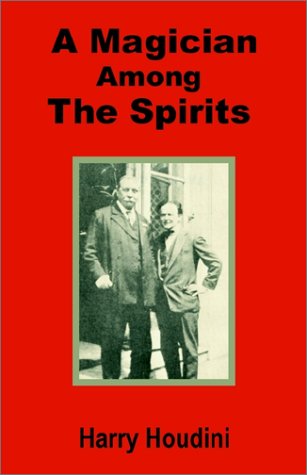
| Sir Arthur Conan Doyle on the left, Harry Houdini on the right. |
In A Magician Among the Spirits Houdini details the history of spiritualism in the United States and elsewhere. The first well-known mediums to become a public sensation were the Fox sisters, two little girls from New York who in the 1840s began playing tricks on their mother. They managed to convince her their house was haunted. Pretty soon the neighbors also believed that the girls could communicate with the ghost. No doubt the dim lighting (candles, oil lamps) common in homes at the time made it easy for the girls to get away with their pranks. They created rapping noises by using an apple tied to a string; later they figured out how to make rapping noises with their feet. The girls' oldest sister decided there was money to be made from people who wanted to believe in spirits and communication with the dead; she took charge of the girls' career and toured the country with them. Both sisters eventually confessed to having committed fraud, but only after decades of conning a gullible public.They described how they had trained themselves to make rapping noises using their toes after they began holding seances in places that were too well-lighted to allow them to use the same tricks they had used on their parents.
The American Civil War gave a tremendous boost to spiritualism, both as a belief system and as a lucrative career. The death toll during the war was staggering; grieving parents and widows were desperate for a chance to communicate with their deceased loved ones. Spiritualists and mediums quickly learned to adapt new technology to their trade: some spiritualists became adept at creating "spirit photographs" using the simple technique of double exposure. Others invented electrical devices to create the various noises associated with communicating with the spirits. Houdini describes one battery-operated device that was fitted into the heel of a woman's shoe; the wires ran up the medium's leg and the long, full skirts with the multiple petticoats in vogue at the time ensured that the device remained undetected.
Houdini made an intense investigation of spiritualism because he hoped that the basic premise -- communication with the dead -- was possible. He describes himself as having been devastated when his mother died; he kept hoping for evidence of true communication with her, but of course never found it. Numerous spiritualists would claim that her spirit was present, but none ever produced any evidence that Houdini found credible. His thought processes were simply too logical to accept the "proof" the mediums offered. Among other things, his mother never spoke a word of English -- she was a Hungarian immigrant -- yet the communications from beyond were always in English. The spiritualists explained that in the spirit world, people learned things they hadn't known here. Houdini naturally thought that was ridiculous.
Still, although Houdini remained skeptical his entire life, he did sympathize with the victims of spiritualism. He understood why they were so anxious to believe what they were hearing. He was good friends with Sir Arthur Conan Doyle, who was a fervent believer in spiritualism, although they were often in complete opposition on the issue. Doyle kept hoping to convince Houdini of the validity of spiritualism; Houdini kept hoping his good friend Doyle would see through the charlatans.
What Houdini had absolute scorn for were the spiritualists who preyed upon grief-stricken widows and bereaved parents. He cooperated with numerous investigations of fraudulent mediums and, along with other magicians, was able to expose a number of con artists. He was able to show that many of the supposedly inexplicable results achieved by mediums were easily duplicated by anyone who was shown the proper techniques. Table raisings, for example, were accomplished through a combination of using one foot under the leg of a table and a special belt with a stiff metal rod concealed in it. Other results were achieved through the power of suggestion.
Houdini also noted that skilled mediums were adept at fishing: they would learn enough in conversation with a client to be able to say something that led to the client spilling more information that the medium could build on. If there was enough money on the line, mediums were known to have engaged in active snooping: reading mail, planting a spy in a household (e.g., having an accomplice take a position as a housemaid or other servant), and bribing hotel staff. Houdini describes several mediums who actually paid burglars to break into clients' homes to obtain personal correspondence and other documents that the medium would carefully study and then have the burglars return. When spiritualism was at its height, there were numerous cases of wealthy clients being fleeced for hundreds of thousands of dollars. Not surprisingly, many of the victims of these cons by unscrupulous mediums refused to believe the spiritualists had lied to them.
One thing that did baffle Houdini was why so many people persisted in wanting a magical or supernatural explanation for what were purely physical and easily explainable phenomena. Over and over Houdini and other magicians would find their work, which they described honestly as sleight of hand or illusion accomplished through various tricks, described by others as actual magic. Houdini specialized as an escape artist. He worked hard at perfecting techniques for escaping from handcuffs, straight jackets, and other restraints and had various devices built to his specifications that he would use for his performances. Rather than admit that Houdini was simply extremely skilled at what he did, many of the advocates of spiritualism would claim that Houdini had actually dematerialized and transported himself outside whatever restraints or container he had been in. Today, of course, when people see someone like David Blaine or Criss Angel perform the typical reaction is "wow, cool trick. I wonder how he did that?" We don't think Criss Angel has supernatural powers when he performs an illusion like walking on water; we just think he's really good at what he does. It must have been incredibly frustrating for Houdini to have the people who believed in spiritualism touting Houdini's illusions and escapes as examples of the spirit world at work. He'd spend many months or even years perfecting a trick only to have the spiritualists dismissing his hard work as simply being his ability to teleport himself.
What struck me as I read that chapter was that the spiritualists' insistence that Houdini had supernatural powers was a classic example of the human tendency to insist on a complicated or unrealistic explanation when a simple truth exists. For some strange reason, we humans want life to be messier than it actually is. It's not enough that there be an explanation for something; it has to be a complicated or improbable explanation rather than a simple one. And then when something is debunked, we don't want it to stay debunked.
Here in the western Upper Peninsula for quite a few years people were intrigued, some might say fascinated, by a phenomenon known as the Paulding Light. Paulding is a tiny community located on US-45 between Watersmeet and Bruce Crossing. The Paulding Light was a mysterious light that could be seen through the woods when a person stood in a certain location. I personally never made the pilgrimage to Paulding after dark even though it's not that far from where we live (about an hour's drive), but both of our kids did at some point in the 1990s. I think one saw the light; the other just complained about mosquito bites and boredom. Local stores sold tee-shirts and other souvenirs touting the Paulding Light, and one of those ridiculous ghost hunter type shows actually came and filmed a segment on the light. There were various explanations as to why the light existed. I vaguely recall some odd story about a train and brakeman and a tragic accident, and no doubt I'd find a few other anecdotes if I bothered to Google Paulding Light.
This went on for years, people coming to the Paulding area in hopes of seeing the light. Then those damned logical engineering students at Michigan Tech decided to check it out. They did a controlled experiment and proved pretty quickly that the mysterious, ghostly Paulding light was nothing more than car lights on the highway. They went to the observation spot where people claimed to have seen the light, they saw a light, they got out a telescope, and it was obviously car lights. They were even able to locate the exact spot where the lights originated: there was an Adopt A Highway sign visible. Since then, other people have been able to confirm that, yep, car lights. No doubt if US-45 was a busier highway the explanation would have emerged much sooner because people would have seen more lights closer together long before the Tech students set up their telescope. Not surprisingly, once the car lights explanation became widely known, other people visiting the site quickly agreed that yes, the light is obviously a light from a vehicle.
At least that's what most people say. Having been provided with an explanation, suddenly most people no longer see a railroad lantern being held by a dead brakeman but instead see tail lights on a Ford truck. There are still a few die hard would-be spiritualists, however, who keep right on insisting the light is a paranormal phenomenon. They still see a ghostly trainman.
People are strange.
Or, to put it another way, the stupid, it burns.


