Showing posts with label vietnam. Show all posts

Sunday, December 2, 2018

An urban legend that refuses to die

Encountered another person on Facebook who's confused his life with that of a fictional character. In the 1982 film "First Blood" Sylvester Stallone's character, John Rambo, is a Vietnam war vet who does a rant about being spit on by "maggots" at the airport. The character of Rambo has been singled out to serve as a target for police brutality, apparently because he appears to be a harmless drifter, another down on his luck loser so the local cops can beat the crap out of him and no one will care. His rant encapsulates all the frustrations he felt as someone who should have been treated like a hero but instead was unappreciated, ignored, and insulted. It was an epic rant that apparently resonated with quite a few movie goers. It's been over 35 years and there are still dudes channeling John Rambo and confusing the abuse he suffered in the movie -- greeted by organized protesters who spit on him instead of showering him with vacuous platitudes ("thank you for your service") -- with their own lives.

Historians and folklorists alike have studied the "military personnel getting spit on" question for close to 30 years now, and guess what? Prior to that first Rambo movie there were no reports. Following the movie? By the end of the '80s it had become common knowledge that members of the military were spit on when they returned from Vietnam. The researchers who have studied this phenomenon have never been able to find a single verifiable incident -- it's always "it happened to a friend of a friend." You know what you call something that's attributed to a friend of a friend? If you're kind, it's an urban legend. Or, if you're me, you just call it bullshit.

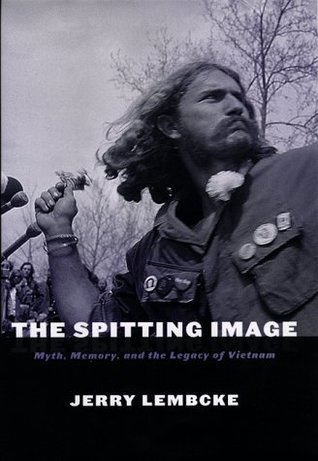
The author of the book shown, incidentally, interviewed hundreds of people who initially claimed to have personal knowledge of spitting happening but in the end there was no corroborating evidence (e.g., news reports in print or on television) and it turned out the person making the claim was actually repeating "a friend of a friend" story.

Actually, some of the stories that get cited as "evidence" by the people who swear the spitting happened are so totally bizarre that it's amazing anyone believes them. One story, for example, claims that when service members arrived in Los Angeles, they'd duck into restrooms to change into civilian clothes to avoid being abused by the public. So many uniforms were removed and discarded that trash cans were overflowing with jettisoned Class A uniforms. WTF? If these service members were still in the military and were en route to a new duty station, they were going to need those uniforms. If they'd already been discharged and were heading home, they would have been in civilian clothes. If they were still in the military, sooner or later they'd need their Class A uniform, the one with the most expensive pieces, for some occasion. On the pitiful pay personnel got back then, no one still in the military was ever going to throw a uniform away because they'd have to pay real money to replace the various pieces. Classic sign of an urban legend: it contradicts common sense.

(Side note/minor digression: the uniform story reminds me a lot of the anti-Jane Fonda story about her betraying POWs by getting them to tell her their names and service numbers and then passing that info on to the North Vietnamese. Whatever moron thought that one up apparently forgot that when the POWs were captured they (a) were wearing dog tags with name and serial number, and (b) the one thing every person in the military is told is that when they're captured the only thing they're supposed to tell the enemy is their name, rank, and serial number. Fonda did ask guys their names but it was so she could let their families know she'd seen them and they were okay. She also carried letters from POWs back to the States to mail for them.) 

Anyway, I can understand Vietnam era veterans feeling neglected and mistreated, but it was not by the general public. The people they should be pissed at are the paper pushers in the Veterans Administration who refused for decades to acknowledge the harmful effects of Agent Orange, who dithered about recognizing and treating PTSD, and who put up roadblocks to almost every disability claim. Nothing new about that, of course. Veterans have been getting screwed over by an ungrateful government since the country was founded. 

The same person who's channeling John Rambo also made the claim that during the 1970's service members were told not to wear their uniforms while traveling because of the low opinion the public had of the military. Again, bullshit. For a brief time members were indeed told not to wear their uniform while traveling on civilian aircraft but it was not because of any anti-military sentiment on the part of the general public. The '70s witnessed record numbers of hijackings; service members were advised not to travel in uniform so they'd blend in with the other passengers. Arriving in Cuba in a U.S. Army uniform would not have been cool. However, as a general rule, including during most of the Vietnam conflict, if the military paid for the plane ticket, you had to be in uniform. The government was (and still is) notoriously cheap so when you flew on a civilian plane, you flew stand-by. If you weren't in uniform, the gate agent stuck you at the bottom of the stand-by list. In uniform you were at the top.

I do feel obligated (as usual) to note that way too many of the people who tend to do the super patriotic thank you for service garbage are the same ones who never had the time or desire to serve themselves and who freak out at the suggestion that maybe their high school age kids think about enlisting. I'm still wishing I could have somehow preserved the horrified look on a supervisor's face in Omaha when I responded to his lament about his no-clear-goals adolescent by saying, "Well, what about the military?" You'd have thought I'd said, "Hey, Don, how about if your kid tries prostitution for awhile?" So please don't thank me for my service (I'm Vietnam era) and I promise I won't call you out as an elitist classist ass who thinks getting shot at by the Taliban is a chore reserved for the low-income kids from the sketchy neighborhoods.

Sunday, April 13, 2014

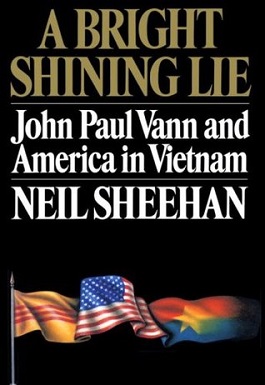
Book Review: A Bright Shining Lie

I seem to have a knack for pulling books off the library's shelves that are guaranteed to depress the hell out of me. Neil Sheehan's A Bright Shining Lie: John Paul Vann and America in Vietnam was another one. The book provides a thorough explication of just how stunningly stupid the policy-makers in Washington, D.C., can be, especially when they're relying on "intelligence" provided by the Central Intelligence Agency. Of course, it doesn't help when the people in power have a vision of the United States and its place in the world that does not match up with reality.

The author, Neil Sheehan, was the New York Times reporter who broke the Pentagon Papers story. He spent several years in Vietnam, first working for UPI and later for the Times. He witnessed the initial troop build-ups and saw firsthand the disconnect between what was happening on the ground and what the policy wonks back in the Pentagon and the State Department believed. He met Lt. Col. John Paul Vann in 1962, about the same time both men arrived in the country, and came to admire Vann for his skills and dedication.

This is an interesting book in many ways. I think it would have been a very different book had Sheehan been able to complete it when he first got interested in the project. When the book was originally conceived, around the time John Paul Vann died in a helicopter crash in 1972, it probably began as a far more hagiographic work than it turned out to be. At the time of Vann’s death, he was viewed by many as being one of the few U.S. military men who actually knew what he was doing in Vietnam. Vann had tried to get through to people in power right up to the level of President Kennedy that the U.S. could never win in Vietnam if it continued with the policies it had in place. Vann had even apparently sacrificed his military career because he believed so strongly that the policies were misguided and wasting American and Vietnamese lives. Having tried and failed to get the Pentagon to see that they were being fed bad intelligence from the field, he retired from the Army after a 20-year career.

Within a few years, Vann was back in Vietnam working for the Agency for International Development advising local officials on pacification efforts, which included everything from building schools to coordinating military attacks against the Viet Minh insurgents, or, as Americans preferred to call them, the Viet Cong. When Vann returned, he discovered that everything he had warned about in 1962 – the flow of weapons from the local militia to the guerillas, the corruption of Vietnamese officials, the stupidity of the strategic hamlets program – had gotten a lot worse. The more American troops that the U.S. poured into the country, the stronger the Viet Cong became. Vann did his best with what he had, but it was a hopeless task. Sheehan makes it clear that the U.S. commander for Vietnam, William Westmoreland, was an idiot, a man who had been promoted way above his level of competency and had no intention of ever wavering from his plan to wear down North Vietnam through attrition. In reality, North Vietnam was wearing down the U.S. Vann didn’t live to see the end of the war, which was probably a kindness. By the time he died, he had succumbed to the same fantasies that drove the other Americans. He had settled on a pacification policy he was convinced would work and refused to admit that it would never be implemented.

If Sheehan had written the entire book right after Vann died, I’m not sure he would have included Vann himself as one of the bright shining lies that comprise the American experience in Vietnam. As it was, Sheehan was seriously injured in an automobile accident in 1974. Sheehan’s long recuperation from the accident delayed work on A Bright Shining Lie but may have also provided more time for him to reflect on Vann’s complicated life and its many contradictions. For a man who valued honesty in intelligence gathering, analysis, and policy formation, when it came to his personal life Vann was a consummate liar. He also had a remarkably strong self-destructive streak.

Some of the less savory facts about John Paul Vann, Vietnam war hero, were actually well-known long before he died. He openly bragged about his womanizing while in Vietnam. Although he had a wife back in Colorado, he kept two Vietnamese mistresses, both of whom were considerably younger than he was. In addition to the mistresses, he had numerous casual sexual encounters with women on trips to Saigon. Today he’d probably be labeled a sex addict; in the 1960s his friends and acquaintances simply marveled at his stamina.

What Sheehan apparently did not know about Vann when he first began researching the book included the fact that many of the anecdotes Vann told about himself were actually borrowed from other people’s lives. Vann told a story about learning from an experience in Korea, for example, that had actually happened to another officer. Vann had served with distinction in Korea, but what he actually did there and what he said he did there turned out to be very different. Sheehan also did not know that many of Vann’s actions in Vietnam that appeared to be grounded in moral outrage or strong principles were simply stage dressing for Vann’s departure from the Army. While he was being held up by many as example of someone who was willing to speak truth to power at the risk of being pushed into retirement, Vann already knew he’d be retiring after he returned to the U.S.

Vann had reached the point in his career where he either had to be promoted or retire. He knew that the promotion board would have access to his full personnel jacket and would discover a morals charge against him. There was no way he’d ever be given a general’s star when he’d come close to going to prison for the statutory rape of a 15-year-old babysitter, a charge which he managed to escape by training himself to beat the polygraph test (he learned he could lie most effectively when sleep-deprived). However, if he was perceived as a contrarian, someone who would not go along just to get along, he’d be encouraged to leave instead of being asked to proceed to the next step up the career ladder. He wouldn't have to experience the humiliation of being turned down by a promotion board. Before going to Vietnam, he had already reached out to defense contractors about possible employment when he retired. His criticisms about the way the war was being handled were accurate, but whether or not he would have been quite as vocal or as tactless if he thought he had something to lose is debatable.   

Conclusions about the book? It won the 1989 Pulitzer for Nonfiction for a reason. It was meticulously researched, is quite readable, and is unremittingly depressing. It provides a plethora of details about a war we all know now was a colossal error conducted using tactics that made it unwinnable. Does anyone really need more proof that Westmoreland was an absolute ass or that the military has a bad habit of rewarding incompetent officers with commendations and promotions?

I had a few minor quibbles, of course. Sheehan mentions a Foreign Service officer, Douglas Ramsey, who was captured by the Viet Cong in January 1966. At several points, he refers to the conditions of Ramsey’s captivity but then just leaves the reader hanging as to what happened in the end. There’s no mention of when or why Ramsey was finally released. He also mentions Vann’s last minute concern that his younger mistress and his illegitimate daughter be recognized as his heirs, but then doesn’t tell us what happened to them. He obviously knew because he includes interviews with both mistresses in the sources listed for the chapters where they’re mentioned.

Would I recommend the book to other readers? Yes, if you’re interested in military history, the Vietnam War, or still more proof that the U.S. should learn to mind its own business and avoid foreign entanglements. No, if you’d prefer to remain cheerfully oblivious to the fact that more things change, the more they stay the same.