Showing posts with label military history. Show all posts

Sunday, December 2, 2018

An urban legend that refuses to die

Encountered another person on Facebook who's confused his life with that of a fictional character. In the 1982 film "First Blood" Sylvester Stallone's character, John Rambo, is a Vietnam war vet who does a rant about being spit on by "maggots" at the airport. The character of Rambo has been singled out to serve as a target for police brutality, apparently because he appears to be a harmless drifter, another down on his luck loser so the local cops can beat the crap out of him and no one will care. His rant encapsulates all the frustrations he felt as someone who should have been treated like a hero but instead was unappreciated, ignored, and insulted. It was an epic rant that apparently resonated with quite a few movie goers. It's been over 35 years and there are still dudes channeling John Rambo and confusing the abuse he suffered in the movie -- greeted by organized protesters who spit on him instead of showering him with vacuous platitudes ("thank you for your service") -- with their own lives.

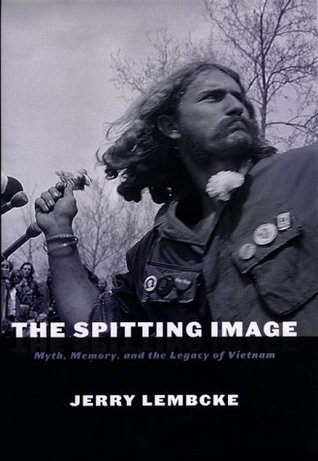
Historians and folklorists alike have studied the "military personnel getting spit on" question for close to 30 years now, and guess what? Prior to that first Rambo movie there were no reports. Following the movie? By the end of the '80s it had become common knowledge that members of the military were spit on when they returned from Vietnam. The researchers who have studied this phenomenon have never been able to find a single verifiable incident -- it's always "it happened to a friend of a friend." You know what you call something that's attributed to a friend of a friend? If you're kind, it's an urban legend. Or, if you're me, you just call it bullshit.

The author of the book shown, incidentally, interviewed hundreds of people who initially claimed to have personal knowledge of spitting happening but in the end there was no corroborating evidence (e.g., news reports in print or on television) and it turned out the person making the claim was actually repeating "a friend of a friend" story.

Actually, some of the stories that get cited as "evidence" by the people who swear the spitting happened are so totally bizarre that it's amazing anyone believes them. One story, for example, claims that when service members arrived in Los Angeles, they'd duck into restrooms to change into civilian clothes to avoid being abused by the public. So many uniforms were removed and discarded that trash cans were overflowing with jettisoned Class A uniforms. WTF? If these service members were still in the military and were en route to a new duty station, they were going to need those uniforms. If they'd already been discharged and were heading home, they would have been in civilian clothes. If they were still in the military, sooner or later they'd need their Class A uniform, the one with the most expensive pieces, for some occasion. On the pitiful pay personnel got back then, no one still in the military was ever going to throw a uniform away because they'd have to pay real money to replace the various pieces. Classic sign of an urban legend: it contradicts common sense.

(Side note/minor digression: the uniform story reminds me a lot of the anti-Jane Fonda story about her betraying POWs by getting them to tell her their names and service numbers and then passing that info on to the North Vietnamese. Whatever moron thought that one up apparently forgot that when the POWs were captured they (a) were wearing dog tags with name and serial number, and (b) the one thing every person in the military is told is that when they're captured the only thing they're supposed to tell the enemy is their name, rank, and serial number. Fonda did ask guys their names but it was so she could let their families know she'd seen them and they were okay. She also carried letters from POWs back to the States to mail for them.) 

Anyway, I can understand Vietnam era veterans feeling neglected and mistreated, but it was not by the general public. The people they should be pissed at are the paper pushers in the Veterans Administration who refused for decades to acknowledge the harmful effects of Agent Orange, who dithered about recognizing and treating PTSD, and who put up roadblocks to almost every disability claim. Nothing new about that, of course. Veterans have been getting screwed over by an ungrateful government since the country was founded. 

The same person who's channeling John Rambo also made the claim that during the 1970's service members were told not to wear their uniforms while traveling because of the low opinion the public had of the military. Again, bullshit. For a brief time members were indeed told not to wear their uniform while traveling on civilian aircraft but it was not because of any anti-military sentiment on the part of the general public. The '70s witnessed record numbers of hijackings; service members were advised not to travel in uniform so they'd blend in with the other passengers. Arriving in Cuba in a U.S. Army uniform would not have been cool. However, as a general rule, including during most of the Vietnam conflict, if the military paid for the plane ticket, you had to be in uniform. The government was (and still is) notoriously cheap so when you flew on a civilian plane, you flew stand-by. If you weren't in uniform, the gate agent stuck you at the bottom of the stand-by list. In uniform you were at the top.

I do feel obligated (as usual) to note that way too many of the people who tend to do the super patriotic thank you for service garbage are the same ones who never had the time or desire to serve themselves and who freak out at the suggestion that maybe their high school age kids think about enlisting. I'm still wishing I could have somehow preserved the horrified look on a supervisor's face in Omaha when I responded to his lament about his no-clear-goals adolescent by saying, "Well, what about the military?" You'd have thought I'd said, "Hey, Don, how about if your kid tries prostitution for awhile?" So please don't thank me for my service (I'm Vietnam era) and I promise I won't call you out as an elitist classist ass who thinks getting shot at by the Taliban is a chore reserved for the low-income kids from the sketchy neighborhoods.

Friday, November 11, 2016

Veterans Day

Today is Veterans Day, a day I remember from my youth as being one that was still celebrated, more or less, as Armistice Day to commemorate the end of World War I. Back when I was in elementary school in the 1950s, at 11 a.m. we'd all have to stand and observe a moment of silence. It is amazing how long a minute can last when you're 6 years old, which is probably why I remember it.

Today, of course, it's an occasion for a lot of blathering about anyone who wore a uniform being a hero, regardless of why they wound up in the service, when they served, or what they did while they were in. I'm not sure if it's from a weird collective psychological guilt trip or because it's a good political ploy to make anti-war protesters look like they're unpatriotic, but ever since we got stuck in the quagmire that is Afghanistan, the glorifying the military without providing any actual support for them seems to be increasingly popular. At the same time I've been seeing a lot of memes lately about Vietnam era vets and thanking them for protecting us. From what? A nonexistent Communist domino theory? Fighting the Commies in Vietnam so we wouldn't have to fight the Viet Minh on the beach in San Diego? It's not like they were all super eager to go off to die in rice paddies in a war most of them recognized as unnecessary and unwinnable or that they all behaved in stellar fashion while they were there (for some reason the names My Lai and My Khe come to mind).

I have no idea who is creating the meme to begin with, but lately the one that annoys me the most is captioned "Not everyone in the '60s wore love beads" and has a picture of dog tags. Total garbage. When I was in, I met a lot of guys who had been to Vietnam. Most of them would have cheerfully protested the war given a chance, and quite a few of them wore love beads and peace symbols when they were in civilian clothes. And, wow, every single one who had been to 'Nam either drank like the proverbial fish or smoked enough weed to make Cheech and Chong envious. In retrospect, obviously self-medication for PTSD, which no one talked about back then. None of them wanted to go to Vietnam, and having been there once for sure no one wanted to go back. There was a reason "When I die I'm going to Heaven because I've served my time in Hell" jackets with a map of Vietnam on the back were popular.

Remember, back in the 1960s there was a thing called "the draft." If you were male, you registered with Selective Service when you turned 18 and hoped your draft physical turned up something that would disqualify you from serving. I had a friend who was quite tall; he spent weeks before his draft physical lying down hoping to relax his spine enough that when they went to measure his height in Milwaukee he'd be a half inch over the upper height limit instead of half an inch under. There were guys who enlisted, some prior to getting drafted so they'd have more of a choice (the U.S. Air Force was full of guys avoiding the Army and an infantry MOS) and some after. Another friend decided to go Regular Army so he could pick his occupation instead of taking his chances with what the Army might decide he was good for (i.e., cannon fodder). The difference between having US and RA on your dog tags was a shorter period of service; if you were US you might get out sooner but you were at greater risk (or so guys assumed) of coming home in a body bag.

I got sucked into a comment thread on Facebook when a younger (she's in her 20s) friend shared the Thanking Vietnam Vets for their service meme. Had the interesting experience of someone considerably younger than myself tell me I was wrong, wrong, about both Vietnam and the military. So how much time did you spend in uniform, dude? And what era? Unless you're old enough to have voted for McGovern, you weren't there.

That same comment thread included people repeating that much loved urban myth that returning vets were treated like shit. You know, they got spit on. Well, they did, but only metaphorically and not by the general public. The one group that really showed a lot of contempt for Vietnam veterans was the "greatest generation," the World War II veterans who belonged to the VFW and the American Legion. As far as those guys were concerned, Vietnam wasn't a real war and they didn't want the guys coming back from there in their organizations. It took a decade or two for them to realize they needed new members or their organizations were going to wither and die. Now, of course, it's Vietnam vets who keep those groups going, but there are still a lot of Vietnam era veterans who want nothing to do with either organization.

Small digression: One of the most heartbreaking as well as nauseating things I've read recently was an editorial in the VFW magazine (the S.O.'s cousin, a WWII veteran, gives us his copies). The national commander expressed support for military intervention in the Middle East and then a few lines later tossed in the fact the VFW needs new members to survive. In other words, the VFW supported sending troops off to die because if no new wars get fought, the VFW's membership rolls shrink. Holy fuck. That's even worse than trading blood for oil.

In any case, the most meaningless phrase on the planet has to be "thank you for your service." It's even more vacuous than "have a nice day." Want to thank a veteran for his or her service? Stop voting for politicians who get us into senseless wars and then do everything they can to prevent veterans receiving any benefits or help once they're home. Instead of believing the asshats who represent your Congressional districts when they bloviate about supporting the vets, take a look at their actual voting records. Maybe if more people did that -- actually research what politicians do instead of believing campaign promises -- we wouldn't have homeless vets panhandling on street corners.

Or, even better, want to thank me for my service -- I am a Vietnam era veteran, after all, and being a woman obviously made an active choice to serve -- how about if you twenty-somethings try enlisting yourself? That's right, millennials, stop parroting the crap being fed to you and actually walk the walk. And if you're a little older, how about encouraging your kids to serve? I can still recall quite vividly the look of horror on the face of a co-worker in Omaha when I suggested the military as an option for his about-graduate-high-school spawn. The kid was totally undecided about college, did not have any thoughts on a possible major, so I said, "How about the military for a couple years?" It was like, holy shit, no way in hell, military service is for the lower classes! Of course, the follow-up expression when I said "I'm an Army veteran and my sister was in the Navy" was priceless. Still, that initial reaction pretty much typified what the middle class in America actually thinks of the military and veterans. Military service is something other people's kids do, and then it's because they're poor, uneducated hillbillies or ghetto dwellers not good for anything else.

So, just what do you people think you're doing by doing a lot of public posturing about respecting veterans when you (a) won't support programs that help them, (b) have no absolutely no desire to ever be in the military or have a family member in the military yourselves, and (c) lack the political will to elect politicians who aren't tools of the military-industrial complex? Do you honestly believe slapping a magnet made in China on your car is enough? Do you even know why the VFW and the American Legion have poppy sales? Or do you just figure we have always been at war with Eastasia so you just won't think about it at all?

Saturday, August 1, 2015

Book Review: Cataclysm: World War I As Political Tragedy

Alternative title: A Whole Lot More About World War I than You Ever Wanted to Know. 

This book was, to say the least, a hard slog. It's one of the few times in my life when I've looked up from a book and thought, wow, I really need to take a break and do some light reading -- where did I put that copy of Max Weber's Essays in Economic Sociology? There was just something about the combination of lots and lots of information and the depressing consequences of various players' stupid actions that turned the reading experience into an endurance test. It wasn't the author's fault, other than the fact he does too good a job of piling up the data. David Stevenson can write; the text is crystal clear. So, unfortunately, are the conclusions.

I can remember thinking more or less the same thing every time discussions of World War I came up: how on earth did an assassination in Sarajevo, which was part of the Hapsburg empire, result in Germany, which was NOT part of that empire, deciding to invade Russia and France more or less simultaneously? It made no sense. Well, now I know why they did it -- and it still makes no sense. Let's just say that whenever a country starts to believe it's somehow exceptional or that it has the world's strongest army and the best selection of cool military toys to play with, it's easy to get sucked into believing you can win any war. Turns out, as the Germans found out, that the war you can win easily on paper isn't necessarily the war you're going to end up fighting in the real world.

I am not going to do one of my usual detailed reviews of this book. Take my word for it -- it's packed with data, both political and technical. How many battleships did the Germans have? How many miles of trenches got dug? When did the various countries involved resort to conscription to get the cannon fodder their armies required? Stevenson has all the numbers. How did the civilian populations of the different countries feel about the war? Stevenson gets into the cultural aspects, too. He describes popular culture -- poetry, novels, music -- during and after the conflict. Tons and tons of information, all of which is simultaneously fascinating and mind-numbing.

And depressing, of course. One of the most depressing aspects of reading anything about World War I is how many battles were fought that served no purpose other than to attempt to wear down the other side through attrition. Millions of rounds of ordnance were expended, thousands and thousands of soldiers killed or crippled, and the front lines never budged more than a few yards at a time. It's easy to see why some parts of France and Belgium are still uninhabitable thanks to unexploded World War I ordnance. During one of the battles of Ypres, the British fired over a million artillery shells at the German lines. No doubt the Germans reciprocated. Neither side seemed to have a problem with munitions until the last year or so of the war.

So would I recommend this book to other readers? Yes, if you're seriously interested in military history or World War I. No, if you'd rather not know that history has a nasty habit of repeating itself. The final chapters in Cataclysm are a nice summation of the way WWI laid the groundwork for Hitler's rise to power and World War II.

Tuesday, December 16, 2014

What if they gave a war and no one cared?

Remember when we invaded Canada? I didn't think so. I recently read J. Mackay Hitsman's excellent history, The Incredible War of 1812: A Military History, and learned a whole bunch of stuff they never bothered teaching us in American history class. Hitsman was a Canadian historian who specialized in military history. Not surprisingly, the Canadians have a slightly different perspective on the War of 1812 than we Americans do.

Now, I did know a few odd bits of trivia about the War of 1812. Thanks to an August Derleth book, The Captive Island, my grandmother gave me when I was in about 5th grade, I knew the British had taken Mackinac Island back from the Americans. The Derleth book is a young adult historical novel about an American youth who escapes from the island to bring information to the Americans at Detroit, which the British also took away from the United States, at least briefly. Having worked for the Park Service, I knew about the huge honking monument at Put In Bay, Ohio, dedicated to Oliver Hazard Perry and his fleet's victory over the British back in 1813. And I had been to Fort Ontario in Oswego, New York, back in the 1980s and saw the poor saps doing their re-enactments on a hot July day while dressed in the heavy wool uniforms common in the early 19th century. I have a vague recollection of kind of scoffing at the idea of a fort being built on Lake Ontario to protect us all from Canadian invaders even though the interpretive material at the time no doubt mentioned there had been an actual battle at Oswego.

In any event, when I thought about the War of 1812 at all I remembered Fort McHenry, the origins of "The Star Spangled Banner," the White House getting torched, and the fact the Battle of New Orleans was fought after a peace accord had already been signed in Europe. Does it still count as a victory if the war ended before the battle took place? What never crossed my mind was the fact that the active front of the war, the main line of battle, so to speak, was the United States-Canadian border. There was a fair amount of naval action on the Atlantic Ocean in the form of British warships blocking access to American ports with American privateers retaliating by harassing British merchant ships, but Hitsman makes it clear that the major military operations, both naval and land-based, took place along the northern border of the United States. This could be a function of the author's obviously pro-Canadian bias, but it does seem to match up with the facts. Both countries worked frantically in their Great Lakes ports to construct more warships, from small gunboats to frigates that came close to qualifying as ships of the line, because both sides recognized that whoever controlled the Lakes had the upper hand in the war.

Actually, I shouldn't describe the concerns in such sweeping terms. It would be more accurate to say that the guys doing the actual fighting recognized that whoever controlled the Lakes would have the upper hand. No one else seemed to care very much. In North America, despite the war there was a lot of cross border commercial activity: the Canadians bought supplies of various types from the merchants in New York and New England,and vice versa. Ports that were supposedly blockaded actually weren't because so many special exceptions and passes were issued that the blockades and trade embargoes were essentially meaningless. The War of 1812 was a war no one really wanted -- everyone recognized that it was hurting business, citizens in both countries realized that there was always the danger the Indian allies on either side could be hard to control and tended to have a take no prisoners approach, and none of the men in the state and provincial militias particularly wanted to fight. In fact, members of the New York state militia flat out refused to cross the border when ordered to pursue British troops into Canada, saying that it was illegal to make them fight on foreign soil (and wouldn't it be nice if American troops would do that now? Just say hell, no, I'm not getting on a plane to BFE to fight people who don't even know where the U.S. is?)

Adding to the complicated mix was the fact that many of the settlers in Canada were people who had been living in what was now the United States and decided to move following the Revolutionary War, some for economic reasons and some because they viewed Canada as just another frontier that the U.S. was going to eventually cross. Instead of going west to settle in what is now Ohio or Illinois, they opted to go north to what is now the province of Ontario. Some were loyal to Great Britain, some were loyal to the United States, and no doubt a fair number shifted their allegiance based on what they perceived to benefit themselves the most.

Over in Europe, Great Britain had no choice but to focus most of its attention on the Napoleonic wars. Thus, when the War of 1812 began, there were no British troops to spare to send to Canada. By the time there were troops and supplies available that could be diverted to North America, peace negotiations had ended the conflict. The war itself had effectively been a draw. Neither side gained any territory, but neither side lost any. The United States had invaded and seized sites in Upper Canada; the British had invaded and seized sites in the United States (e.g., Fort Michilimackinac, Detroit). Both had retreated from those sites so neither was in possession at the time of negotiations, hence, an argument could not be made for retention of conquered territory.

The Incredible War of 1812 was an interesting book. I had no idea there'd ever been a Battle of Plattsburgh or that the British government issued medals for something called the Battle of Crysler's Farm. I did know there had been a battle at the River Raisin near Detroit -- the site is, if memory serves me right, the nation's most recently created National Battlefield park -- but was struck by just how low the numbers were of the combatants and others involved. By contemporary (or even Civil War) standards, it wasn't much of a battle. It's also hard to believe that, as the park's website puts it, the phrase "Remember the Raisin!" served as a rallying cry, especially when what seems to have swung the battle in the British favor was the complete incompetence of the U.S. commanders. First, General William Hull had surrendered all of Michigan Territory to the British in 1812. Then, in January 1813 the Americans found themselves surrendering to the British for a second time. In the aftermath of that battle, Native Americans allied with the British raided the Frenchtown settlement, burning houses, carrying off prisoners, and killing about half a dozen civilians. In a logical world, "Remember the Raisin!" would have been the rallying cry for a couple of courts martial. But apparently not in frontier America. Although Winchester did quietly slink away later in the year -- he had had a checkered, apparently rather sleazy career, and apparently figured out that (a) there was no money to be made on the battlelines in the Northwest Territories and (b) he might end up dead by accident. He didn't exactly resign, but he did get replaced.

Minor digression: considering that almost 200 years had passed before that battlefield park had been created and it is in the southeast corner of the Downer Peninsula, an area that's seen wave after wave of development, what exactly was left there that made it merit park status? It does seem like the site could have been adequately commemorated with one of those book on a stick historic markers the State of Michigan erects if there's sufficient public pressure. Oh well. . . the Park Service can always use a few punishment parks, places to shuffle incompetent superintendents off to when they're not yet eligible for retirement but need to maintain the illusion of still being gainfully employed.

There were numerous other skirmishes on both sides of the border on the shores of Lake Ontario, Lake Erie, and the banks of the Niagara River. Both sides engaged in behavior the other side condemned as barbaric, e.g., the Americans burned the government buildings at York (the capital of Upper Canada). In fact, when the British were condemned for later trying to burn down the President's house in Washington, their response was they were simply giving the Americans a taste of what they had done in York. And so it went for two years, seesawing back and forth across the border and neither side gaining much of an advantage for very long. In the end, the border remained where it had been, the British continued their impressment policies on the high seas, and, other than for the guys who died, the war didn't change much of anything.

Would I recommend The Incredible War of 1812 to other readers? Only if military history fascinates you. Overall, I thought it was worth reading but have to confess there were sections where Hitsman really got into minutiae and I had a hard time staying focused. On the other hand, it is well-written and meticulously footnoted. There is a treasure trove of fascinating trivia hiding in the notes, so I guess I'd recommend it to historians. All historians love good footnotes.

Sunday, April 13, 2014

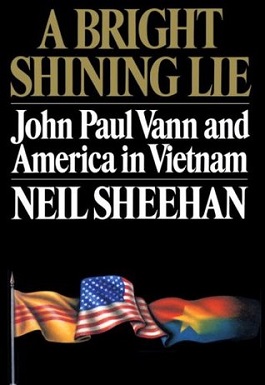
Book Review: A Bright Shining Lie

I seem to have a knack for pulling books off the library's shelves that are guaranteed to depress the hell out of me. Neil Sheehan's A Bright Shining Lie: John Paul Vann and America in Vietnam was another one. The book provides a thorough explication of just how stunningly stupid the policy-makers in Washington, D.C., can be, especially when they're relying on "intelligence" provided by the Central Intelligence Agency. Of course, it doesn't help when the people in power have a vision of the United States and its place in the world that does not match up with reality.

The author, Neil Sheehan, was the New York Times reporter who broke the Pentagon Papers story. He spent several years in Vietnam, first working for UPI and later for the Times. He witnessed the initial troop build-ups and saw firsthand the disconnect between what was happening on the ground and what the policy wonks back in the Pentagon and the State Department believed. He met Lt. Col. John Paul Vann in 1962, about the same time both men arrived in the country, and came to admire Vann for his skills and dedication.

This is an interesting book in many ways. I think it would have been a very different book had Sheehan been able to complete it when he first got interested in the project. When the book was originally conceived, around the time John Paul Vann died in a helicopter crash in 1972, it probably began as a far more hagiographic work than it turned out to be. At the time of Vann’s death, he was viewed by many as being one of the few U.S. military men who actually knew what he was doing in Vietnam. Vann had tried to get through to people in power right up to the level of President Kennedy that the U.S. could never win in Vietnam if it continued with the policies it had in place. Vann had even apparently sacrificed his military career because he believed so strongly that the policies were misguided and wasting American and Vietnamese lives. Having tried and failed to get the Pentagon to see that they were being fed bad intelligence from the field, he retired from the Army after a 20-year career.

Within a few years, Vann was back in Vietnam working for the Agency for International Development advising local officials on pacification efforts, which included everything from building schools to coordinating military attacks against the Viet Minh insurgents, or, as Americans preferred to call them, the Viet Cong. When Vann returned, he discovered that everything he had warned about in 1962 – the flow of weapons from the local militia to the guerillas, the corruption of Vietnamese officials, the stupidity of the strategic hamlets program – had gotten a lot worse. The more American troops that the U.S. poured into the country, the stronger the Viet Cong became. Vann did his best with what he had, but it was a hopeless task. Sheehan makes it clear that the U.S. commander for Vietnam, William Westmoreland, was an idiot, a man who had been promoted way above his level of competency and had no intention of ever wavering from his plan to wear down North Vietnam through attrition. In reality, North Vietnam was wearing down the U.S. Vann didn’t live to see the end of the war, which was probably a kindness. By the time he died, he had succumbed to the same fantasies that drove the other Americans. He had settled on a pacification policy he was convinced would work and refused to admit that it would never be implemented.

If Sheehan had written the entire book right after Vann died, I’m not sure he would have included Vann himself as one of the bright shining lies that comprise the American experience in Vietnam. As it was, Sheehan was seriously injured in an automobile accident in 1974. Sheehan’s long recuperation from the accident delayed work on A Bright Shining Lie but may have also provided more time for him to reflect on Vann’s complicated life and its many contradictions. For a man who valued honesty in intelligence gathering, analysis, and policy formation, when it came to his personal life Vann was a consummate liar. He also had a remarkably strong self-destructive streak.

Some of the less savory facts about John Paul Vann, Vietnam war hero, were actually well-known long before he died. He openly bragged about his womanizing while in Vietnam. Although he had a wife back in Colorado, he kept two Vietnamese mistresses, both of whom were considerably younger than he was. In addition to the mistresses, he had numerous casual sexual encounters with women on trips to Saigon. Today he’d probably be labeled a sex addict; in the 1960s his friends and acquaintances simply marveled at his stamina.

What Sheehan apparently did not know about Vann when he first began researching the book included the fact that many of the anecdotes Vann told about himself were actually borrowed from other people’s lives. Vann told a story about learning from an experience in Korea, for example, that had actually happened to another officer. Vann had served with distinction in Korea, but what he actually did there and what he said he did there turned out to be very different. Sheehan also did not know that many of Vann’s actions in Vietnam that appeared to be grounded in moral outrage or strong principles were simply stage dressing for Vann’s departure from the Army. While he was being held up by many as example of someone who was willing to speak truth to power at the risk of being pushed into retirement, Vann already knew he’d be retiring after he returned to the U.S.

Vann had reached the point in his career where he either had to be promoted or retire. He knew that the promotion board would have access to his full personnel jacket and would discover a morals charge against him. There was no way he’d ever be given a general’s star when he’d come close to going to prison for the statutory rape of a 15-year-old babysitter, a charge which he managed to escape by training himself to beat the polygraph test (he learned he could lie most effectively when sleep-deprived). However, if he was perceived as a contrarian, someone who would not go along just to get along, he’d be encouraged to leave instead of being asked to proceed to the next step up the career ladder. He wouldn't have to experience the humiliation of being turned down by a promotion board. Before going to Vietnam, he had already reached out to defense contractors about possible employment when he retired. His criticisms about the way the war was being handled were accurate, but whether or not he would have been quite as vocal or as tactless if he thought he had something to lose is debatable.   

Conclusions about the book? It won the 1989 Pulitzer for Nonfiction for a reason. It was meticulously researched, is quite readable, and is unremittingly depressing. It provides a plethora of details about a war we all know now was a colossal error conducted using tactics that made it unwinnable. Does anyone really need more proof that Westmoreland was an absolute ass or that the military has a bad habit of rewarding incompetent officers with commendations and promotions?

I had a few minor quibbles, of course. Sheehan mentions a Foreign Service officer, Douglas Ramsey, who was captured by the Viet Cong in January 1966. At several points, he refers to the conditions of Ramsey’s captivity but then just leaves the reader hanging as to what happened in the end. There’s no mention of when or why Ramsey was finally released. He also mentions Vann’s last minute concern that his younger mistress and his illegitimate daughter be recognized as his heirs, but then doesn’t tell us what happened to them. He obviously knew because he includes interviews with both mistresses in the sources listed for the chapters where they’re mentioned.

Would I recommend the book to other readers? Yes, if you’re interested in military history, the Vietnam War, or still more proof that the U.S. should learn to mind its own business and avoid foreign entanglements. No, if you’d prefer to remain cheerfully oblivious to the fact that more things change, the more they stay the same.