Showing posts with label history. Show all posts

Wednesday, July 8, 2026

Birthright citizenship, voting, and history

I've been reading Eric Foner's The Second Founding. Foner has written extensively on the post-Civil War period and Reconstruction. This particular book looks at the 13th, 14th, and 15th amendments to the Constitution. Although in hindsight it seems like Congress clumped the three together rather quickly, it was 15 years from ratification of the 13th to ratification of the 15th.

The 13th amendment was pretty much a no-brainer immediately following the war. The Emancipation Proclamation had freed slaves in the Confederacy; it didn't do a thing for slaves in border states that weren't in active rebellion, like Kentucky and Missouri. Congress recognized slavery everywhere had to be eliminated so they cranked out the 13th Amendment pretty quickly. It's short and simple: "Neither slavery nor involuntary servitude, except as a punishment for crime whereof the party shall have been duly convicted, shall exist within the United States..."

Foner details the debates, which naturally included demands from slave owners for financial compensation for their lost property, but the committees working on the drafts managed to pare it down to a basic statement. In retrospect the exceptional clause has been repeatedly criticized. It's the rationale for prison labor. Need some road work done cheaply? Chain gangs. Or, a more modern example, need furniture for schools and state hospitals? Prison work shops. Or, as I read about not long ago, an airline reservation call center operating out of a prison, which really had me wondering about stuff like how secure is your credit card number when the person asking for it is sitting behind bars. But that's a digression. The exceptionalism clause wasn't seen as much of an issue in 1865; it took decades of Jim Crow and rising awareness of places like Angola (notorious Louisiana prison farm) for people to realize the exceptionalism clause has led to some horrific abuses. In any case, after both houses of Congress passed it, the amendment went to the states for ratification. Twenty-seven were needed for passage; there were 30 ratifications submitted before the end of December 1865. A few states were a little slow -- naturally, Mississippi was last, with the formal paperwork from Mississippi submitted in 2013. (And no doubt there are some Mississippians who think they could have waited a few more years.)

The 14th and 15th amendments did not sail through the process as quickly or as easily as the 13th. The 14th has been in the news a lot lately. It's the birthright citizenship amendment. In reading about the debates a number of oddities struck me. One was that for some Congress critters that big problem with affirming birthright citizenship wasn't that anyone black and born in the United States would automatically be a citizen, it was that birthright citizenship could apply to children born to Chinese laborers in California or Nevada or, possibly even worse, the children born to drunken Irish immigrants. In 1868 there were a lot of Chinese laborers in California. They were, as immigrants so often do, working at jobs sufficiently dangerous or arduous that most white guys wouldn't do them. In retrospect, the paranoia about the Chinese suddenly forming a voting bloc seems rather stupid. There may have been 50,000 adult men laboring on railroads and at other unpleasant tasks, but there weren't very many women immigrating -- and even if there were the amount of time from the amendment's passage to when new natural born citizens would be eligible to vote (age 21) seems like plenty of time for politicians to figure out how to manipulate the masses. 

The nervousness about the drunken Irish was an East Coast issue. Prejudice against the Irish was common in all the major cities. Despite Ireland being part of the United Kingdom at the time, the Irish were never seen as safely English. The Irish did not speak the King's English -- many no doubt were comfortable only in Gaelic -- and, even worse, they were Papists, the dreaded Roman Catholics who answered to the Pope, who was labeled by some American Protestant leaders as a despot. Again, in retrospect it seems rather odd, but while prejudice against the Irish has disappeared over time there is still a lot of fundamentalist Protestant prejudice against Catholics. (A minor digression, but I know people who were raised in a fundamentalist tradition -- not exactly snake-handling Pentecostal Holiness types, but close -- who were/are convinced Catholics worship idols because of the statues of saints in churches.) 

There was also discussion about Native Americans, but Congress concluded that if a Native American belonged to a recognized tribe that tribe was a sovereign nation and that's where a Native American's citizenship lay. Ergo, U.S. citizenship was a nonissue for indigenous persons. 

In any case, the important part of the amendment, Article 1, does three things: it says if you're born in the U.S., you're a citizen. As a citizen you are entitled to equal protection under the law, and, third, states can't take rights away without due process. The other sections of the amendment were basically cleaning up some issues after the war such as Article 3 saying if you'd rebelled (i.e., been in the Confederate army or government) you couldn't run for federal office (no convincing your fellow traitors that you belonged in Congress). Article 3 is often referred to as the insurrection clause; it's the clause some activists tried to use against Donald Trump running for a second term because he'd encouraged the January 6, 2021, rioters at the Capitol. The intent in 1868, of course, was to prevent the asshats who had been stupid enough to drag multiple states into seceding and causing a war from trying to get back into political power and doing something equally stupid again. And it worked, at least briefly, but mainly because Congress also passed the Reconstruction Act for the Confederate states. Reconstruction lasted until the administration of Rutherford B. Hayes. Hayes effectively ended Reconstruction by withdrawing federal troops, which is a subject for a different post.

The 15th amendment provided the right to vote to all citizens regardless of race or ethnicity. The wording is succinct -- "The right of citizens of the United States to vote shall not be denied or abridged by the United States or by any State on account of race, color, or previous condition of servitude." -- and is notable for what it omits (gender). Gender was debated, but apparently giving ladies the right to vote along with former slaves was a bridge too far for male legislators in the late 1860s. Not surprisingly, some of the same objections to the 14th admendment were recycled to argue against the 15th: omigod the Irish might vote! What about the Chinese? It probably helped that states would still control voting (when, where, limiting eligibility through requiring literacy tests or poll taxes, all of which and more states did in attempts to limit who actually got to vote). The amendment passed both houses of Congress in 1869 and was sent to the states for ratification, which took less than a year. 

So what did I learn from this book other than the basic facts? Well, it's pretty clear that there will always be some shit weasels politicians who worry a lot more about hanging on to their Congressional seat than they do about what's good for the country. It's also clear that the current criticisms of birthright citizenship aren't new. They're recycled bigotry from the 1860s. Ditto voting rights. There have always been and probably always will be people who think the ideal voting population consists of one person: one rich guy who's willing to subsidize your preferred lifestyle. Therefore the goal becomes to make voting harder, thus thinning the voting pool. Ecclesiastes 1:9. 

Saturday, January 20, 2018

No state monopolies on racism

Caption above done by person who scanned the photo and didn't quite realize what she was looking at. 
In commenting on my last post, Ol' Buzzard mentioned the Klan in Mississippi. I'm not going to disagree that Mississippi had lots and lots of overt bigots, but they weren't exactly unique. The North was full of sundown towns (as in  if you were black the sun had better not set while your ass was still in town), like Ironwood, Michigan. I took the train a lot when I was younger (I had a pass for free rides on the Chicago & Northwestern) and asked my dad once why the black porters never got off the train when it was standing in the Ironwood station. It routinely stood in the station long enough for the engineer, fireman, conductor, and train man to all step down, stretch their legs, and do some schmoozing with the depot agent and other locals. That's when I learned about sundown towns. This was in the early 1960's but the town still retained enough of a nasty reputation that no black train crew member was going to take a chance by setting foot on the depot platform.

Interestingly enough, when the Klan started growing in the early 20th century, it actually had more members in the North than it did in the South. The state of Indiana, if I recall correctly, had the largest number of Klan members of any state in the country. The South had individual acts of terrorism -- black men being lynched for supposed sexual assaults, houses being burned if a family seemed too uppity -- but the 20th century race riots where mobs of white racists wiped out whole neighborhoods did not take place in the Deep South. They happened in the border states, the North, or the West, e.g.. the Tulsa riot in 1921. In the South the acts of terrorism were intended to remind blacks of their proper place in society, i.e., as the servant class. In the North the goal was much more "we don't want you here" and "go back where you came from."

And, yes, we had the Klan locally. The person who scanned the historic photo above and labeled it as Odd Fellows may have genuinely believed it was Odd Fellows, but it's definitely the Ku Klux Klan. It's a high quality resolution and when you blow it up the Klan emblem (the blood drop cross) is clearly visible on the front of the robes. There were chapters of the Klan in a number of Upper Peninsula towns, although they seem to have been a phenomenon of the nativist movements of the 1920s and then faded away. Maybe it was because Michigan had a law saying you couldn't cover your face. If you look at the photo, you'll notice there are no masks. It can get a little embarrassing to be spouting hate when everyone knows exactly who you are. Or maybe it never did have much traction. It would be hard to keep an anti-immigrant (the Klan wasn't just about hating blacks; they also opposed immigration from what they considered shithole countries like Finland and Italy) group going once Congress passed the Immigration Act of 1924 and the number of new immigrants from undesirable countries dropped. It would be especially hard to be anti-immigrant in an area where a huge chunk of the population consisted of fairly recent arrivals who'd managed to get off the boat before the laws changed.

Minor digression. Both of the commercial buildings shown in the photo are still standing, but both had the clapboard covered with cheap asphalt siding decades ago. The cornices are still there, though.

Monday, October 9, 2017

Book review: The Red Line

Anyone who's ever wondered why their immigrant ancestors came to this country needs to read this book. I know quite a few third or fourth generation Finnish-Americans who have made the pilgrimage back to the old country, been blown away by what a lovely place Finland can be (especially if you're a tourist), and wondered why on earth their grandparents or great grandparents ever left. Track down an English translation of Punainen viiva (The Red Line) and it'll be crystal clear. When your kids are going barefoot in Finnish winters and you're surviving by mixing pulverized pine bark with flour, the uncertainties of the New World had to look like a much better deal than anything Finland had to offer at the time.

The Red Line is set in rural Finland right after the Finnish national assembly passed legislation in 1906 granting universal suffrage. There was a literacy test, but other than that all adults age 24 and above could vote -- men and women, landowner and tenant farmer, rich and poor. Finland was, in fact, the first country to give women the vote. The literacy test, incidentally, was not much of a bar to any adult voting. Even Finns living in abject poverty who tended to view newspapers as something primarily used to line walls for insulation were literate. They had to be. You couldn't get married if you weren't a church member, and you couldn't be a church member if you couldn't read the Lutheran catechism. Despite Finnish being an extremely difficult language for non-Finns to learn, it's actually pretty easy to read for a native speaker. Each letter has a unique sound. Once you've mastered an aapinen* you can read anything by sounding it out. You may not understand what the words mean, which becomes clear as the protagonists in The Red Line try to figure out just what an "agitator" is (they have no clue whether it's a good thing or a bad one), but you'll know what they sound like.

The first general election was scheduled for March 1907. The months leading up to the election witnessed party advocates fanning out across the country. A socialist party worked particularly hard at turning out the rural vote, getting the dirt-poor crofters and others at the bottom of the economic scale to buy into their campaign promises. Never having gone through a truly general election before, voters tended to be a bit . . . gullible. To them, the campaign promises sounded like magic: vote for the socialist candidate and the whole system that kept poor tenant farmers in rags while the rich dressed in silk and had coffee every day would be overthrown instantly. The characters in this book truly believe that things would change overnight. If they vote socialist, their lives will see an immediate improvement. Instead, after agonizing over whether or not to believe the agitator and vote against the monied interests, they draw the red line, go home, and slowly realize nothing has changed. If anything, things get worse -- Fate (or, more accurately, the author) has some nasty surprises to throw at them before the snow is gone.

The red line, incidentally, refers to the mark, a diagonal red line on the ballot, voters made and not to the socialist party.

I found The Red Line interesting, but I did have some quibbles. I think the author kind of went overboard in his descriptions of the desperate poverty of the crofters. Yes, I believe there were poor farmers who lived so close to starvation at least part of the year that they had to resort to pine flour** to survive. Famine was a recurring problem in a country that practiced slash and burn agriculture and had an astoundingly short growing season. On the other hand, in this book the farmers are practically starving and worrying about every bite when it's still more than a month until Christmas. They're also short on hay for their animals (a cow, a calf, and some sheep). It struck me as a bit unbelievable that the farmers would be running out of hay barely a month into winter.

I was also more than a bit skeptical about the descriptions of the farm house/hovel as being filthy. I'm not sure why so many authors seem to conflate dirt-poor and dirty, but it happens all the time. Don't have any money? Than obviously you also don't know how to use a broom or to wash the communal stew bowl occasionally.

On the other hand, the cockroaches living in the filth were amusing. They were better read than the humans, although one does lament the fact he can't read Latin.

I will not claim to have read this book in the original Finn, although I wish I could have. The author includes dialect (Finland has a bunch of regional dialects) and I'd love to read Finn well enough to be able to pick up on the way a Karelian accent gets rendered compared with an ordinary crofter's and the more educated characters in the novel.

*aapinen -- children's primer used to teach the alphabet

**pine flour -- literally made by drying and grinding the inner bark of pine trees. The S.O. remembers a Lutheran minister describing it to his catechism class back in the early 1960's. Many rural families survived by mixing pine flour with wheat, rye, or barley. It didn't provide any nutritional value because humans can't digest cellulose, but it stretched the grain flour supply and helped stave off hunger pangs. There were good reasons many Finnish immigrants never felt any nostalgia for the Old Country.

Tuesday, June 9, 2015

Family trees with missing branches

I've been dealing with a research request at the museum that's turned into a bit of puzzler. As a result, I have a suggestion for anyone who's contemplating doing genealogy and delving into his or her family's past: pick ancestors with unusual last names. It is not exactly fun trying to track down the ancestors of someone with a surname like, for example, Johnson in a community where every other person seems to be named Johnson. It also does not help to be dealing with ethnic groups and generations where a lot of kids were given Swedish or Finnish names at birth so they were registered as Johannes or Jussi but decided they'd rather be called John when they got older. Or maybe they disliked their first name so always used their middle name instead. Then toss in the possibility that the only name you ever heard your grandfather referred to by was actually a nickname and not his actual name at all and things will get truly frustrating.

I have, in short, spent a whole lot more time worrying about this one research request than something as simple as the normal research request should take. After investing way too many hours in the project, I still have no solid information. The grandfather in question was apparently not married in Baraga County, or, if he was, his first name was different than what the grandson remembers. Similarly, he did not die in Baraga County -- there are death certificates for persons with the name the grandson remembers, but none are the man I've been looking for. He was well-known in the community so there should be an obituary. No doubt there is, but the L'Anse Sentinel isn't indexed and I'm not prepared to spend all summer reading through 50 or 60 years worth of newspapers looking for one dead guy. I'd like to have at least one solid clue before I turn on the microfilm reader at the library. Was he buried in Baraga County? He's not on any of the grave indexes we have for the cemeteries -- the one person I've found with the right name as born too recently to be the guy I'm looking for.

The requester did give me one solid clue: his mother's name and birthday. Theoretically this would yield a birth certificate with her parents' names on it. Only one problem: his mother's birth was apparently not recorded in Baraga County either. At the time she was born, pregnant women had three choices: they could give birth at home, they could utilize a small "nursing home" operated by a nurse-midwife, or they could go to a hospital in a neighboring county. Women who could afford it often chose the last option. (Small digression: we have not progressed since then. The choices have been narrowed to one: go to a neighboring county. There are no certified midwives available to attend home births, and the local hospital doesn't have a delivery suite.) If a baby was born in Houghton or Marquette County, there'd be no record locally.

There are other possibilities: he's remembering the wrong year for her birth or he's got his grandparents' names wrong. Either one is possible.

So how much more effort am I going to put into this request? I'm not sure. I know from reading through the correspondence files at the museum that people don't like it when we come up with null results. Personally, considering how incredibly low the museum's research fee is, I think they should be amazed we're willing to do the work at all, but then again most people have no clue just how time-consuming and tedious trawling through legal records and old newspapers can be. I'd love to raise our rates -- or, better yet, find out there are actually some professional genealogists locally I could refer people to -- because right now we're so under priced it's pathetic. If I were doing research work as a contract historian, I'd charge at least $80 an hour so it kind of floors me that I'm volunteering for an organization that only charges $10. Then again, maybe that low rate is one reason people get pissy when we can't find anything. After all, how hard can we be working when we're practically giving our time away?

Monday, March 30, 2015

Life (and death) in a delusional bubble

I've been reading The Last Tsar: The Life and Death of Nicholas II. Nicholas was the last of the Romanov tsars to rule Russia. Except it's pretty clear that in a lot of ways he never did rule the country; he and his immediate family existed in a lovely bubble and were pretty much out of touch with any sort of reality.

I'm into the section of the book now where Nicholas and his family have been exiled to Siberia and are living under house arrest. They're only a few months away from being executed, but they're all cruising along as though everything is going to be fine. One indignity after another, more and more things stripped from them, and they still don't get it that they're heading down the same road as Louis XVI and Marie Antoinette. They're given opportunities to flee the country, to go live in exile, sponge off some of their numerous royal relatives scattered around Europe, but they refuse to leave Russia. It's bizarre. I can halfway understand why Nicholas would decide to stay in Russia -- he really bought into the notion that the tsar was Russia -- but why didn't he try to get his kids or his lunatic wife out of the the country? He was reading the papers; he knew about the riots and social disorder. Did he really believe that because he had abdicated, they were now safe?

Then again, considering that he'd spent his entire life being passive, maybe it's not so surprising "Nicky" just sat back and waited for events to happen. Most of the time he was tsar he was pretty much oblivious to what was actually happening in the country or being done in his name. On the rare occasions when he actually asserted his authority, it usually wasn't his idea -- it was his wife's. And his wife was, to put it mildly, delusional. She was even more out of touch with reality than Nicky was.

And what were the underlying reasons for their happy, delusional life? There were actually two things. One was the Tsarina Alexandra. Nicholas and Alexander were that rare royal couple: they'd married for love against the wishes of various relatives, including Nicky's parents. They'd met as teenagers, Nicholas had fallen for Alexandra at first sight, and never gave up on the idea that someday they'd marry. His parents had consented only because they'd figured out that Nicholas wasn't going to agree to any other arrangements. His father had even tried the classic Russian aristocratic technique of hooking his son up with a ballet dancer in the hopes that he'd become sufficiently enamored of his mistress that he wouldn't care who his legal wife was -- it didn't work. Once Nicholas and Alexandra were married, they formed a self-sufficient bubble. This might not have been a problem if Alexandra hadn't been quite so insecure. She was easily offended and good at holding grudges. Nicky adored Alix so refused to do anything that might upset her. End result? Their social circle kept shrinking until it consisted of a handful of people who would tell the Empress only what she wanted to hear. If someone tried to insert an unpleasant truth, they'd find themselves cut off.

The other reason was religion. The tsar's only son, the heir to the throne, had hemophilia. The condition was diagnosed when Alexei was an infant. Alexandra's life became basically a search for a miracle cure. She absolutely refused to admit that her son had what was a terminal condition, that no matter how careful they were or how intensely she prayed, Alexei was not going to live long enough to be Tsar. It's not surprising that she fell for the lies told by Grigory Rasputin, a con man who was remarkably adept at telling Alexandra exactly what she wanted to hear. As anyone who's ever read any Russian history knows, Rasputin's influence on the royal family became widely known and despised. At the same time, articles and political cartoons in the newspapers openly suggested scandalous behavior -- Rasputin's public behavior away from the palace was, in a word, debauched so it was easy for ordinary people to believe the worst of the rumors circulating about the tsarina. Naturally, the worse Rasputin behaved away from the royal family, the less Alexandra was willing to believe she was being conned. Even when stories reached her about virtually public orgies, she just said this was proof of his holiness. Apparently there's a long Russian tradition of holy men indulging in remarkably outrageous ways and it somehow serving as proof not that they're perverts or degenerates but are instead especially blessed by God. I know -- it makes no sense, but Alexandra 's surviving letters and journals confirm that she believed it.

And then when you throw in World War I, the fact the Russians were getting slaughtered by the Germans, and Alexandra was a German princess who tried to meddle in politics by writing privately to her cousins? It didn't take many years of warfare and Russian losses for most of the country to believe Alexandra was a German spy and the tsar himself was betraying his country by not locking her up. I guess the biggest mystery when it comes to the last of the Romanovs isn't so much how they happened to end up lined up and shot in a basement, but why it took until the Bolshevik Revolution for it to happen. By the time Nicholas abdicated in 1917, he and Alexandra were so universally hated that it's moderately amazing they survived as long as they did.

One thing I have always wondered about, though, is why the Reds felt the need to execute the grand duchesses -- the tsar's daughters. They had no rights of succession; the throne followed the male line. No one was going to rouse the populace by saying "Let's put Princess Olga on the throne." Then again, fanatics have always had a problem with overkill -- and the Bolshevik leadership definitely qualified as fanatics.

As I was reading this book, I found myself thinking about how easy it is for people in leadership positions to fall into the same trap Nicholas II did: just listen to the happy news, chase away anyone who tries to do a reality check, and then find themselves wondering why their company is going bankrupt or their favorite policies are failing. The sad thing is that there probably is no good cure for the problem: the more powerful a person becomes, the less willing other people are to tell them the unvarnished truth.

So would I recommend Nicholas II to other readers? I'm not sure. It's probably a good one for anyone interested in Russian history -- the author does look at various events from a different perspective than I'd read before -- but the structure of the book is odd. It felt choppy and tended to be a little hard to follow. For someone with only a casual interest, though, it's not a good choice.

Thursday, February 12, 2015

And you think politics are ugly now?

I just finished reading a fascinating book, The Presidents' War: Six American Presidents and the Civil War that Divided Them. The author, Chris DeRose, provides brief descriptions of the administrations of the presidents and administrations that fell between Andrew Jackson and Abraham Lincoln and then discusses how the five living ex-presidents responded to the Civil War. You think politics can be nasty now? Or that "journalists," especially the ones on Faux News, have a tendency to lie?  Read some history, my friends, because compared to the 1850s and 1860s we are living in a remarkably civilized time.

Granted, no one in South Carolina has decided (yet) that it would be a good idea to have the state militia open fire on Fort Jackson, although I'm sure there are some idiots on the far right who think that it would be a good idea. The lack of open warfare does have to make the present day look a lot better than Lincoln's time regardless of whatever vitriol gets spilled on the air or in Congress. But, holy wah, they were nasty back then.

Among other things, no matter what Bill Clinton or George W. Bush might privately think about the current occupant of the White House, they're polite in public. All the ex-presidents are nice to each other. They don't openly criticize the decisions their successors make or allow themselves to get sucked into second guessing existing policy. Their minions and/or acolytes might get nasty, but the ex-presidents themselves? Never. In contrast, Lincoln had to deal with five living former presidents who weren't nearly as restrained. Four of them were pro-slavery and either openly secessionist or close to it. John Tyler, in fact, was a delegate to the Virginia state convention that voted for secession. He bears the dubious distinction of being the only U.S. president to have died as an enemy of the country he once led.

Andrew Jackson was the 8th President of the United States; Abraham Lincoln was the 16th. Their administrations fell a mere 24 years apart but were separated by a string of one-term office holders, two of whom rose to the position from the vice presidency following the death of a president. These are the guys who cause high school students' eyes to glaze over and who most of us can never remember: Martin Van Buren (who I remember primarily because in at least one of Gore Vidal's historical novels his characters speculate that Van Buren is Aaron Burr's illegitimate son; I have no clue if Vidal based that bit of fiction on any actual 19th century gossip), William Harrison (notable for, if I recall correctly, insisting on marching in the rain on inauguration day, getting sick as a result of his stubbornness, and dying barely a month later), John Tyler, James K. Polk (whose name only comes up as the answer to trivia questions about presidents with 4-letter names; there have been five. Polk is the one no one can ever remember)(Taft, Ford, Bush the Elder and Bush the Younger are the other four), Zachary Taylor (rumored to have been poisoned; he was actually exhumed a couple years ago and tested for arsenic); Millard Fillmore, Franklin Pierce, and James Buchanan.

Of the five living ex-presidents at the time Lincoln took office, only Van Buren came close to supporting the administration. Van Buren, who had been Andrew Jackson's vice president, was nominally a Democrat but appears to have tried the hardest to keep his mouth shut. He was active in organizing support for the Union troops and made a point of staying out of politics. Unfortunately for Lincoln, Van Buren died in 1862. As for the others? The vitriol flowed freely. Pierce referred publicly to Lincoln as an ape, an ignoramus, a tyrant who was shredding the Constitution and should be removed from office by any means necessary. Pierce even carried on an active correspondence with Jefferson Davis during the war -- prior to the war, Pierce had promoted Davis as a presidential candidate (and what an interesting alternate history novel that would make: Jefferson and Varina Davis in the White House instead of Abraham and Mary Lincoln). Pierce actually came close to being indicted for treason when Union forces captured the Confederate capital in Richmond and the Pierce-Davis correspondence was found.

All the ex-presidents wrote long letters, which usually included a phrase saying that although they didn't intend the actual letter for publication, the recipients were free to share their sentiments with others. They described Lincoln publicly in terms that today not even the talking heads on Faux News would consider using in dissing President Obama. Lincoln was a subhuman mongrel, a shambling ape. A few of them nourished fantasies of returning to the White House themselves; after all, they'd served only one term. . . and a couple of them (Tyler, Fillmore) hadn't even been elected to the office to begin with. The fact their party's convention had passed them over after seeing how they did the first time around didn't faze them. They were still convinced they knew the pulse of the country and could do a better job than Lincoln. It does show how delusional politicians can get: Pierce, Buchanan, and Fillmore were being reviled as Copperheads, they were openly mocked in the popular press, but because they still attracted a crowd of fellow Copperheads when they spoke, they thought they represented mainstream thought (and, wow, does that ever sound familiar, kind of like a Sarah Palin or Ted Nugent public appearance).

Copperheads were the Civil War equivalent of today's Tea Party, a radical faction within the Democratic Party. Copperheads wanted to end the Civil War on almost any terms, including restoring slavery throughout the entire United States. Their position was that whatever it took to get the secessionist states back in the Union was okay with them. It didn't seem to register with them that once thousands of Union troops had died in battle, most of the Union states weren't feeling particularly conciliatory. Pierce was so tone-deaf (or oblivious to reality) that he gave an anti-Lincoln, pro-Southern speech the day after the Union army managed to defeat the Confederates at Gettysburg. The crowd present at the speech cheered him; the rest of the country was disgusted and horrified. Secure within their own little bubble, the Copperheads were convinced that they would win the 1864 presidential election handily, especially when General George McClellan (one of the most useless military men in the history of warfare) was their candidate. They were, needless to say, stunned when Lincoln was re-elected by a large majority.

John Tyler probably caused the fewest headaches for Lincoln. Tyler had retired to a Virginia plantation, Sherwood Forest, when he left the presidency. Initially snubbed by his neighbors who perceived him as having been too pro-free state while he was president, by the time the war broke out he had repaired his reputation within the state. He was elected as a delegate to the state convention that voted for secession and then as a representative to the Congress of the Confederate States of America. If he had still been living when the war ended, he might have been tried for treason along with Jefferson Davis and other members of the CSA government. He was extremely critical of Lincoln, but as an open member of the Confederacy, his opinions probably didn't carry much weight in the North.

A small digression: Tyler's home, Sherwood Forest, is the only presidential home that's still owned by a member of the president's family. His grandson Harrison lives there. Yep. Tyler's grandson. Tyler was married twice and had 15 children; he was 63 when Harrison's father Lyon was born. Lyon in turn was married twice and had children late in life; he was 75 when Harrison was born.

Several things struck me while reading this book. One was that no matter how badly most of the politicians mentioned in this book screwed up, they were never willing to admit they'd blown it, e.g., that getting rid of the Missouri Compromise was a bad idea. There were exceptions: Stephen Douglas publicly castigated himself for having pushed for state sovereignty (i.e., letting new states decide for themselves whether to be free or slave), and Lincoln was notable for being willing to change his mind and admit errors. Almost no one else, however, seemed capable of saying they'd blown it. If anything, the worse things got, the less willing they were to admit they'd had a hand in creating the situation.

I did feel a few twinges of pity for a couple of the ex-presidents. Pierce, for example, was close friends with the author Nathaniel Hawthorne. They'd been good friends since their college days; Hawthorne dedicated one of his last books to Pierce; and Hawthorne was actually visiting with Pierce when he died. Nonetheless, Pierce was by then so universally disliked that the people arranging Hawthorne's funeral cut Pierce out. In the normal course of events, Pierce would have been at least a pall bearer if not one of the eulogists. Not this time. I don't know if Pierce was told not to attend at all (DeRose doesn't make that clear), but given that Pierce is described as distraught over the exclusion, it's possible he was indeed told to stay away.

In addition to shedding light on some of the political maneuvering going on in the years preceding the war, the book also makes it totally clear that the one and only reason the southern states seceded was slavery. It wasn't states' rights in a general sense because the only right the southerners were interested in was the right to own slaves. DeRose provides direct quotes from the various secession declarations, and in every one where a state did a specific statement of secession, that state gives the right to own slaves as its reason. This is a historical fact that needs to be pointed out on a regular basis along with the fact that it was the south that started the war. It was not a glorious cause; it was a war to perpetuate slavery. And it was not a "war of northern aggression" when it began with a southern state attacking a federal facility.

The Presidents' War is a recent publication. I actually found it on the New Books shelf at the library -- which prompted a "holy wah, it's actual history" reaction, because that space is usually filled with the most recent Janet Evanovich or Nora Roberts releases. It's quite readable, and it does probably provide enough biographical information on each of the key players that any burning desire a person may have had to learn more about Millard Fillmore or James Buchanan will probably be satisfied. It's also nicely concise for a history that covers several decades; DeRose did a good job of figuring out what was important without loading the book up with material that's been well-covered elsewhere. I'd recommend it to anyone with an interest in antebellum and Civil War history.

Tuesday, December 16, 2014

What if they gave a war and no one cared?

Remember when we invaded Canada? I didn't think so. I recently read J. Mackay Hitsman's excellent history, The Incredible War of 1812: A Military History, and learned a whole bunch of stuff they never bothered teaching us in American history class. Hitsman was a Canadian historian who specialized in military history. Not surprisingly, the Canadians have a slightly different perspective on the War of 1812 than we Americans do.

Now, I did know a few odd bits of trivia about the War of 1812. Thanks to an August Derleth book, The Captive Island, my grandmother gave me when I was in about 5th grade, I knew the British had taken Mackinac Island back from the Americans. The Derleth book is a young adult historical novel about an American youth who escapes from the island to bring information to the Americans at Detroit, which the British also took away from the United States, at least briefly. Having worked for the Park Service, I knew about the huge honking monument at Put In Bay, Ohio, dedicated to Oliver Hazard Perry and his fleet's victory over the British back in 1813. And I had been to Fort Ontario in Oswego, New York, back in the 1980s and saw the poor saps doing their re-enactments on a hot July day while dressed in the heavy wool uniforms common in the early 19th century. I have a vague recollection of kind of scoffing at the idea of a fort being built on Lake Ontario to protect us all from Canadian invaders even though the interpretive material at the time no doubt mentioned there had been an actual battle at Oswego.

In any event, when I thought about the War of 1812 at all I remembered Fort McHenry, the origins of "The Star Spangled Banner," the White House getting torched, and the fact the Battle of New Orleans was fought after a peace accord had already been signed in Europe. Does it still count as a victory if the war ended before the battle took place? What never crossed my mind was the fact that the active front of the war, the main line of battle, so to speak, was the United States-Canadian border. There was a fair amount of naval action on the Atlantic Ocean in the form of British warships blocking access to American ports with American privateers retaliating by harassing British merchant ships, but Hitsman makes it clear that the major military operations, both naval and land-based, took place along the northern border of the United States. This could be a function of the author's obviously pro-Canadian bias, but it does seem to match up with the facts. Both countries worked frantically in their Great Lakes ports to construct more warships, from small gunboats to frigates that came close to qualifying as ships of the line, because both sides recognized that whoever controlled the Lakes had the upper hand in the war.

Actually, I shouldn't describe the concerns in such sweeping terms. It would be more accurate to say that the guys doing the actual fighting recognized that whoever controlled the Lakes would have the upper hand. No one else seemed to care very much. In North America, despite the war there was a lot of cross border commercial activity: the Canadians bought supplies of various types from the merchants in New York and New England,and vice versa. Ports that were supposedly blockaded actually weren't because so many special exceptions and passes were issued that the blockades and trade embargoes were essentially meaningless. The War of 1812 was a war no one really wanted -- everyone recognized that it was hurting business, citizens in both countries realized that there was always the danger the Indian allies on either side could be hard to control and tended to have a take no prisoners approach, and none of the men in the state and provincial militias particularly wanted to fight. In fact, members of the New York state militia flat out refused to cross the border when ordered to pursue British troops into Canada, saying that it was illegal to make them fight on foreign soil (and wouldn't it be nice if American troops would do that now? Just say hell, no, I'm not getting on a plane to BFE to fight people who don't even know where the U.S. is?)

Adding to the complicated mix was the fact that many of the settlers in Canada were people who had been living in what was now the United States and decided to move following the Revolutionary War, some for economic reasons and some because they viewed Canada as just another frontier that the U.S. was going to eventually cross. Instead of going west to settle in what is now Ohio or Illinois, they opted to go north to what is now the province of Ontario. Some were loyal to Great Britain, some were loyal to the United States, and no doubt a fair number shifted their allegiance based on what they perceived to benefit themselves the most.

Over in Europe, Great Britain had no choice but to focus most of its attention on the Napoleonic wars. Thus, when the War of 1812 began, there were no British troops to spare to send to Canada. By the time there were troops and supplies available that could be diverted to North America, peace negotiations had ended the conflict. The war itself had effectively been a draw. Neither side gained any territory, but neither side lost any. The United States had invaded and seized sites in Upper Canada; the British had invaded and seized sites in the United States (e.g., Fort Michilimackinac, Detroit). Both had retreated from those sites so neither was in possession at the time of negotiations, hence, an argument could not be made for retention of conquered territory.

The Incredible War of 1812 was an interesting book. I had no idea there'd ever been a Battle of Plattsburgh or that the British government issued medals for something called the Battle of Crysler's Farm. I did know there had been a battle at the River Raisin near Detroit -- the site is, if memory serves me right, the nation's most recently created National Battlefield park -- but was struck by just how low the numbers were of the combatants and others involved. By contemporary (or even Civil War) standards, it wasn't much of a battle. It's also hard to believe that, as the park's website puts it, the phrase "Remember the Raisin!" served as a rallying cry, especially when what seems to have swung the battle in the British favor was the complete incompetence of the U.S. commanders. First, General William Hull had surrendered all of Michigan Territory to the British in 1812. Then, in January 1813 the Americans found themselves surrendering to the British for a second time. In the aftermath of that battle, Native Americans allied with the British raided the Frenchtown settlement, burning houses, carrying off prisoners, and killing about half a dozen civilians. In a logical world, "Remember the Raisin!" would have been the rallying cry for a couple of courts martial. But apparently not in frontier America. Although Winchester did quietly slink away later in the year -- he had had a checkered, apparently rather sleazy career, and apparently figured out that (a) there was no money to be made on the battlelines in the Northwest Territories and (b) he might end up dead by accident. He didn't exactly resign, but he did get replaced.

Minor digression: considering that almost 200 years had passed before that battlefield park had been created and it is in the southeast corner of the Downer Peninsula, an area that's seen wave after wave of development, what exactly was left there that made it merit park status? It does seem like the site could have been adequately commemorated with one of those book on a stick historic markers the State of Michigan erects if there's sufficient public pressure. Oh well. . . the Park Service can always use a few punishment parks, places to shuffle incompetent superintendents off to when they're not yet eligible for retirement but need to maintain the illusion of still being gainfully employed.

There were numerous other skirmishes on both sides of the border on the shores of Lake Ontario, Lake Erie, and the banks of the Niagara River. Both sides engaged in behavior the other side condemned as barbaric, e.g., the Americans burned the government buildings at York (the capital of Upper Canada). In fact, when the British were condemned for later trying to burn down the President's house in Washington, their response was they were simply giving the Americans a taste of what they had done in York. And so it went for two years, seesawing back and forth across the border and neither side gaining much of an advantage for very long. In the end, the border remained where it had been, the British continued their impressment policies on the high seas, and, other than for the guys who died, the war didn't change much of anything.

Would I recommend The Incredible War of 1812 to other readers? Only if military history fascinates you. Overall, I thought it was worth reading but have to confess there were sections where Hitsman really got into minutiae and I had a hard time staying focused. On the other hand, it is well-written and meticulously footnoted. There is a treasure trove of fascinating trivia hiding in the notes, so I guess I'd recommend it to historians. All historians love good footnotes.

Wednesday, June 18, 2014

Why does the CIA still exist?

On a regular basis, politicians of all stripes will bloviate about the need to trim the federal budget, eliminate waste, and generally have government do a better job for the taxpayers. Well, here's a suggestion, something that would plug a giant black hole that's sucking dollars into some bizarre netherworld, the government should get rid of the Central Intelligence Agency. It was created following World War II in response to the Cold War. Communism with a Capital C posed such an existential threat that various policy-makers decided it would be a good idea for the U.S. to have a permanent intelligence service that functioned independently of every other agency.

From what I can tell, those people, from President Truman on down the government chain of command, were pretty much totally wrong. Based on everything I've seen and read about the CIA's performance over the past 7 decades, everything they touch turns to crap. They work really, really hard and still manage to be dead wrong over and over and over. Either that, on those rare occasions when they've got it right and they really do know what's going on, they don't bother to tell anyone what they know.

I know. I know. I've ranted on this subject before. So what inspired this latest rant? I just finished reading The Looming Tower: Al-Qaeda and the Road to 9/11. By the time I was done with it, I was starting to feel like strapping on a C-4 vest myself and heading for Langley wouldn't be a bad idea. There's nothing quite like learning that the guys in the CIA thought it was more important to keep hoarding data than it was to bother telling anyone in the FBI's counter-terrorism unit that several known terrorists were in the U.S. and taking flying lessons. The fact that Al Qaeda and other groups had been talking for many years about (a) taking a second shot at the World Trade Center and (b) flying airplanes into buildings was apparently irrelevant. After all, alerting the FBI would have let Al Qaeda know that U.S. intelligence was tracking them. Words fail me. I'd love to know what the point of gathering intelligence is if you don't plan to ever use it. If you're not going to use it, then that intelligence gathering is as pointless as hoarding used matchbooks or Hummel figurines.

Bottom line. The Central Intelligence Agency knew what Al Qaeda was up to, they knew it was just a matter of time, and they did absolutely nothing to prevent it. Tell them to go into another country and figure out a way to overthrow its government and they're right there, setting up coups and doing the happy dance. Suggest to them that maybe they do something proactive to help their own country and what's the response? A stone wall, silence, and active efforts to prevent U.S. law enforcement from finding out just what the CIA does know. I'd suggest that the next time around the terrorists go after CIA headquarters, but why would they? Based on all the evidence, the one building in the country that's never going to be a terrorist target is that structure in Langley, Virginia.

National Security Agency buildings and operatives should be pretty safe, too. They're another agency that has a pack rat mentality: they also hoard data apparently solely for the sake of hoarding data. Neither agency is much of a threat to any potential terrorists; CIA and NSA are voyeurs, not actors. They like to watch, but they're never going to do anything useful. If they do act, they'll manage to get it wrong or create a situation that leads to major headaches down the road -- the CIA isn't real good at thinking about long term consequences. If they were, they'd never have cooperated with the Pakistani intelligence service in supporting the taliban.

Of course, when it comes to anti-terrorism efforts and our bungling government, the CIA isn't exactly alone in its stupidity. One of the more depressing sections of the book describes the FBI's attempts to investigate the attack on the USS Cole in Yemen. The American ambassador to Yemen apparently created more problems for the investigative team than any of the Yemeni officials did. According to multiple sources, Barbara Bodine was more concerned with preserving the illusion of good relations with the Yemeni government than she was in helping find out exactly who was responsible for the deaths of American sailors. When the FBI's lead investigator returned to New York, Bodine refused to allow him to re-enter the country, which effectively knee-capped the investigation. At the time (and continuing to this day, for that matter) Yemen was teeming with operatives and cells of various jihadist groups, a fact that was well-known in the intelligence community but Bodine apparently preferred to ignore. In a just world, Bodine would now be rotting in some obscure hellhole, demoted to file clerk status or teaching at a cash-strapped community college, but no such luck -- she's a regular lecturer at Princeton University's Woodrow Wilson School of Political and International Affairs.

I say "illusion of good relations" because another thing that's become abundantly clear through the various books I've read on the subject is that the U.S. in general can be truly stupid in figuring out what's going on in the minds of our "allies." Maybe it's an American fault, but over and over we get lied to, sometimes in truly outrageous no-one-in-their-right-mind-would-believe-this-crap fashion, but the politicians keep right on taking people solely at face value. The Saudis repeatedly told the Americans, yes, we'll help you get Osama while at the same time they were steering money into the terrorists' treasuries. Al Qaeda would never have succeeded without the active, albeit covert, support of multiple Arab governments. Saudi Arabia, Algeria, Libya, Egypt. . . none of them worried about Al Qaeda and similar groups as long as those groups stayed in Afghanistan.

I'm not quite sure just what the takeaway is for me from this latest excursion into the incompetent cesspool that is American government. I already knew bureaucracies tend to be incredibly inefficient, and the more money that gets poured into them without any accountability, the more inefficient and incompetent they become. The CIA is a black hole: what are they spending money on? Who knows -- it's all classified, but Charlie Wilson's War with its descriptions of million dollar payrolls for Afghan warlords did a nice job of illustrating how easy it is for them to waste money. Further, all bureaucracies tend to end up focusing more on preserving their personal turf than on the reason they were created in the first place. And of course I knew that there are always desk monkeys who over-interpret the rules and create roadblocks where none should exist. You run into those people everywhere, from the power-tripping jerk at the DMV who doesn't want to accept your out of state birth certificate as legitimate because it's not exactly the same format as the one his state uses to the Human Resources clerks who insist on remarkably narrow definitions for job qualifications. I guess I just hadn't realized just how bad it was in the parts of the government we all hope are actually trying to help us, and for sure you don't expect to see pretty vindictiveness and personal power tripping on the ambassadorial level.

It is definitely time for me to stop reading recent American history -- I need to immerse myself in some upbeat, cheery fiction for awhile, something that will look good compared to the morass that is the current "war on terror." It's definitely time to re-read Game of Thrones. 

Sunday, June 1, 2014

If there's a Hell, I hope the Dulles brothers are in it

I just finished reading yet another depressing book about American foreign policy stupidity. This particular narrative describes the first (but definitely not the last) attempt by Allen Dulles and John Foster Dulles to mold the world to fit their ethnocentric and elitist view of the way things should be. The great colonial powers -- Britain and France -- were losing their grip on the regions they once controlled so the Dulles siblings decided it was appropriate that the United States "take up the white man's burden," all in the name of fighting Communism.

Every so often when discussions of Iran's relationship with the United States come up, there'll be a reference to U.S. interference in Iranian politics in the 1950s. The fact the CIA engineered the overthrow of a popularly elected Prime Minister and helped strengthen an autocratic monarchy will get mentioned, but often the details are vague or the rationale obscure, e.g., "Iran was going to raise oil prices." That always had me wondering why we'd bother to overthrow a government over oil in the 1950s when we weren't as dependent on foreign oil then as we would be a few years later -- and so far as I know we didn't try to overthrow any governments  in the 1970s when OPEC jacked up oil prices. Now I know the real story -- it wasn't oil that the U.S. worried about; it was Stalin.

All the Shah's Men: An American Coup and the Roots of Middle East Terror by journalist Stephen Kinzer lays it all out: Iranian history beginning with the rise of the Persian Empire under Cyrus the Great, the importance of Shi'a branch of Islam, the role of the British in the Middle East, and the decision by the Dulles brothers to get the U.S. involved in suppressing nationalism and thus sow the seeds for generations of terrorism to follow. The years following World War II were troublesome ones for the European countries that had established colonies and "protectorates" around the world; more and more colonies decided they preferred governing themselves instead of putting up with exploitation by the British, French, Dutch, and other Europeans. Iran was never an actual colony, but generations of a corrupt monarchy had acquiesced in selling off the nation's resources to foreign interests. In the early 1900s, a British company obtained a concession giving that company exclusive rights to oil exploration and development in a region in southern Iran. On May 26, 1908, they struck liquid gold in what Kinzer describes as the greatest oil field ever found. Later that year, a group of investors formed the Anglo-Persian Oil Company. Within a few years, they had drilled hundreds of wells, laid many miles of pipeline, and built what was for many years the world's largest oil refinery on the island of Abadan in the Persian Gulf.

Under the terms of the concession, the British had complete control of Anglo-Persian. The Iranian government received royalties every year, but no Iranians were involved in managing the company or even working at professional positions such as engineer. The only Iranians employed were persons working at the lowest level jobs (i.e., manual laborers), those Iranians were paid subsistence wages, and the only housing available was a slum with no sewers, running water, or paved streets. In contrast, the British workers lived in a company town that was what Kinzer calls a "typical colonial enclave." These were conditions that anyone with more than two brain cells to rub together would recognize as a status that could not continue indefinitely, but the British chose to remain willfully ignorant.

It was not until after World War II, though, that Iranian unhappiness about the oil concession finally reached the point of no return. Over time, Iranians had become more and more unhappy about the many ways the British were screwing the country over: among other things, the oil company management refused to allow any representatives of the Iranian government to audit the books so there was a strong suspicion that the amount being paid in royalties was much smaller than the actual amount owed. The situation got worse when U.S. oil companies negotiated a deal with Saudi Arabia to form the Arab-American Oil Company and agreed to a 50/50 split on the oil revenues. The British flat out refused to agree to such an arrangement. In fact, according to Kinzer, no matter what proposal the Iranians put on the table, the British simply responded with a flat no. As far as the Brits were concerned, there was no negotiating points. From their perspective, everything was fine and they didn't intend to change a thing.

Then the Iranians elected Mohammad Mosaddegh as prime minister. Mosaddegh decided Iran had been getting cheated by the British long enough; he gave them an ultimatum: negotiate or Iran will nationalize its oil. Once again, the Brits said no, apparently assuming that Mosaddegh was bluffing. He wasn't.

Even before Mosaddegh followed through on the threat to nationalize Iran's oil, the British had begun plotting to overthrow the Iranian government. They had a well-established network of spies and covert operators in Iran; the British Secret Service had no qualms about sabotaging a democratically elected government if that government was threatening Britain's interests. Unlike the Americans who would take over the plotting when the British were expelled from the country, the British were motivated almost solely by greed. British investors didn't want to lose any of the money they'd been getting from the Anglo-Persian Oil company. While the Americans fretted about Communism creeping over the border into Iran from the Soviet Union, the British knew it was an unlikely prospect. Their decades of experience in the country meant they actually had a pretty good idea of what was a real threat and what wasn't. In 1952, as far as the British government was concerned, the real threat was financial and not ideological.

At the same time, the British knew that the U.S. would never agree to help with the Iranian problem if they realized the real issue was monetary rather than ideological. So they started pushing the threat of a Communist incursion, doing their best to make it sound like Mossaddegh and his political allies were one step away from inviting Stalin in to replace the Shah. That ploy didn't work on the Truman administration, but as soon as Truman was gone and Dwight Eisenhower was in the White House, things changed. British officials had begun talking with John Foster Dulles and Allan Dulles as soon as Eisenhower was elected. Both men were obsessed with combating the threat of Communism to the point of being unable to accept any other explanation for world events. Rather than seeing the rise of nationalism in former colonies as the natural desire of exploited peoples to be able to govern themselves, they were convinced every revolution was begun by agents funded by Moscow.

In December 1952 Winston Churchill himself insisted to Eisenhower that Mossaddegh had strong Communist leanings, a line Eisenhower apparently swallowed. Mossadegh, in fact, was strongly anti-Communist and was disdainful of even moderate socialism. In March 1953 John Foster Dulles, who was serving as Secretary of State for Eisenhower, directed the CIA (headed by his brother Allan Dulles) to spent $1 million to stage a coup to overthrow Mosaddegh. Kermit Roosevelt (grandson of Theodore Roosevelt) was sent to Iran to manage events in person. By the end of August, the CIA's coup d' etat had succeeded, the Shah was firmly on the Peacock Throne, Mosaddegh was in prison, and the British were back in charge of the oil. 

Having placed the Shah firmly back on the throne, the U.S. began funneling massive amounts of foreign aid to Iran to keep the Shah in power. As we all know now, the Shah become increasingly autocratic, the Iranian secret police terrorized the population, and opposition to the Shah and hatred of the U.S. government (the Great Satan) grew exponentially. Following the Islamic Revolution, the U.S. managed to cement its image as the Great Satan even more by welcoming the exiled Shah with open arms. It's no surprise that the Iranian government under the ayatollahs provided funding and guidance to various Islamic radical terrorist groups, such as Hamas. We're still paying today for the arrogance of the Dulles brothers and the British. They gave a good-sized chunk of the world valid reasons to hate us.

As for the Dulles brothers, having succeeded in overthrowing one government, they apparently decided that it would be fun to do it again. The CIA's second coup was in Guatemala, where once again the U.S. helped topple a democratically elected government in order to install a dictatorship. Hundreds of thousands of people died, and the country is still recovering from decades of civil war and unrest. Their obsession with Communism is why we wound up in Vietnam, and it also gave us the Bay of Pigs. They set a pattern for the CIA that probably continues to this day. They may not have been as openly evil as Hitler or Stalin, but they set in motion events that over time may have killed just as many people. The more I learn about the Dulles brothers, the more I find myself hoping that there really is a Hell. If there was ever anyone who deserved to be roasted over a slow fire, they qualify.

Friday, April 4, 2014

They never learn

I am busy depressing myself this week by reading Neil Sheehan's A Bright Shining Lie: John Paul Vann and America in Vietnam. I'm barely one third of the way into it and must confess it's turning into a hard slog. It's remarkably depressing to read page after page describing how thoroughly government official after official, both American and Vietnamese, displayed astounding levels of incompetence and no one seemed to notice or care.

I may do a longer review once I've actually finished the book, for now suffice to say that all the same mistakes we're still making in the Middle East happened in Vietnam. We aided and abetted the Army of the Republic of Vietnam in creating recruits for the Viet Cong, we were sloppy with armament and munitions so it never took long for anything we gave to the ARVN to find its way into VC hands, and intelligence data were either cooked (wildly inflated body counts, for example) or deliberately misinterpreted.

The more I read of recent foreign policy and military history, the more I wonder just why agencies like the Central Intelligence Agency and the National Security Agency exist. If in any situation there is more than one possible explanation for anything, the CIA and NSA will consistently pick the wrong answer. If they have a choice of allies, they'll go with the most thug-like and corrupt. When they're ask to pick targets, they'll manage to kill off the local school teachers or bomb a convent full of nuns. They'll see threats where none exist and ignore ones that are real. A reader could substitute names (delete Saigon, insert Kabul) and it would read like it was reporting on events from this decade instead of 50 years ago. It really makes a person wonder just how on earth the U.S. has managed to muddle along without accidentally triggering a nuclear war or some other disaster for as long as it has.

As I've said in other posts, I'm sure both agencies have dedicated, competent employees who actually know what they're doing. In the section of the book I've finished, there is one intelligence officer mentioned who is really good at his job. Unfortunately, when he passes the information up the chain of command, no one higher up wants to hear it because it contradicts what they want to believe. So they ignore the facts and lie to the White House and the Pentagon. We all know how well that turned out.

The stupid, it burns.

Sunday, March 16, 2014

Lies, damned lies, and interpretations

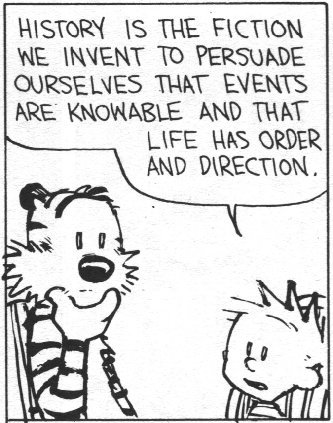
History, in the end, is only another kind of story, and stories are different from the truth. The truth is messy and chaotic and all over the place. Often it just doesn’t make sense. Stories make things make sense, but the way they do that is to leave out anything that doesn’t fit. And often that is quite a lot. -- Paul Murray, Skippy Dies
What is history? The lies the winners tell about the losers? One damn thing after another? Back when I was a temporary historian with the Historic American Engineering Record, I knew it was just one dam after another -- Newhalem, Diablo, Gorge, and Ross (chronological order of construction in what is now North Cascades National Recreational Area). I should know -- I wrote the HAER history of the Skagit Hydroelectric Project. At the time, I viewed it as an engineering triumph. I loved those dams. Would I write the same history today? No.* Would someone else write the same history I did? Again, no. I was fascinated by the controversy over the evolution of the mathematical modeling involved in designing a constant angle (aka variable radius) thin arch dam; another HAER historian might have emphasized the nitty gritty details involved in building the dams, like hauling supplies in to a difficult to reach site in a mountain canyon. Someone reading my version would be treated to a discussion of paradigm shifts and the debate in civil engineering over empirical versus theoretical knowledge. An alternative version might leave the reader with an appreciation for innovations in pouring cement. Would one version be better than another? Who knows? Who cares?

I still tend to refer to myself as a historian because that's been my official job title more than once, but I'm not sure that what I think of as history (philosophically? epistemically?) matches up with the way other people would define it. I tend to lean towards the Calvin and Hobbs definition.

Data and interpretation do not automatically add up to a universal truth. We might know that a battle happened on a certain day or that a politician got voted in or out of office, but the data alone do not tell us what anything means. We tell stories to try to make sense of events, but how well those stories match up with reality is always subject to debate. In the case of the Seattle City Light dams on the Skagit, reality was being defined one way at the time they were built and another by the time the licenses started coming up for renewal. Back in the 1920s, high dams and humongous powerhouses were viewed as progress; today they're environmental rape and an aberration. So whose story gets believed when talking about them: the engineers', the power company's, or the environmental activists'?

One definition of history is that it's the stories the winners tell about the losers. It is true that a lot of simplistic nationalistic history tends to be told that way: the winners brought civilization to the savages, liberated the oppressed peoples, fought off an evil invader, successfully rebelled against a tyrannical monarchy, or triumphed over corruption. It's also true that quite a bit of "history" is written as retroactive justification for various actions. However, the losers (or at least the ones that survive) are perfectly capable of telling their own stories, and if they tell them loud enough and long enough their narratives can drown out the winner's tale. Who decides who the winners were? It doesn't take long, and you have competing narratives, interpretations, and meanings. The more time passes, the more competing narratives you have, some based in fact and some in wishful thinking. Everyone might agree on dates and names and where things happened, but no two stories are ever going to be the same.

*For sure I wouldn't start it off with a cheesy poem about "At every waterfall two angels stay/One clothed in rainbows, the other in spray/The first the beauty of the scene reveals/The last revolves the mighty waterwheels."

Wednesday, March 5, 2014

Other than that, Mrs. Lincoln, how did you enjoy the play?

Reading a biography is always kind of interesting. It's pretty common for the reader to discover that the biographer really did not like his or her subject matter. In fact, some biographies are born out of a writer or a historian's strong antipathy towards a subject; the writer wants to prove just what a flaming asshat the person was.

I'm not sure just what motivated Jennifer Fleischner to write Mrs. Lincoln and Mrs. Keckly, but, wow, Fleischner definitely despised Mary Todd Lincoln. She basically concludes that Mary was a totally self-centered harridan who made Lincoln's life hell and deserved to die crazy and alone. On the other hand, Elizabeth ("Lizzy") Keckly, the former slave and dressmaker who wrote a tell-all about her association with the Lincolns, was one step away from sainthood because of her pluck and business skills. Doesn't matter what Mary does, Fleischner figures out a way to put a negative spin on it. Doesn't matter what Lizzy does, Fleischner turns it into a positive. I don't think I've ever seen a biographer before who even seemed to begrudge the fact her subject managed to have a decent burial. Fleischner manages that neat trick by contrasting Mary Lincoln's current resting place (next to her husband in an elaborate tomb in Springfield, Illinois) with Elizabeth Keckly's (unknown) in a way that makes it seem like it's Mary's fault Elizabeth didn't end up in a high dollar mausoleum, too.

I read a couple reviews of this book in which the reviewers seemed to think Fleischner painted Mary Lincoln in a sympathetic light. Well, maybe it's just me, but I don't see where calling Mary Lincoln self-centered or a narcissist when she breaks down with grief over the death of a child is a particularly sympathetic move on the part of a biographer. Her suggesting over and over that Abraham Lincoln never really loved his wife, that he was pressured into marrying her because he'd started courting her and couldn't figure out a way to extricate himself, also struck me as bizarre. It is true that Lincoln loved another woman before he met Mary. All his biographers agree he truly loved Ann Rutledge and was devastated when she died. That doesn't mean he was incapable of ever loving anyone else. I couldn't figure out just why Fleischner was so insistent on portraying the Lincolns as being trapped in a loveless marriage, especially when there's a fair amount of documentation showing that wasn't true. Not many letters between the couple survive (their son Robert burnt most of them in the 1890s), but the ones that do have been described by other historians and biographers as affectionate.

It is true Mary had a volatile personality. It is possible, if one wanted to indulge in retroactive psychoanalysis, that she suffered from bipolar disorder. She did seem to go through manic periods. Another possibility Fleischner suggests is that Mary had untreated diabetes. Both hypoglycemia and hyperglycemia can affect a person's behavior. On the other hand, in Team of Rivals Doris Kearns Goodwin described many of the same situations Fleischner does and put an entirely different spin on them. According to Kearns Goodwin, Mary's spending spree on furnishings for the White House wasn't a mindless spending spree to feed her own ego but an attempt to refurbish the President's residence after several decades of neglect. She wasn't indulging in shopping for her own gratification but in attempt to make the White House worthy of its public role. Unfortunately, she was unbelievably bad with money. She never met a budget she couldn't destroy. She'd grown up in a household where money was never an issue, and, once Abraham Lincoln became a successful lawyer, hadn't had to worry about a budget before getting to the White House.

For that matter, Kearns Goodwin describes a number of incidents that Fleischner glosses over. Fleischer describes Mary as visiting wounded soldiers once; Kearns Goodwin notes that Mary volunteered at the hospitals many times and would spend hours talking with and comforting the soldiers. She wrote letters for them, read to them, put in long hours, and avoided having her visits publicized, which is hardly the behavior of a self-centered harridan.

The parts of the book that focused on Elizabeth Keckly tended to tilt the other way. Elizabeth is the plucky heroine coping with adversity, she endures the hardships of slavery as well as the indignity of being owned by people who are just unbelievably bad with money -- Virginia planters who by birth are the closest thing this country would have to an aristocracy but through incompetence and over-breeding (when you have a zillion children, a family fortune can disappear pretty fast) are the equivalent of the impoverished vicars and down-at-the-heel landed gentry in 19th century English novels. In a Bronte novel, the daughters would all end up as governesses. In the real world of antebellum Virginia, the women struggled as poorly paid schoolteachers trying to operate private academies out of their own homes and the men became lawyers with not enough clients to prevent them from continually falling into debt. One of the ongoing features of Elizabeth Keckly's early life is that her owners, the Burwells, seem to be perpetually dodging bill collectors or bankruptcy.

The fact that Elizabeth manages to avoid being sold down the river is fairly notable in itself, slaves being one of the easily liquidated assets impoverished Virginia planters had, but she does. The Burwells take great pride in not ever selling any of "their people." Of course, how much of that determination not to sell was moral fortitude and how much was reluctance to try untangling a legal entailment to the Burwell estate that prevented selling slaves easily is debatable. They may have just been reluctant to spend money on attorney fees if challenged by another family member. In any case, instead of being sold, slaves were lent or bequeathed to family members. Elizabeth goes from one member of the Burwell family to another; eventually she ends up in St. Louis, Missouri. The city has a sizable number of slaves who are rented out by their owners; Elizabeth persuades her master to do the same: let her work for wages in the city while returning a portion of those wages to him. She's a skilled seamstress; she quickly builds a reputation for being able to do the difficult fittings the fashions of the time dictated. Her clientele grows and eventually help her buy the freedom of herself and her teenage son. For reasons that were unclear in the book, she decides to leave St. Louis and moves to Washington, D.C. It is in Washington that her path crosses that of Mary Lincoln.

Once Elizabeth Keckly becomes Mary Lincoln's dressmaker, they see a lot of each other. Elizabeth becomes Mary's confidante; she's in the house with the family when Willie Lincoln dies from typhoid, and she's there almost continuously comforting Mary when President Lincoln is shot. She even accompanies Mary back to Illinois to help her get settled there. She had a thriving dressmaking business in Washington, which she neglects in order to help Mary Lincoln. She behaves, in short, more like a close friend or a family member than as a paid employee. She continues to be close to Mary until she makes a fatal mistake: in 1867 she publishes a memoir.

According to Elizabeth, her book was intended to counter all the harsh things being said about Mary in the press. She wanted to show Mary in a good light. Mary doesn't see it that way; the two women never speak to each other again.

This was an interesting book, especially with Team of Rivals still fresh in my mind. There was a strong contrast between Goodwin's nterpretation of events and Fleischner's. One thing that struck me as odd was that some of the social events that one would think would be particularly interesting to describe in talking about Mary Lincoln were barely mentioned in Fleischner's book but were detailed in Goodwin's, which was ostensibly a book about Abraham Lincoln, his Cabinet members, and other men in politics. It truly felt as though Fleischner deliberately omitted anything that would make Mary look good.

The details about Elizabeth Keckly's early life and her relationship with the Burwell family were intriguing, too. She was a slave, but was allowed to learn to read and write. As a young woman, she was sent to North Carolina with one of the Burwell daughters after that daughter married sons and his new wife. While living there, she wrote letters back to Virginia to one of the daughters still living at home. The behavior was more like that of a sister (which she in fact was; she shared a father with the Burwell girls) than that of a slave and a household servant. After the Civil War, Elizabeth returned to Virginia to visit the Burwells several times and was a guest in their home; when one of the Burwell daughters visited Washington, D.C., she stayed with Elizabeth. It was apparently fairly common after the war for former slaves to visit their old masters, but usually it was a one shot deal. It didn't turn into a continuing relationship complete with friendly letters back and forth. It does highlight that the personal dynamics in any Southern household were a lot more complex than we can imagine today.

As for the usual question, would I recommend this book? Yes, with the caveat that a reader not take Fleischner's simplistic portrait of Mary Lincoln as the last word on the subject. I don't think either of the subjects of this particular book led lives that were quite as neatly defined as the author would have us believe.  

Update: Corrected to reflect the fact I made a mistake. The first time Elizabeth Keckly leaves Virginia it's with one of the Burwell sons and his wife, not with one of the daughters. 

Monday, January 27, 2014

Thinking about donating Grandad's fishing stuff to a museum?

You might want to go through it first to make sure there's nothing stashed in it that you'd prefer the whole world not know about. I was cataloging a stack of odds and ends that included a Helin Tackle Co. pamphlet devoted to explaining the wonders of a Flatfish lure. Something tells me the old dude figured out that his fishing books were one place his significant other would never bother looking for anything risque. This was tucked in the pages:
Definitely an early 1950s classic pose. Of course, back at the time both the picture and the pamphlet were new, the old dude wasn't that old, maybe in his 40s, and obviously interested in more than just fish. 

I have a hunch that one of these days I'll stumble across actual porn, which will then raise some interesting cataloging questions. It would qualify as historic material, but would it be relevant to our museum's mission? And do I bother noting just who made the donation so future generations will know exactly who to thank for the vintage smut? 

Sunday, June 9, 2013

Seeing this felt good

Back a few years ago, in about 2000, I got asked to serve as a local historical society's representative to a county-wide committee to work on a project that the Tourist and Recreation Association had thought up. The plan was to publicize some of the county's cultural and historical attractions. It was an interesting experience. Our county has about a dozen small groups devoted to various preservation or cultural efforts, most of which focus on just one thing, e.g., preserving a one room schoolhouse, and a few with broader goals. The representatives to the committee were a mixed lot. People definitely are strange. There were some folks who seemed to think historical knowledge is a private good and weren't real keen on sharing -- an odd attitude, to say the least. If you believe the history is important enough to form a local historical society to preserve it, shouldn't you also want to make sure as many people as possible have a chance to learn it?

Overall, though, we managed to reach some consensus and came up with a list of possible sites to include on a map. With help from the Copper Country Council for the Arts, the group put together a grant application that succeeded in getting a decent amount of funding from the Michigan Council for Arts and Cultural Affairs. It wasn't a huge amount, but, along with a few bucks kicked in by each of the participating local groups, it was enough to help pay for an individual sign to be posted at each site and for three large signs to be erected at each of the highway rest areas (Tioga Falls, Canyon Falls, and near the community of Keweenaw Bay) that tourists are likely to stop at. It's been about twelve years since this sign went up at Canyon Falls. There's some minor wear and tear, but overall it's still looking good. So are the signs at each of the heritage sites. It is remarkably satisfying to look at the end product of something designed by a committee and realize that it actually was worth doing.

The hardest part of this project, incidentally, wasn't getting a dozen people to agree on which sites should be prioritized and it wasn't finding the funding. It was getting the Michigan Department of Transportation to agree to the signage at the rest areas. If it's not their idea, they don't want it there.

If anyone feels like stalking us, the S.O. and I live fairly close to the number 7 on the map.

Sunday, May 5, 2013

And then Elo begat Toivola: History of the Finns in Michigan

Back when I was in grad school, my professors would rant about "History is more than just one damn thing after another!" Pastor Armas K. E. Holmio never got that message. Either that, or his training in the seminary meant his writing style was influenced way too much by the Old Testament and its long lists of begats. History of the Finns in Michigan has some fascinating tidbits buried in it, but it can be a hard slog finding them.

Every chapter reads like something out of the Bible, except instead of Adam begetting Cain it's the Hancock Co-operative begetting the Bruce Crossing and the Mass and the Trout Creek co-ops or the South Range temperance society begetting Negaunee and Rock and Trenary. The founding of Suomi College calls for what reads like a summary of the personnel records, i.e., "Faculty were . . . " starting with John Nikander in 1896 and wrapping up with who the archivist is at the time of publication (Holmio in 1967). When did the first Finns arrive in Michigan? Who knows, but in 1880 certain Finns lived in Calumet, and we're treated to another long list of names. No doubt people doing genealogy love the name index at the back of this book, although it is incomplete -- not every person mentioned in the text got indexed, which leads me to believe the copy editor got as burnt out on the list of names as I did.

History of the Finns in Michigan was first published in 1967. It was printed in Finnish; if I'm reading the information in the book correctly, an English translation did not appear until 2001.Why is an intriguing question, particularly when one of the interesting themes in the book is the rift developing between the older Finns -- folks who had emigrated from Finland or who were the first generation born in this country and could speak and read Finnish -- and younger generations. The intense nativism in the United States following World War I meant that children were discouraged from learning Finnish, either spoken or written, so by the time History of the Finns in Michigan was published, the number of potential readers under the age of 60 had to be fairly small. Holmio mentions this rift in a number of chapters: its effect on church going (English speaking young people had no interest in sitting through sermons preached in Finn), fraternal orders (membership in the Knights and Ladies of Kaleva began dropping as older Finns died and younger people had minimal interest in an organization that insisted on conducting all business in Finnish), and cooperatives. In the latter case, larger economic forces played a role, but the insistence on the part of older co-op members on conducting business meetings in Finnish may have hastened the end for some stores.

Another interesting portion of the book discusses the reasons for immigration: emigrants left Finland for multiple reasons, but there were two that were key: economics and avoiding the Russian draft. In the last half of the 19th century, immigrants went to the United States and Canada almost purely for economic reasons. For example, the first Finns arriving in the Copper Country in the 1860s came because they were experienced miners and were recruited by one of the mining companies. As the mining industry grew, so did the stream of immigrants looking for work in Michigan. That first wave of immigration tapered off in the late 1880s. Then the Russians changed the rules in the Duchy of Finland. Russian military service had been voluntary; the Russians made it compulsory in the early 1900s, and, not surprisingly, young men began leaving. That was the second big wave of immigration. With the first wave of immigration, quite a few men stayed in the United States only long enough to save the money they needed to buy land or establish a business back home in Finland; they didn't see themselves as permanent immigrants. The second wave came to stay. This is a section that could have benefited from an editor telling Holmio, "Hey, you've listed almost every parish in Finland in the tables; you don't need to mention each one in the text, too."  

History of the Finns in Michigan is one of those books you may find worth reading if you have Finnish ancestors, live in Michigan's Upper Peninsula, are interested in social movements like temperance or cooperatives, or have a burning desire to know the difference between Evangelical and Apostolic (aka Laestadian) Lutherans. Pastor Holmio was a Suomi Synod Evangelical minister; his take on the Apostolics is almost worth suffering through the begats. The Laestadians begat a lot: apparently it was impossible to form an Apostolic congregation without it splintering into two or three separate congregations in fairly short order,  kind of like Pentecostal and other fundamentalist congregrations in the South.

As I read the chapter on churches, I couldn't help thinking about the old adage that "history is the stories the winners tell about the losers." At the time Holmio wrote the book, the Evangelicals thought they were the winners; the Laestadians were the crazy people who didn't allow dancing or frivolity in their homes but did shout and dance in the aisles at church, the Finnish equivalent of Holy Rollers. Too bad Holmio is dead or he'd know it doesn't pay to gloat. The Apostolics may not have emphasized higher education and advanced degrees for the ministry, but they definitely knew how to begat: they were practicing quiver-full Christianity long before other fundamentalists coined the term: the family car for many Apostolic families is a 15-passenger van. They may not have won the doctrinal war, but they've triumphed in the demographic one.

History of the Finns in Michigan does have some distinct flaws. One is that it was obviously updated before its publication in 2001, but there is no mention of who did that updating. Pastor Holmio died in 1977; the person credited with the English translation, Ellen Ryynanen, passed away in 2000. Did she do the translation as one of her final activities before dying, or did she translate the book at the time it was first published? Was she also the person who updated the manuscript by adding recent dates to some sections, but not others? And if there had been a decision made to update the manuscript, why not go all out and give complete histories for organizations like the Copper Country Dairy (a farmers' cooperative that shut down in 1986)? As it is, the random pieces of more recent data are jarring. They feel anachronistic or like typographical errors. How could the author know that a certain event took place in 1999 when at that point he'd been dead for 22 years?

Another flaw is the selection of photographs. I've seen the Finnish language edition. It has numerous photographs salted throughout the book, and the photos cover a wide variety of subjects. The English language edition seems to be a lot thinner when it comes to photos, and they're all clustered in one section in the middle of the book.

As for my overall assessment of History of the Finns in Michigan? I'm glad I read it, I learned some interesting and useful information, but I'm also really happy it's a library book and not something I spent actual money to obtain.

Note: Elo and Toivola are actual town names; Elo means "life" and Toivola is "land of hope."