Showing posts with label museum. Show all posts

Thursday, December 15, 2022

Words (almost) fail me

 As my two faithful readers know, I volunteer at the local county historical society museum. Things I've assumed responsibility for are the gift shop (such as it is) and online sales. I'm the person who orders books that might sell reasonably well in the gift shop, and I manage sales through Amazon and EBay. One of the books the museum has had consistently steady sales with is a local history, which describes the development and growth of a lumber company town, Pequaming. 
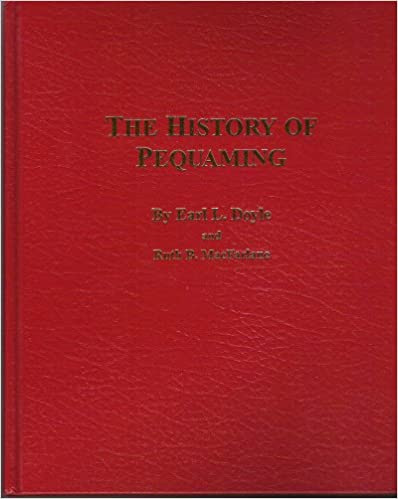
The book has been out of print for many years, but like many local histories the original press run was ordered by a historical society that (as usual) was wildly optimistic about how many copies they would manage to sell. Every time the museum runs out of copies, it turns out there is still another case or two of them stashed elsewhere in the county. We may be coming to the end of the infinite supply -- when I picked up a case of the books a couple weeks ago my source told me there were only two boxes left in addition to the one I'd just purchased for the museum -- but I know as long as we've got some, they'll keep selling.

The book had actually been out of stock in the gift shop for awhile. When the last one sold I'll confess I procrastinated about tracking down more. Still, once I did re-stock I figured we get enough questions about the book that it would be good to let people know. So I did a post on the museum's Facebook page advising folks that if they wanted a copy the book could be picked up at the museum in Baraga. $12 a copy, which is a bargain for a book that is really nicely done (hard cover, printed on glossy paper, lots of good quality photos, decent writing). All people had to do was email the historical society and we'd meet the buyers at the museum at a mutually agreed upon time. Alternatively, they could order the book directly from the museum for $16 -- $12 for the book, $4 for shipping and handling. 

A  couple people did ask about the mail order option. Gave them the mailing address for the museum and said we'd ship as soon as we got their check. Guess how many people have actually done that? To date, zip. Zero. Zilch. 

As for the pick it up in person route? Several people did ask about that. Two of them did make appointments. Twice each. Once again, guess how many bothered to show? If you're thinking it was like the no-follow-through on the mail order option you'd be right. No shows both times. Then one of them had the nerve to suggest trying a third time. 

Nope. Double nope. I figure the hours I wasted going down the luge run to town and back to sit in a cold museum waiting for book buyers that never showed added up to the equivalent of a full day. I live 14 miles from the museum so just the drive down and back can eat up close to an hour. I might go down the luge run like I'm practicing for Le Mans in the summer but once it's snow-covered? I creep. Not a fast trip either way. 

Granted, I did get stuff done while I was waiting at the museum. There is always stuff to do so it's not like I just killed time reading a first edition Tarzan of the Apes (which I actually am doing when I take a break to eat lunch down there; the mix of racism and sexism is kind of mind-blowing)(there were half a dozen Edgar Rice Burroughs 1920s' novels in a donation box; they're in the gift shop now except for the one I'm reading a couple jaw-dropping pages at a time). Nonetheless, despite the fact I did use the time productively, I have noped right out of meeting anyone at the museum during the off season. I may be retired, I may be a volunteer, but my time still has value.

So what happens now if someone wants to buy that particular book or any of the others we have listed on Amazon or EBay? I refer them to the appropriate link. The amount of stuff we have listed is fairly small. One Sterlite tote and it all came home with me. I'll even haul it along when we head for Arkansas tomorrow (assuming the storm has blown itself out and there's no freezing rain happening between here and Portage). But will people be getting that book at the bargain price of $12? Pshaw. Amazon charges fees. I've done the math. When you add in our costs (the price of the books, cost of mailers, postage, the fees Amazon sucks out) there's no way we can sell the book that cheaply. Anyone ordering it online is going to fork over $30.50. And, yes, that is more than double the in-store price, but, hey, not my idea. If anyone complains, I'll just tell them to talk to the folks who couldn't be bothered to keep their appointments.  

Tuesday, August 16, 2022

So what's new at the museum, you ask?

Well, no one is actually asking but I'm answering anyway. 

We're living in exciting times. I was finally able to erase one of the "action items" off the list on the white board in the office. Number one for the past several years has been "flagpole." A few seasons back one of the flag clips broke. We bought new clips and then discovered the method of fastening the clips to the lanyard was a tad fucked up. The lanyard is a metal cable; the clips were clumsily safety wired in place. I brilliantly figured out there had to be a better way of doing stuff. 

At about the same time, it struck me that the flagpole didn't look real good. The dominant color for the metal pipe was rust. So the museum manager made an executive decision that we wouldn't settle for just safety wiring a new clip in place: we would paint the pole and replace at least one of the pulleys that was twisted in an odd way. Flagpole went on to the action items list. Time marched on. 

Tank float or finial? Inquiring minds want to know.
At some point we noticed a strange object on the ground near the flagpole. The wind (which down in Baraga blows more or less constantly) had managed to dislodge the finial from the top of the pole. After first doing a 'holy wah, what a clever hack' when it sank in just what the finial had been, new finial got added to the flagpole's refurbishment supply list. I toyed briefly with going looking for a new copper toilet tank float, but then remembered the eagle in the storage building. If the wind had managed to dislodge the original tank float finial, sooner or later it would blow an equally lightweight replacement off the pole. Granted, the original hung in there for over 20 years, but still . . . The eagle, which appeared to be solid cast iron, was definitely not lightweight. If there is ever a wind strong enough to blow that eagle off, it will mean the museum is probably gone, too. 

Where the cast iron eagle came from to begin with is another one of those unknown provenance cases that the museum is rife with.We have absolutely no clue where the thing originated. The bird weighed a ton (well, at least 10 pounds, possibly 20), had peeling gray paint, and was mounted on a broken cast iron base. After I remembered the bird existed the S.O. removed the base, figured out what size pipe was needed to fit neatly inside the flagpole, and then tack welded the eagle to an appropriately sized 3-inch nipple. (And exactly why are short chunks of threaded pipe referred to as nipples? It's a gendered part because both ends are threaded as male, so why is it a nipple? Why isn't it a dick?) The eagle turned out to be perfectly proportioned for perching on the pole:not too big, not too small.

Long before we figured out the eagle would be the perfect finial, I started spritzing penetrating oil on the nuts on the bolts on the base for the flagpole on a regular basis. That can of penetrating oil lasted a remarkably long time, through at least three summers, and it's not empty yet. I figured penetrating oil was a good idea because the bolts, nuts, and washers had had a couple decades to rust solid in. Turned out it wasn't that bad. When the time finally came to remove the bolts, the nuts came loose without much effort. 

The flagpole is set up in what is probably the classic fashion: two very solid supporting metal posts on either side of the metal flag pole; a couple of long bolts going through all three. If we pulled the bottom bolt, the pole would pivot and we would paint it and fix the lanyard pulleys. The trick was just going to be lining up some muscle to pivot the pole: it's got to be twenty feet long, maybe longer, and is an iron pipe about 3 inches in diameter. It has, to say the least, a fair amount of mass. 

We got the muscle in July. That's when we discovered that whoever set up that flagpole was determined it wouldn't go anywhere. In addition to the two very obvious bolts, it turned out there was a third one at ground level that didn't show until we got the middle bolt out and nothing was happening. I tend to view that as overkill but it's also typical of the museum: the things that don't matter were over-engineered; the ones that count are half-ass or worse. (One of these days I'll do a rant about the wiring: the open junction boxes, switches that don't control anything, and the ceiling fans that can only be controlled by turning a circuit breaker on or off.) 

So now the flagpole is back in position, We painted the pole silver and jazzed up the eagle with gold so the pole is looking good. We can start flying an American flag again and hope that the spotlight on the side of the building really does illuminate the flag after the sun goes down.. The only question left is just how long the current flag will last. The same wind that rips toilet tank floats off the top of flag poles does a remarkably efficient job of shredding fabric.

Saturday, February 19, 2022

Feeling a bit weirded out

 Retail display fixtures definitely can slide over into totally weird and creepy pretty quickly. I've been wandering around the intertubes searching for clothing display equipment for the museum. We have a distinct lack of decent mannequins and other fixtures for exhibits that involve clothing of any sort. 

We have a couple torsos, including two dudes that have heads and arms but stop at about crotch level, which means pants are going to hang kind of loose on them. We have one complete female mannequin (head and torso, arms, and legs -- the top half and bottom join at the waist) but she's in sad shape with a smashed skull (sort of taped together and hidden with a wig when she's used) and a mangled arm. And we have a couple dress maker's dummies. When we did a World War I exhibit we resorted to using a rather busty dressmaker's dummy to display a man's uniform -- we just put it on the dummy backwards and positioned it so the lumps in its back weren't too noticeable. 

I have been pricing good mannequins for awhile now. They're not cheap. If we went all out and ordered from a museum supplies catalog there'd be a comma in the price tag for just one mannequin. The only way we'll ever order a museum quality conservation mannequin will be when/if the museum gets a very generous grant for mounting an exhibit and finds itself desperate to spend it all. Even an ordinary store display mannequin can cost several hundred dollars. 

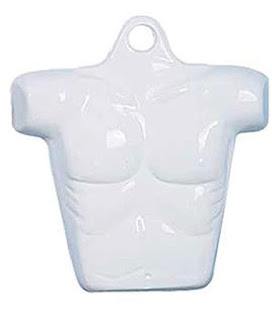
Anyway, knowing actual mannequins currently qualify as fantasy items, I went searching for shaped hangers, something that I could hang a uniform on and then display on a wall. The ideal hanger would be shaped enough to fill out the uniform jacket a bit instead of it just laying flat as well as having rounded shoulders to prevent creases forming in the material. 

You know, there really is a remarkable variety of molded plastic body parts out there. I did find the torso hangers I was looking for. They come in a variety of genders and age ranges -- you can get flat-back children, women, men. And they're cheap, which is good. I ordered four dudes, which means I can do at least two drum corps uniforms, maybe three, and then will use the fourth one to add a Vietnam era U.S. military jacket to the military exhibit.   

I did step away, figuratively speaking, from the search with just one question: why was there such a huge variety of men's "swimsuit" forms? There were a gazillion, all with a bulge to indicate that yes, this particular piece of molded plastic is male. And they were like snowflakes. When it came to the package, no two were alike. Some of the plastic men were obviously extremely well endowed; others must have jumped into a very cold lake. It was weird. None, however, resembled a piece of a Ken doll. 

I also found myself remembering an old Toivo and Eino joke ("the potato goes in front"), but ethnic humor is frowned upon these days. 

Sunday, February 13, 2022

Obligations

I checked the museum's email this morning. It appears a trip down the luge run (or maybe it's a skeleton run -- I will be facing forward while going down The Hill; not staring at the sky and screaming) is on the agenda for tomorrow. We sold another lot of vintage ladies' hankies so as the secretary/treasurer I get to go down, stuff them into an envelope, and haul the package to the post office. It may be the last lot of decorative snot rags out of the ones listed on Ebay a couple weeks ago. If only the other weirdness we'd like to get rid of would move as fast. Alas, the market for vintage laminated Tigers souvenir placemats apparently 'borrowed' from a Big Boy restaurant or an 1890s guide to American artists (Recent Ideals of American Art; a book that's both humongous and heavy) is apparently limited. We've got half a dozen of the placemats. No one wants them. Ditto the art book.

The museum's been on my mind a lot lately anyway. Besides the Ebay stuff and thinking about the water stains on the ceiling (just how many shingles go missing every time there's a strong north wind?) I'm worried about summer. At this point we have zero, nada, zilch, absolutely no volunteers waiting in the wings to serve as docents. Our older members who are still breathing and used to volunteer have hit that stage of fragility in geezerhood that doesn't allow them to deal with being on their feet as much as a docent has to be; our younger members (a depressingly small number) all have conflicting obligations, like jobs. We don't have anyone who hits that sweet spot: old enough to be retired, young enough to still be physically fit and reasonably agile. 

It is, to put it mildly, going to truly suck if we get two really nice new exhibits up and there's no one available to unlock the front door so visitors can see them. (The S.O. and I have a conflicting commitment for this coming summer; we will not be around to see what, if anything, happens between the end of May and Labor Day.)

Tuesday, January 11, 2022

Minor weirdness at the museum

I spent a couple hours yesterday at the museum. A brief moment of brilliance flared about a week ago that led to the secretary/treasurer/museum manager (aka yours truly) ordering a paper towel dispenser for the rest room. Since the day the museum opened almost 30 years ago, the paper towel dispenser has been the same type common in most people's kitchens, a simple rack on the wall that holds a roll of Scott or Bounty or whatever happens to be on sale. You know, you got to rip one sheet off at a time, assuming the towels tore evenly. Or, more likely, you got to curse quietly when the roll pulled loose from the holder and bounced across the floor and then you rolled it back up, stuck it back on the holder, and hoped the noise from the rest room fan masked the sound of your profanities. 

Anyway, it occurred to me that this particular dispenser wasn't the most sanitary piece of equipment to be using right now in the  time of cholera  middle of a pandemic. It didn't occur to me until I'd been flipping through the Uline catalog looking for something else when the towel dispensers caught my eye, but at least it did occur.  The cost was surprising low. Even the cost for the rolls for filling the thing didn't seem particularly costly considering how few people use the rest room annually. I'm actually a little surprised it took me 8 years of being the person who orders supplies for it to sink in that the rest room could use an update, but better late than not at all. 

I will confess the idea of ordering anything from Uline does not bring me joy. The company is based in Wisconsin and owned by people who thought Scott Walker was God's gift to the state and who no doubt are handing over wheel barrow loads of money to Ron Johnson's Senate campaign even as I type. Johnson had promised to serve only two terms, but oddly enough totally forgot that promise when the prospect of going back into anonymity in Wisconsin became imminent. In any case, right wing asshats is an understatement. On the other hand, they do supply an amazing range of equipment useful for almost any commercial venture, everything from dust mops to floor mats to caution tape. And a dozen different kinds of paper towel dispensers, which they promised to deliver in under 48 hours. (A promise they kept. It was ordered late Wednesday afternoon; UPS delivered it Friday.)

I opted for the Junior model of this particular type of dispenser. It doesn't take up much space and was relatively easy to mount. I didn't do the mounting, of course. I drafted the S.O. Anything that involves power tools, even if it's just a cordless drill being used to put in two screws, tends to get done by the S.O. The hardest part from my perspective was simply getting the first towel to emerge from the hole at the bottom. It's not as easy as they claim to get that first tail to drop down. 

While I was at the museum waiting for the S.O. to do the dispenser installation, I did a little more cataloging. L'Anse Township recently donated some drum and bugle corps uniform pieces -- pants, jacket, a feathered plume that once sat on a hat -- that were found stashed mysteriously in the Township Hall. The local drum and bugle corps, the Golden Eagles, were quite good in their day, even won a state championship 60 years ago, but faded away sometime in (I think) the mid-to-late 1970s. No doubt they faded for the same reason a lot of groups do: the original founders and members aged out (or got burnt out), no one replaced them, and that was that. The uniform donation reminded me that it has been 60 years so this summer the museum will do a temporary exhibit commemorating that anniversary. 

The uniform does present a bit of a mystery in itself. The jacket is small, really small (the corps was a junior corps so some of the kids in it were still in junior high and petite) but the pants have a 48 waist and legs that look long enough to have been worn by an NBA player. Two mismatched uniform pieces and a plume without a hat. Intriguing.

Fortunately, the museum has a lot more than just those three pieces for the planned exhibit. There are a couple bugles, multiple uniform pieces (both musicians and color guard), a snare drum, the heads off a bass drum, a couple color guard flags, and a lot of small memorabilia. The volunteer curator should have no trouble putting together a nice display. 

Photo was lifted from a Golden Eagles Facebook page that has unfortunately seen zero activity in almost ten years. Someone set it up before the corps did a 50-year reunion in 2012 and no one has apparently gone near it since. I'm going to do multiple press releases in the next couple of months hoping to scare more photos out of the woodwork. There must be people locally who took pictures at parades even if they didn't have kids in the corps. Wish me luck. 

Tuesday, March 16, 2021

The weirdness never ends

 Also known as "Why, dear Lord, why?"

I guess I should view this as a sign of returning normalcy. I'm back to muttering about some of the weirdness I'm still stumbling across at the museum instead of sharing a gazillion sweet-jesus-I-despise-[the orange former occupant] memes with friends who figured out a long time ago that I was not one of that man's fans. Instead of stressing about weirdness in politics I'm once again being baffled by weirdness lurking within the walls of the Baraga County Historical Museum.

I spent a few hours at the museum yesterday. I had to be there to wait for UPS to deliver a package, and, using my typical reasoning, as long as I had to come down the hill I decided I might as well put in some time working on various things that need to be worked on. I buckled down and actually completed the 2020 financial report so I can get the 2020 newsletter (such as it is -- it's going to be a challenge filling it with any news when 2020 was basically The Year Where Nothing Happened) finished and mailed sometime before it's time to do a 2021 annual report. 

The good news with the financial report is that we did actually take in more money than we spent, which I think qualifies as a minor miracle considering we had zero income from admissions and almost nothing from on-site sales. Generous donations saved us. The bad news is that nice though it was to end the year in the black, our bank balance is still much too anemic to think about replacing the almost 30-years old shingles on the roof. But for now we'll pretend that the Baraga County Historical Museum is actually a Georgia mansion and we're Scarlett O'Hara optimistically believing that she'll win Rhett back tomorrow. As long as we're not setting out buckets when it rains, we're good. 

I finished wrapping the financial report and doing the happy dance because we actually got a small payment from Amazon Smiles (the charitable con Jeff Bezos has going; consumers can assuage their collective guilt for adding to his billions in wealth by designating that a tiny percentage of the cost of a sale goes to support a charity of the consumer's choice). So few people do it that usually the museum just gets a token $5 annually, the donation Amazon makes to acknowledge we actually exist. This past year we got an additional $7.70. Enough to buy one shingle? Maybe? But it is proof (finally) that I'm not the only person who has designated the Baraga County Historical Society as a recipient of Bezo's tokenism. 

Then I moved on to cataloging. I've been emptying a Sterlite tote, a fairly big one, that was full of stuff from a display the museum did years ago on medicine in Baraga County. I don't know when they did it (before my time, obviously) but the tote has an intriguing assortment of goodies in it: a vaginal speculum (very cold and heavy -- no fun memories associated with that device)(they make disposable ones from lightweight plastic now, not that any doctor I've ever known has used one), an ether mask, scalpels, forceps, a truly disgusting looking enamel ware emesis basin, a lovely clear glass male urinal that holds up to two quarts (I'd love to know just who could piss that much in one go), lots of tonic and prescription bottles. . . started photographing things, writing descriptions down, and began thinking about where to stash stuff once I had it all documented. I didn't want to just put all back in a tote where a person would have to paw through multiple layers to retrieve just one or two items. The ideal place would be a location with shelves.

Then I remembered the metal cabinet in the exhibit area (pictured above) that functions as a plinth for a bust of Phil LaTendresse, inventor of the Pettibone Cary-Lift and a local hero. The cabinet came from a dentist's office. I have no idea what Dr. Guy stashed in it, but I figured it might be an appropriate location for medicine-related items. I had a vague memory that there were a few items in it already, but I also knew whatever was in it had never been cataloged. It was all overdue for being pulled out, sorted, and the inventory process started. 


The first few items seemed quite innocuous. Lots of 45 rpm records (that's what in the books in addition to the small naked stack; the books are albums with sleeves), a small box with bits and pieces of dental tools, a bottle of mercury, . . .well, maybe the mercury isn't exactly innocuous (it is a hazardous substance), but it's not totally weird. And then I pulled out the black leather satchel. It looked like a typical doctor's bag, the kind you see doctors carrying in movies and television shows that are set when doctors still made house calls. 

I don't think it was much of a surprise to discover it did not contain medical instruments. 

On the positive side, tossing plaster teeth is easy. No inventorying involved, just a trash can. We already have a few plaster molds on hand to provide examples in the dentistry exhibit. We do not need several dozen more. 

The dental impressions always creep me out. It's an odd feeling to pick up a plaster mold, read the penciled name on the bottom, and discover an impression that bears a startling resemblance to a rat's smile actually belonged to the father of a friend. 

I am also, of course, moderately baffled as to why any of my predecessors at the museum thought all those plaster casts of people's mouths were worth keeping. The logical thing to do would have been to put a couple in the Dr. Guy exhibit when they were setting it up, stash a couple others someplace else to have as backups just in case the ones in the exhibit got dropped and broke, and toss the other multiple dozens into the trash instead of stuffing them into that doctor's bag and shoving it into a cabinet. The weirdness never ends.  

Tuesday, January 19, 2021

Recent adventures in cataloging


A Rubbermaid tote crammed full of photographs has served as my focus at the museum for the past several weeks. The tote had a note on the lid describing the contents as "logging photos" but it turned out to be a mix. There were definitely logging photos, most of which were of course not labeled. There were mill photos, which is what I think the one above is (there is a sizable chimney lurking in the background, which implies a steam boiler, which in turns implies saws). 

It is a intriguing photo on multiple levels. First, the mystery of when -- what year is it from? Where? Why are there children in the photo? Surely those little barefoot urchins weren't child labor in a sawmill. I know really young kids wound up working in textile mills in the 19th century, but it seems a bit much to put shoeless 5-year-olds to work at a lumber mill. And who's the dude sitting in front with the woman and girls to one side and the little boys to the other? My first thought was "manager," but he's got a star on his vest. Did the local constable or sheriff also own a sawmill? It's all a bit strange. 

On another level, of course, it is a totally typical 19th century photograph. The photographer was not taking casual snapshots. The large format cameras with the glass plates meant you didn't mess around with multiple exposures or splitting people up into smaller groups; managers and owners packed everyone and everything into one shot and then purchased multiple prints to give to the workers as well as investors or co-owners. Large groups of workers tell investors the mill is doing well -- look at how many employees we have to have. You work at the mill? The photographer is coming? You ask the boss if your kids can be in the picture, too, because it might be your only chance to get a photo of them. You include tools (two of the workers are holding cant hooks). If there's a way to do it, you include the horses. This photo doesn't have any of the horse teams that would have been used at a typical 19th century mill, but there is a dog. Does the dog count?

Other photos in the tote included color snapshots from the 1990s, some of which actually had labels, family portraits and wedding photos from the early 20th century, logging camp photos, woods work photos, fishing and hunting snapshots, and photos (mostly snapshots) of local businesses. This was my favorite fishing photo of the half dozen or so I scanned. Apparently fly fishermen did not look like walking advertisements for Orvis back in the 1920s. I don't know who Fred was, but he fished in style. 

Some were mysteries of another sort. Like the photo below. It's obvious what it is -- work on what looks like a sewer line in the Village of Baraga sometime around 1920 -- but the big question is why? Why bother to  mat a photograph of a public works project on what is now known as State Avenue (in the 1920's it was Ontonagon Street; the cross street was and is Superior Avenue)? Was this something a person on the Village council wanted to hang on his wall to prove they'd actually done the work? The photo documentation makes sense; the mat does not. 
The tote is now empty, everything in it worth scanning has been scanned, the hard copies have been catalogued both in PastPerfect and in the Collections Guide Word file, and I can move on to the next box, a mix of items that seem to have a common theme of "medicine." I'm not sure what's under that tote. I do know it's never going to end. 

Sunday, July 21, 2019

Words (almost) fail me

Loyal readers (all two of you) may recall I volunteer at the local historical society museum. As part of my volunteer duties, I let myself get suckered into serving as the Secretary. That in turn means I get to tote around the museum's Tracfone. Don't recall if I ever mentioned it before, but the museum got rid of its land line a few years ago when we realized that (a) most of the time that phone would be ringing in an empty building (when open hours add up to barely 8 hours a week you know there's not going to be anyone there to answer it), (b) even when we were there if it did ring it was basically a personal call for whichever volunteer happened to be on that day or a telemarketer, and (c) it was costing almost $1,000 annually. Granted, the phone service did include Internet but we almost never used it.

We did the math and figured out that if we invested in the best smart phone Shopko had in stock for Tracfone at the time we could cut the phone expenses by at least 75 percent annually, maybe more. Then we learned we could transfer the landline number to a mobile, and that was that. Changing the phone number had been the one thing making us hesitate. So back in 2016 we made the switch. When the museum is open the cell phone stays at the museum for the use of whichever volunteer is there. When it's not, it lives with the Secretary. Me.

Minor digression. One of the advantages of the cell phone is we were able to get a Square so now we can take plastic for payments. No more listening to visitors say "I'd love to buy this book but I don't have enough cash." Not a problem, we say, and people either whip out the Mastercard or start to stammer. Fun for us either way.

Anyway, I do tend to check the cell phone daily. It has the EBay and Amazon Seller apps so I can see at a glance if the museum has sold anything (we sell stuff that doesn't fit into the museum's mission on EBay and new and used books through Amazon). I can also see if anyone has left a voice mail.

So yesterday the phone said new voice mail. It was midday, more or less. What do I hear? Someone asking for a special tour, one by appointment, for her group. They had just gotten into town, were here only for the weekend, and were wondering if someone could meet them at the museum basically ASAP. What the. . .?? On our website we do say "by appointment." We also say it on the sign on the door. The sign on the door says "seven days advance notice." The website isn't quite as specific, but what do people think "by appointment" means? You don't call a doctor's office and say you'd like an appointment for five minutes from now.

I am kind of wondering just who she thought was going to answer the phone when the museum was closed. But that's a different issue.

I am happy the phone was turned off when the person actually called. Otherwise the caller might have gotten to hear "Are you fucking kidding me? It's a gorgeous sunny Saturday in July and you expect one of our volunteers to drop everything immediately? Hell no."

Would I have tried to set something up for them if  there had been more than a few minutes notice? Maybe. I've been kind of losing patience with the public recently so it's a toss-up. I'm still liking doing the cataloging, but for sure my tolerance for humans is dropping rapidly.

Thursday, January 31, 2019

Fecking amateurs.

Or, Another Museum Horror Story.

It is astounding how much damage people can do when they don't have a clue as to what they're doing. This is especially true when they think they're doing something good. For example, I've experienced many a day spent quietly weeping, figuratively speaking, over labels written in ink on photographs and documents, especially labels that weren't necessary or were positioned on the front instead of the back. You name a practice or activity that is an absolute Never Do This for archival documents or museum objects and I can say with certainty it's been done at our local historical society museum, and done multiple times by people who were sure they were doing the right thing.

The latest nightmare: because there's no heat in the building, I decided to take uncatalogued archival material home to sort through, scan, and get into the PastPerfect database. I figured out back in December it's hard to work with documents when you're wearing mittens. There's been a clear tote packed full of documents sitting unsorted since I began volunteering in 2012. It's about a 40 quart size. I popped the lid on it awhile back to get some sense of what was in it. Didn't take long to figure out the overall theme for the stash was "schools." I'd grabbed a few things out of it in the past couple years, like some rolled up diplomas that I flattened and encapsulated, but never penetrated very deep into what looked to be a spectacular mess.

That changed this week. The last time I went into town, the S.O. and I stopped by the museum. I dropped off a stack of material that will be filed once things warm up a little and grabbed a fresh stack from the "schools" box. It is indeed a mess. Today I weep.

Why do I weep? Because salted in with a lot of odds and ends are pieces that were obviously pulled out of a scrapbook -- the residue of scotch tape adhesive is a telling clue. A ticket stub from the Milwaukee Road, matchbooks from Chicago restaurants, and other souvenirs. A few have "senior trip" scribbled on them. I have a strong hunch where they came from. Last year I inventoried several scrapbooks that belonged to a woman who graduated from Baraga High School. One had a lot of gaps in it, spaces where things had been removed. Of course, I have no way of knowing that these things came from her scrapbook other than the fact that a souvenir program from the senior girls' tea has the woman's name and adhesive residue. That constitutes a suggestion that the other ripped from someplace else items might have been hers, too, but there's no way to ever know for sure.

So what's the result in the end? If this were a crime investigation, I'd say the chain of custody has been broken. In museum terms, provenance is now unverifiable. And just in general interpretive thinking and cultural history, what happened is some well meaning amateur took a scrapbook that if left intact would have provided a really nice slice of late 1950s high school life, a coherent picture of one person's history, and turned it into a stack of miscellaneous out of context incoherent junk. All that senior trip stuff, for example, if it was still in the scrapbook would have been really nice to incorporate into the schools' exhibit with the album open to those pages. As it is, even if a matchbook has "senior trip" written on it there's no way to know which school, what year, who the student was, or anything else. In short, a potentially valuable piece of local history got converted into garbage. 

Saturday, January 5, 2019

Another museum mystery

A new year, a new mystery at the museum. This time a minor one, but a mystery nonetheless. Why is this little pink box car stuffed full of rocks?


Seriously. It's full of rocks. It's part of a homemade model train set that was in the back of a display cabinet. In the process of shuffling stuff around in the museum we discovered not only could we not move the display cabinet while it was still full of stuff, we actually needed to jettison the cabinet entirely.

We being the S.O. and myself, of course.

The original intent was merely to shove the cabinet back closer to the wall -- there was a gap of almost two feet behind it -- to make it easier to move some other things past it. I cleared away some objects that were sitting on the floor in front and on the sides of it, and told the S.O. it was ready to shove. We were about to when he took a closer look at the beast and discovered it was racked too badly to move safely. The corners were spreading, there was significant crack in the base, and there were other issues.

Okay, if we can't move it safely the obvious thing to do is empty it, get it out the door and to the landfill, figure out a substitution for it short term, and think about investing in a totally new display cabinet for the long term.

Pink box car is hiding behind stuff right in the middle on the bottom shelf.
Minor digression (aka short rant). All the cases in the museum are apparently ones that came from retail businesses. They're all used and in various states of decrepitude. Some are quite decent; a few are pretty damn old with glass tops that are so scratched up you can't see through them. I can understand hanging on to the really old ones, the ones that look like they came out of a 19th century mercantile, but do not get why the museum felt compelled to keep the pretty modern looking but falling apart case the railroad stuff was in. The museum isn't rolling in money, but it could afford to drop a few hundred dollars on a decent display case. I checked the KC Store Fixtures catalog. A comparable case, one with the equivalent amount of shelf space, can be had for under $300.

Then again, the museum was apparently allergic to spending money on things museum professionals would consider essential, like archival storage boxes. As one of the sweet little old ladies told me when I first began volunteering, "Why should we spend money on boxes when we can get them for free from Larry's?" Larry's being a local supermarket. Well, for one thing, if you spend money on actual file boxes they'll all be a uniform size, they'll have lids, and you can stack them in the attic or the storage building without them turning into a leaning tower of weirdness. But back to the box car full of rocks.
Depot model on case. Notice the large gap between the case and the wall. Given that the case was full, that gap made no sense, but then many things at the museum didn't (and still don't).  
I began emptying the display case. I started with the top. There was a model of the Baraga railroad depot sitting on one end. It sat on a substantial piece of wood. I'd never paid much attention to the railroad stuff until this week when I got forced to deal with it -- it's one of those areas that fell into the I'll get to it eventually category -- and had assumed the wood was the base for the model. You know, the model was attached to the large chunk of wood, which measured about 18 " x 18", basically covering the entire end of the case from front to back. When I tried picking it up, it didn't move. That's when I discovered it was screwed down to the end of the case.

Curiosity compelled me to unscrew that chunk of wood. I already knew as soon as I saw those screws that sure as shit there was going to be a significant hole or a crack or some other flaw under it. I was right. That end of the display case had a hole in the top that you could drop a six-pack of cheap beer through and not worry about it hitting the glass anywhere as it fell. So why the heck did the museum keep that display case to begin with? At one point the museum had a surplus of display cases -- I was told the historical society gave a bunch to the Covington Township Museum when they were getting set up. Why give away good cases but keep a crap one?! But I'm veering into a rant again. . .
Whoever made the model put little green Army men into the cab of the engine. There's also one standing in the door at the back of the caboose. 
Back to emptying the case. I got the top shelf emptied. It turned out to be the usual weird mix of stuff where things were stuffed in there that had no relationship to railroading at all but apparently there was an empty spot of the shelf someone felt a need to fill sitting side by side with some really nifty stuff from the Duluth, South Shore & Atlantic. No interpretive labels, of course. I should have gotten into that case years ago.
I am simultaneously impressed by the effort and appalled by the results. 
Then on to the bottom shelf, starting with the homemade model train at the back. It was a little strange (and I don't just mean the upcycled materials it's made from). There were large rocks sitting in the gondola car and the coal tender for the locomotive. Okay. Rock samples. Someone stuck them there to mimic a load, I guess. That sort of makes sense. I take out the locomotive and tank car first. They weigh next to nothing, which is what one would expect when something's made from old plastic bottles and paperclips. Then I grabbed the box car.

It was like trying to pick up a cement block one handed. The thing weighed a figurative ton. I get it out. I open the little sliding door. What do I see? Rocks. The box car is packed full of rocks.

At least I'm assuming it's all rocks. I did not have the energy yesterday to actually empty the box car. I'll do that the next time I'm at the museum, tempted though I am to just inventory the car as is and stick it out in the storage building for some other person to wonder about a few years from now. The one thing I've learned about the museum in my six years of volunteering is to never assume a stash of anything is just junk. Maybe all those rocks are just the equivalent of pit-run gravel, but it's just as likely that hiding in there will be a nice small piece of float copper or some decent Petoskey stones. Maybe there are some gold nuggets a now-deceased member brought back from prospecting in Alaska years ago. When it comes to the museum and it's never-ending odd little mysteries, you just never know. 

Sunday, October 7, 2018

Interesting times

And, no, I'm not talking about politics. I'm referring to the museum. I went wandering in yesterday planning to do some work. It felt a mite chilly in the building (the thermostat has been set in the low 50s since last Spring) so I cranked it up.

I knew it was going to take awhile for any warmth to spread. The building is on a concrete slab foundation, the heating system is hot water, and there's a large volume of air (30 x 70 x ~12 equals what? Over 26,000 cubic feet?) so I anticipated shivering for at least an hour. Well, time passed and the register stayed cold. Totally cold. Inert. No indication that anything warmer than the ambient temperature in the building was flowing through the system. Not good.

Turns out the furnace apparently decided that 25 years of working with no problems was long enough. There is power going to whatever it is that ignites the burner for the boiler but nothing is happening. Fortunately, we haven't had intense cold yet, no freezing temps that drop well down into the 20s and stay there for many hours, so the water pipes are safe for the moment. I do need to run down there later today and start the bathroom faucet dripping -- I was startled enough yesterday by the lack of response from the device that I blanked on keeping water running until the repair guy can get there. And I'll bring in an electric space heater so I won't have to worry about chilblains while communing with PastPerfect.

The good news, such as it is, is that the museum finally had a fiscal year with no major expenditures so we actually are running in the black. Sort of. At the moment. Keep your collective fingers crossed that all the furnace costs us is the labor charge and a relatively cheap part and not a whole new boiler.  If it does, that's when I'll make a strong push for changing the system entirely and ripping out the baseboard registers. Although I understand why "they" did it, every time we deal with positioning stuff up against a wall I am reminded again what a truly stupid design decision they were.

Saturday, July 21, 2018

Really good day at the museum

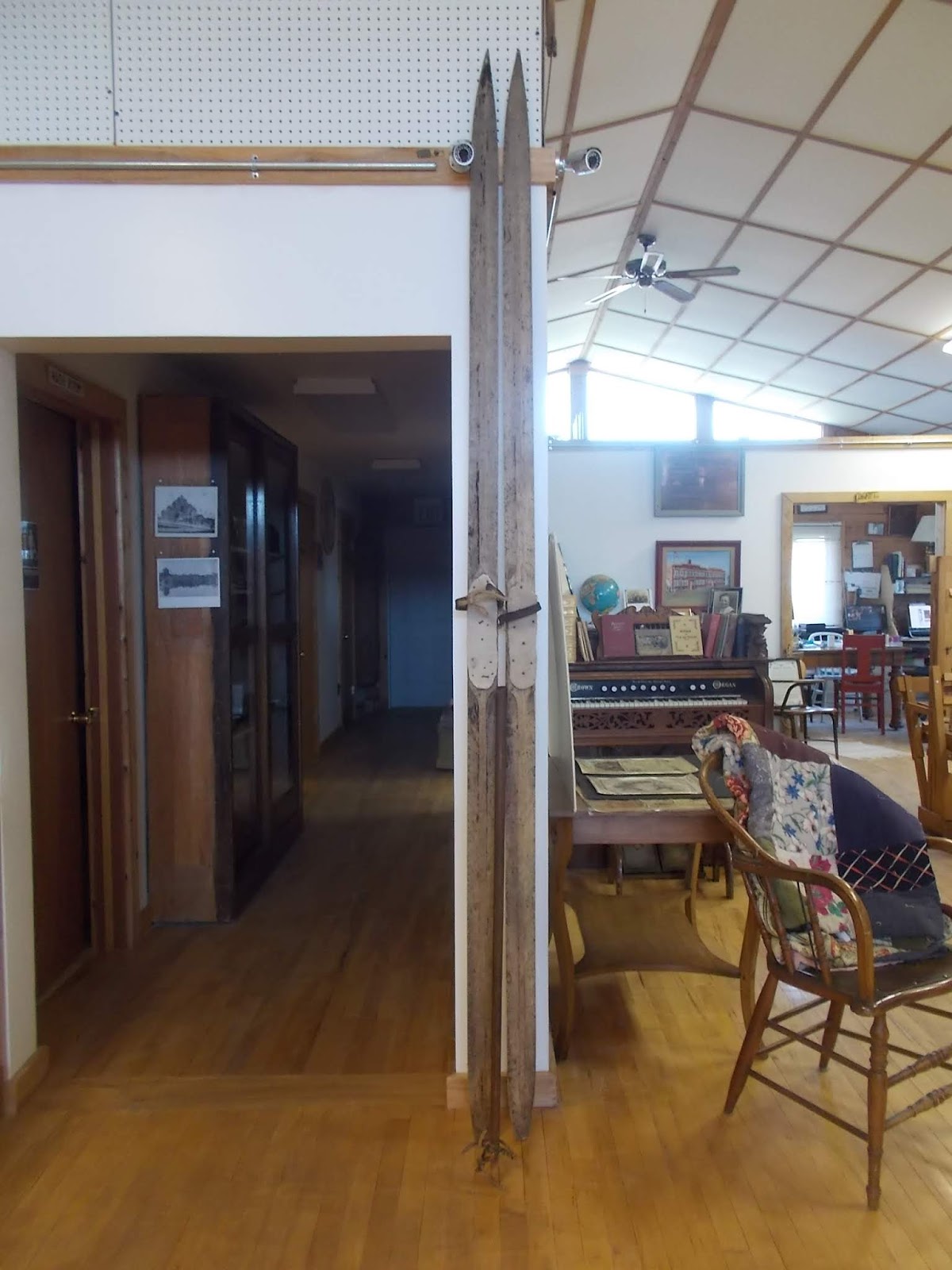
Hand-made skis that are 9 feet long.
It struck me the other day that I was having a really good day at the museum, and it wasn't just because there were no visitors. The public contact part is always the hardest for me so I'm automatically feeling a little more mellow when I'm the only person in the building.

No, it was a really good day because when I looked around the office I realized that I could actually see the tabletop. No piles of stuff needing to be sorted or dealt with, at least not on the table. The deck was, so to speak, clear. No correspondence waiting for a response, no weirdness, nothing.

Ditto the basket next to the computer. For months there has been a stack of stuff teetering there waiting to be scanned, cataloged, filed, whatever. That leaning pile of paper is gone. Oh, the basket isn't totally empty but the stuff that's at the bottom has been there for years and can probably stay there for a few more. It all relates to a part of an exhibit on collecting as hobby so it's not leaving the basket until the stuff that matches up with it is ready to go back to the person who lent the objects in the display case to us.

I know I will be rebuilding the leaning pile soon, but not immediately.

And it was a really good day because when I looked out in the exhibit area, everything I'm responsible for is basically done. There's always some minor tweaking that could happen, but all the major stuff is wrapped up. No more apologizing to visitors for the clutter or plaster dust, no explaining that the empty space on the wall will be filled soon. It actually feels a bit odd. Who knows? Maybe I'm finally going to manage to get outside and do some weeding in the native plants garden.

Monday, May 28, 2018

Museum fundraising one EBay sale at a time

I may have mentioned that one of the revenue streams -- or, more accurately, feeble trickles -- for the museum where I volunteer is EBay sales. As we go through things, get stuff cataloged and organized, whether it's a box that's been hiding in the storage building for 15 years or a donation that walked in the door last week. we inevitably find things that do not fit the museum's mission. We also find items that are duplicates, like multiple wooden ironing boards or several sets of curtain stretchers. When that happens, the item in question meets one of three possible fates: we pass it on to another institution that can use it, we toss it, or we try to sell it. We sell used books through Amazon.com, we sell bulky stuff through a local Facebook group (Baraga County Stuff for Sale), and we sell miscellaneous collectibles on EBay.

Sometimes we get lucky with EBay items, like the time we stumbled across a first edition of an early William Faulkner novel that was in excellent condition. I think it set a record for the most we've ever gotten for one item. More typically we sell collectible postcards for a couple bucks each. As long as it sells, though, and we get more for it than it costs us to package and mail it, it's found money. Every little bit helps when our annual budget is just barely four figures.

Anyway, a few days ago I thought we might have gotten lucky. Another volunteer and I were looking around in the storage building for stuff that might be sellable on Baraga County Shit Stuff for Sale and pulled a folio-sized book off a shelf that had obviously been gathering dust for awhile. It was a huge volume, probably a good two inches thick, maybe more. I had glanced it before and knew it had art prints in it. (I had in fact been thinking about pulling those prints to sell individually.) This time we took a closer look. First, I got excited because the cover was embossed with a name, and year, Florence E. Jenkins 1895. My first thought was to remember the recent Meryl Streep movie and get hopeful it was connected in some way with that Florence Jenkins. Second thought was that maybe it would be worth something on its own if it turned out there was no connection.

So I did some Internet sleuthing this morning and discovered that sadly there is no connection between the Florence Jenkins on the cover of the book and the Florence Foster Jenkins portrayed in the film. So much for any value it might have had as a collectible curiosity.

Then I looked into the value of the book as it stands. Turns out it would be worth a shit ton of money if it was in good condition. Copies in good to excellent condition are listed at anywhere from $595.00 to $800 on ABE.com. Unfortunately, the one we have looks like it was tossed off a truck and run over a few times. Calling it "well read "is a bit of an understatement. Selling it on Ebay is probably not going to help the budget a whole lot.

Okay, so it doesn't really look like it's been run over by a truck, but the binding is shot, it has loose pages, and there are water stains on the margins of some of the art prints. But who knows? Maybe there's a passionate graduate student majoring in art history somewhere out there whose life will not be complete until he or she has a personal copy of Sheldon's Recent Ideals of American Art, especially when there's no way the typical grad student (or even struggling assistant professor) could afford to drop $600 or $700 on a copy that qualified as "good." Now all I have to do is figure what a fair price for it might be. Wish me luck.

I wonder what the media mail rate is for a book that weighs almost as much as a small car?

Friday, May 4, 2018

Will the weirdness ever end?

I've been volunteering at the local county historical museum for about six years now. Shortly after I began volunteering back in 2012, I asked the historical society president if it would be okay for me to work on organizing the archives a little. The museum didn't have any finding aids for the documents in its archives, and a finding aid -- or even a simple index -- is always useful for researchers. Being able to see at a glance whether or not the collections include material relating to the researcher's interest saves everyone a lot of time.

So I got started on figuring out the filing system. Turned out there wasn't one. There were five filing cabinets in the file room. One 4-drawer cabinet had a couple empty drawers, even though they were labeled "scrapbooks," and a couple drawers with some odd stuff in it (a softball scoring book, a couple unlabeled photo albums). Two 4-drawer cabinets appeared to duplicate each other. Lots of folders with similar names and similar material. One of the other volunteers explained that one cabinet was "Jim's stuff." Jim was the Society president. Okay, so I wouldn't touch Jim's stuff. The last two cabinets, a 2-drawer sitting on top of a 3-drawer, were also an odd mishmash of papers, books, and stuff that made little or no sense. But I got started, and gradually it all came together, more or less. It is definitely still a work in progress.  On the other hand, at least now things are generally in alphabetical order.

Of course, the archives keep growing because it turned out the filing cabinets probably contained less than 20% of the documents hiding in the museum or the storage building. As time passed, after we were able to purchase a new computer and I began inventorying the objects that were in the various display cases, more archival material started crawling out from odd spaces. We had a display devoted to Bishop Baraga: the bottom area of the case had several framed items (a lithograph of Baraga on his deathbed, a matted letter from Baraga to Captain Bendry, a portrait of Baraga as a young man) leaning against a shelf positioned maybe 8 inches up in the case. When I opened the case, I discovered the area under that shelf was stuffed full of documents of various types -- and when I say packed full, I mean stuffed to the point of practically bulging. There was enough stuff crammed into the space to fill a banker's box. And it was all material that anyone coming in to the museum hoping to use our archives to do some research on Bishop Baraga (a local high school student, for example) would have found extremely useful.

Banker's box: 24"x15"x10"
In the meantime, our "file" on Baraga in the filing cabinets, the actual physical archive, was maybe 1/4 inch thick. We had a treasure trove of Baraga material, but odds are that anyone coming in to ask about it would never know.

Now take that Baraga experience and multiply it. A lot. I opened a drawer on the Bendry desk and discovered every drawer was stuffed full of material, some of which related to Captain Bendry and most of which didn't. Stepped behind the railroads exhibit and found a Rubbermaid tote crammed full of material about railroads. Checked the storage area under a display case and found another stash of archival material. It took a few years, but I had finally reached a point where I figured all the unaccounted-for weirdness had been found. Oh, there are still boxes in the museum that need to be gone through, like that tote filled with railroads material, and for sure the storage building still has a couple dozen mystery boxes, but I was confident there were no more surprises lurking in the exhibit area.

I was wrong.

Does it look like it would have a secret compartment? 
As part of the ongoing painting project, we had to move a display case that contains items relating to schools and education in Baraga County. As long as we were moving it, I told the S.O. we should pivot it so it's oriented right. For some odd reason, maybe for ease of access, it was sitting backwards. What should have been up against the wall -- the side with the unlockable sliding doors -- was positioned as the front. Pivoting it meant taking out the objects in it so they would be turned around. The case had one shelf about two-thirds of the way up and one shelf sitting, for some odd reason, almost on the bottom. It was propped up by a couple inches but not much.

I get the case emptied and go to move the bottom shelf back to where it needed to be if we were going to pivot the whole thing. Oh f. . . .

You got it. That tiny space, that section that was less than 10 inches wide and only a couple inches high, was full of stuff.

Shoot me. Just shoot me now. The weirdness is never going to end.

On the positive side, such as it is, the weirdness this time included a nice 1903 8th grade diploma.

Friday, February 23, 2018

So what's new at the museum you ask?

Nothing dramatic.

We volunteers (the few, the proud, the underappreciated) continue to plug away at the renovation project. It''s one of those things where if we hired a contractor it could have been finished in a few days, but when it's dependent on volunteers it's taking all winter. One of the guys took care of spackling the numerous nail holes in the hallway as well as doing the taping and mudding where the drywall got cut and patched as part of cutting the opening for the new door. Yesterday the S.O. got one side of the hall painted and made a good start on the other. Sometime in the next 7 days he'll finish painting, and on Saturday, March 3, we'll get a large cabinet moved.

The cabinet we move, which is indeed substantial in size (5 feet wide and close to 7 feet tall), will be used to permanently house the museum's rocks and minerals collection. We've got a lot of rocks -- different types of iron ore, chunks of float copper, fossils from the local area  (which always surprises me; there's so much granite around here I don't expect to see chunks of limestone with obvious coral) -- but haven't displayed them in awhile. I am told that back before I started volunteering the museum did a rocks and mineral exhibit, but that was a decade or two ago. We're going to get the cabinet moved, one of the volunteers who actually knows something about rocks and minerals will make sure all the chunks of whatever are properly labeled, and if all goes well no one will ever to worry about them again except to maybe do some dusting.

After the cabinet is moved, we'll take advantage of it being gone to paint the drywall behind where it is now. Theoretically that section of drywall should be close to pristine (I can't picture that cabinet having done much dancing around in the museum before being placed where it is now), but you never know. Maybe the reason the cabinet is there is that at some point someone screwed up and punched a huge hole in the wall. The one sure thing with doing any project at the museum is that there's always an unpleasant surprise of some sort lurking in the wings.

The reason the hallway had a gazillion nail holes in the walls is there used to be a gazillion historic photos hanging there. Some of those photos will be going back up; others are going into a new display system. We are giving serious thought to putting up picture molding so we'll never have to put a hole in the wall again. As part of tweaking the hallway, we're also going to do one other thing that apparently got put on hold and forgotten: hanging the door for the file room. Not sure why that door never got hung when it's been sitting out in the storage building with all the hardware on it for years, but that's a pretty minor mystery compared with some of the stuff I've stumbled across in the past five years. 

Saturday, December 2, 2017

So what's new at the museum you ask?

Well, you can no longer tell that a window ever existed in the wall where we took one out, at least not from inside the museum. A local contractor who specializes in plastering finished mudding and sanding a few days ago. That wall is now as smooth as the clichéd baby's butt. It is ready for painting so one of these days I'll probably prime it. Maybe. Given that the museum has hardwood floors as well as a lot of stuff we really don't want paint splatters on, that may be another task that gets contracted out. If I take a brush or roller in hand, we will end up with mystery splatters landing 30 feet away.
In any case, now that the plastering is done, we can do some shuffling and use that particular space as a staging area while we get to work in the hallway creating a doorway to improve the traffic flow and dissuade visitors from cutting through the office. Once that door is in, then we will paint for sure, both the newly drywalled space, the hallway, and exhibit area side of the wall we cut through. The doorway creation should be fairly fast and easy unless we run into weirdness with the way the electrical lines run through the wall. And you know we will run into weirdness. The past five years of volunteering at the museum have taught me that.
The toy in the foreground is a Buddy L steam shovel from the 1920's.

Tuesday, October 24, 2017

One of these days I need to learn to plan better

The S.O. and I have been involved with some remodeling/renovating at the museum. I mentioned a few weeks ago we were going to pull out a window and then drywall that section of wall. Well, the window came out a couple weeks ago, and the hole got covered from the outside. At the time, we were thinking the drywall part would be easy.

Why would it be easy? Because the space was basically 12 feet wide and not quite 9 feet tall. All we had to do was get two 12 by 4 feet sheets of drywall, put them up horizontally, and that would be that. So when the S.O. and another historical society member framed in the hole where the window had been, a space that was 5 feet high and 8 feet wide, more or less, they didn't worry much about the spacing on the studs. They set them at 24 inches on center. When the dry wall seam was going to be horizontal, it didn't matter much what the spacing for the vertical studs was.

Well, then we did the shopping for drywall. That's when we got reminded that stuff is heavy. Even the lightweight stuff weighs quite a bit. I knew it was going to be me and the S.O. hanging that drywall. The more I thought about it, the less enthusiastic I became about the idea of having to lift a 12-foot long sheet of drywall on to the top half of the wall. We're old. We're not quite feeble, but we're getting there. Trying to lift a large awkward chunk of something weighing well over 100 pounds did not strike me as a fun way to spend our time. I started having visions of us being flattened by a sheet of drywall, pressed like oversize butterflies on to the museum floor. So when we were almost to Menard's I asked the S.O. for his thoughts. He didn't take much persuading. . . and once we were in the store and cursing as we got the actual sheets of drywall on to the cart, shifting to using the 8 foot lengths looked even more attractive. If we had trouble getting a 8 foot sheet on to a cart a couple inches off the floor, trying to lift a much longer sheet up almost five feet on the wall would have really sucked.

Of course, when it came time to actually hang the drywall, we discovered that we could not simply set the 3 sheets vertically. Nope. The studs in the hole didn't line up right. Coming over four feet from one side of the wall put the edge of the sheet about a foot too far from the framing. That's when the S.O. got to be creative. Three sheets of drywall wound up as six pieces, each one a different size, and multiple short seams instead of one long one. But at least it's up and we can move on to the next step.

I suppose we could have rented a drywall jack and that would have solved the handling problem for the longer sheets, but it seemed rather silly to spend more on rental fees than the material we were installing cost, especially when it would have been needed for just one sheet.

Saturday, October 7, 2017

Another day, another crap donation

Every so often someone will ask me if there's anything valuable in the museum. Well, it depends on how you define valuable, I guess, but if they're thinking in terms of something you could haul to a pawn shop and get Big Buck$ for, the answer is No. There are some nifty items in the museum, but in general we get the stuff that's left when the estate sale is over, the chipped Depression glass, the rusting kitchen utensils, the crap no one wanted to buy but, hey, it's old so of course the museum will love to have it. We get to dig through a lot of fertilizer in the hope of finding an occasional pony.

Anyway, yesterday the S.O. and I went to check out a possible donation of some old farm equipment. I should have known. It had been talked up lovingly in the email proposing the donation. When we got out to the now vacant farm to pick the stuff up I discovered that once again someone was attempting to stick the museum with the crap that didn't sell at the estate sale. Apparently not even scrap metal buyers were interested in a rusting hulk of mystery gears and wheels that had been described to me as a "plow." Yeah. Right. I could be wrong, but I tend to believe that for something to qualify as a "plow" there should be at least one visible mouldboard. You know, the thing that cuts into the soil and does the actual plowing? I have no idea what the pile of scrap iron was used for originally -- it had obviously been towed behind a tractor but there were no mouldboards or discs or harrows or anything else attached to it. I kept staring at it trying to figure out just what it might have been once upon a time, but despite having grown up in farm country and spent a lot of time around farm equipment, I had no clue. Neither did the S.O. In short, in terms of it being a useful museum piece, it wasn't.

Another donated item still had a price tag on it from the estate sale. When I say the museum gets the crap that doesn't sell, I'm not joking. I did recognize this particular piece of rusting metal-- it was a row cultivator, more or less. It, too, was missing pieces but at least was still recognizable. Not recognizable enough for me to want to toss it in the back of the truck, not with a bunch of parts missing and the wheel broken, but no mystery about what it had once been.

Allegedly there was a third piece of equipment lurking somewhere on the property, a riding dump hay rake, but we couldn't find it. We walked out into the field where it was supposedly parked but never spotted the thing. Which is probably just as well, considering what poor condition the first two pieces were in. No doubt if we had found the hay rake we'd have discovered the wheels were missing (those high metal wheels are real popular for incorporating into fences or to make gates with) or most of the teeth were gone from the rake.

On the positive side, it was a nice day so wandering around an old hay field looking for derelict farm equipment wasn't a bad way to spend part of the afternoon. We even stumbled across an actual wild crab apple tree. Never did see a hay rake, though.

The down side is I now get to write a note to the donor telling him in as polite a way as possible that it turns out the museum can't take his rusting pieces of scrap iron  valuable family heirlooms after all.

Moral of the story: never ever say yes to a donation, especially one that involves using a truck to move it, without inspecting it first.

Wednesday, July 26, 2017

So much for good intentions

I had semi-vowed to start scaling back on doing stuff at the museum. I was going to focus a tad more on other stuff at home and a tad less elsewhere at anything that involved lots of time and effort. No ambitious plans, no applying for large amounts of grant money, just some gentle coasting for awhile.

Well, so much for that plan. The building has an exterior window that was put in because the original design for the museum included at some point tacking on an ell. The door into it would go through where the oversized unnecessary window currently is. Or so I'm told -- the skeptical part of me says, well, if they'd planned to put a door through there they really shouldn't have run the hot water heating system along the base of the wall or run electrical wiring through it, but that's the type of skeptical thought I generally keep to myself. (The window is in the area to the left behind the switchboard pictured below; you can see the natural light flowing in. We are going to lose a great view of The Lake when that window vanishes. Of course, if we really want to see The Lake, all we have to do is step outside.)

In any case, once we close for the season, more or less (at our last meeting we voted to stay open on Saturdays September through May), we're blocking that window. Closing it off will eliminate a source of unwanted natural light (something that a museum should have a minimum of) and provide another section of wall for displaying stuff. Simple project. No big deal. Just need to get enough bodies together to be able to lift the humongous window out and moved out of the way. Once the window is gone, it won't involve much time or effort to plug that hole.

Except, of course, if we're removing the window, we need to get all the stuff that's in the general area of the window moved. As it happens, that's the museum gift shop area. Well, if we need to get the gift shop items out of the way, we might as well relocate it all entirely. We'll move it to the traditional gift shop location in a museum: it'll become the last space you walk through before exiting the building. That is the classic placement: you amble through the exhibit spaces and then get spit out right by the souvenir racks.

Which in turn means moving the objects that are currently in the space where we're going to put the gift shop. Okay, if we're moving them, what do we do with them? Some will go into storage, no doubt, but if we're moving the rest, what's the most effective way to use them? At the moment, we have no actual dioramas in the museum. We have exhibits that are collections of stuff, but they tend to be a hodge podge. You know, our logging exhibit has a lot of tools and photos and models and whatnot, but it's not like a slice into logging camp life. It's bits and pieces. Ditto everything else. We'd tossed around the idea of editing the area where the Monarch wood-burning kitchen range sits to make it look more like an actual circa 1900 farm kitchen, but then a better idea hit me.

We have a really old switchboard that belonged to Baraga Telephone (photo above). Baraga Telephone began in a local family's front parlor. We could take that switchboard, dress a mannequin in  Edwardian era clothing, set her at the switchboard, and do a for real diorama that highlights an important piece of local history and incorporates a lot of the stuff that as it stands now is just kind of there, i.e., parlor furniture and knickknacks that always make me feel like the ladies who set it up 10 or 20 years ago were having a good time playing house more than they were thinking about historic preservation or educating the public. We have a living room/dining room set up that's no particular time period or place but does have some really pretty tea cups on the dining table. The nice thing about the time period when Baraga Telephone was first up and running was the typical middle class parlor was rather cluttered. We can disguise a vaguely-Victorian looking 1960s arm chair with an afghan, set out the Franklin Mint collectible tea cups, and in general get the feel for the era without being 100% accurate. The key thing will be positioning the switchboard so it's the piece most visible to visitors. The rest is just set dressing to emphasize Baraga Tel started out in someone's home.

Even better, we can set it up in a way that keeps visitors from touching anything. I could finally get the exhibit of my dreams: one that is totally hands off. I'm psyched.
S.O. putting up pegboard to block off view of the attic.

Okay. Moving on. Blocking a window, moving the gift shop, shuffling things to create a diorama. Well, if we're shuffling stuff, why not take the logical next step? Let's make the path visitors follow a true circle. Let's put a door in the hallway wall so no one ever has to back track. The museum has an awkward floor plan, the result of changes in design as they ran out of money 25 years ago. As things stand now, if people want to look at a display of historic photos they walk down a hall that they then either have to walk back up or cut through the office to get back to main exhibit area. Way too many people opt for cutting through the office. Not good. So we'll cut a doorway into the hallway wall. It would come through close to the corner shown above. Not a big deal.

Except, of course, then we run into having to shuffle more stuff around, including rearranging the photos on most of that wall. Rearranging the exhibit area space near the proposed opening wouldn't be bad -- there is a display case that will have to be moved, but that's a fairly minor issue. And now that I'm thinking about moving the display case, other things are occurring to me. One thing does indeed lead to another. . .

I think my first step had better be creating some empty space in the storage building. We're going to need it.