Random thoughts about roadside art, National Parks, historic preservation, philosophy of technology, and whatever else happens to cross my mind.
Saturday, December 13, 2014
New investment opportunity for KBIC?
I haven't heard too much locally about the Justice Department's recent memo regarding marijuana cultivation and sales on tribal lands, but surely there's someone on the KBIC council who can smell a business opportunity when one arises. According to an article in the Los Angeles Times, "the Justice Department will generally not attempt to enforce federal marijuana laws on federally recognized tribes that choose to allow it, as long as they meet eight federal guidelines, including that marijuana not be sold to minors and not be transported to areas that prohibit it."
I think there'd probably be a lot of hand-wringing going on over the potential dangers of commercializing pot if the subject ever gets openly discussed because reservations are often already troubled by substance abuse: alcohol, narcotics, meth, you name it. But I'd be inclined to think that the county would be a lot better off if the drunks and the tweakers evolved into stoners. Drunks get belligerent, start fights, and kill people by driving while intoxicated. Tweakers go crazy, set up shake and bake labs that endanger people, and engage in petty crime to feed their habit. What do stoners do? Get the munchies and giggle a lot. What's the worst that might happen? The profit margins for the local pizza places would improve.
It will be interesting to see what happens if KBIC does decide to get into growing and selling weed. Most of the Village of Baraga, if not all of it, falls within the reservation boundaries. Theoretically, depending on how the tribal council decided to write its laws concerning pot, someone could open a cannabis cafe in one of the currently vacant businesses on Superior Avenue. For that matter, the tribe could add a line of ganja gourmet items to the menu at the restaurant in the casino and put pot brownies next to the Little Debbies in the gas station convenience stores. Well, maybe not right next to the Little Debbies, more like behind the counter with the cigarettes.
Medical marijuana is already legal in Michigan. The biggest problem people have when they're certified to use medical marijuana is finding a good supply. It may be legal to use it, but it's not legal for anyone to sell it. The one loophole is that if you're certified to use medical marijuana, you're allowed to grow up to 6 plants for your own personal use. How you're supposed to get the seeds to start with is, of course, a mystery.
Most people, however, who have medical conditions that benefit from marijuana use (chronic pain, glaucoma, side effects of cancer treatments) aren't that keen on the idea of having to be farmers as well as users, especially when pot is not an especially fast-growing plant. It's not like growing radishes where you plant them one week and by the end of the month they're ready to eat. From seed to weed can take 6 months or more -- there are ways to make it happen faster (grow lights can force a plant into the flowering stage when it's still quite small) but even with the ultimate in hydroponic equipment and plants that are hybrids bred to grow fast, it's not an overnight process.
In short, there is a potential market of buyers. The biggest catch would be that anyone buying marijuana on a reservation would have to use it there -- it would still be illegal to transport it beyond the tribal boundaries. I could get some pot brownies to eat at the museum in Baraga; I couldn't pick some up to bring home for the S.O. to enjoy, too. (It occurs to me that the banker's box full of mangled matchbooks would probably look like a lot more fun to go through if I were thoroughly stoned when I did it. The downside, of course, is I'd probably have really poor judgement while doing so.)
On the other hand, it is now legal to buy marijuana in Colorado but it remains illegal to transport it out of the state. Pot sales in Colorado are booming, but so far as I know the DEA and other law enforcement agencies haven't set up checkpoints at the border to check tourists' luggage. (Do I want to test that perception the next time I go visit my mother? Probably not.)
Given that a number of states have legalized marijuana, either partially (medical marijuana) or totally, and the reservations have been given carte blanche to do the same, I have a hunch we'll see the complete legalization of marijuana nationally within a decade or two. Law enforcement won't be happy, but then they never are.
I think there'd probably be a lot of hand-wringing going on over the potential dangers of commercializing pot if the subject ever gets openly discussed because reservations are often already troubled by substance abuse: alcohol, narcotics, meth, you name it. But I'd be inclined to think that the county would be a lot better off if the drunks and the tweakers evolved into stoners. Drunks get belligerent, start fights, and kill people by driving while intoxicated. Tweakers go crazy, set up shake and bake labs that endanger people, and engage in petty crime to feed their habit. What do stoners do? Get the munchies and giggle a lot. What's the worst that might happen? The profit margins for the local pizza places would improve.
It will be interesting to see what happens if KBIC does decide to get into growing and selling weed. Most of the Village of Baraga, if not all of it, falls within the reservation boundaries. Theoretically, depending on how the tribal council decided to write its laws concerning pot, someone could open a cannabis cafe in one of the currently vacant businesses on Superior Avenue. For that matter, the tribe could add a line of ganja gourmet items to the menu at the restaurant in the casino and put pot brownies next to the Little Debbies in the gas station convenience stores. Well, maybe not right next to the Little Debbies, more like behind the counter with the cigarettes.
Medical marijuana is already legal in Michigan. The biggest problem people have when they're certified to use medical marijuana is finding a good supply. It may be legal to use it, but it's not legal for anyone to sell it. The one loophole is that if you're certified to use medical marijuana, you're allowed to grow up to 6 plants for your own personal use. How you're supposed to get the seeds to start with is, of course, a mystery.
Most people, however, who have medical conditions that benefit from marijuana use (chronic pain, glaucoma, side effects of cancer treatments) aren't that keen on the idea of having to be farmers as well as users, especially when pot is not an especially fast-growing plant. It's not like growing radishes where you plant them one week and by the end of the month they're ready to eat. From seed to weed can take 6 months or more -- there are ways to make it happen faster (grow lights can force a plant into the flowering stage when it's still quite small) but even with the ultimate in hydroponic equipment and plants that are hybrids bred to grow fast, it's not an overnight process.
In short, there is a potential market of buyers. The biggest catch would be that anyone buying marijuana on a reservation would have to use it there -- it would still be illegal to transport it beyond the tribal boundaries. I could get some pot brownies to eat at the museum in Baraga; I couldn't pick some up to bring home for the S.O. to enjoy, too. (It occurs to me that the banker's box full of mangled matchbooks would probably look like a lot more fun to go through if I were thoroughly stoned when I did it. The downside, of course, is I'd probably have really poor judgement while doing so.)
On the other hand, it is now legal to buy marijuana in Colorado but it remains illegal to transport it out of the state. Pot sales in Colorado are booming, but so far as I know the DEA and other law enforcement agencies haven't set up checkpoints at the border to check tourists' luggage. (Do I want to test that perception the next time I go visit my mother? Probably not.)
Given that a number of states have legalized marijuana, either partially (medical marijuana) or totally, and the reservations have been given carte blanche to do the same, I have a hunch we'll see the complete legalization of marijuana nationally within a decade or two. Law enforcement won't be happy, but then they never are.
Friday, December 12, 2014
Blogger weirdness
I see that Blogger is busy being weird again. Word verification seems to have become the default on a number of blogs that never used to have it. Even weirder, on a couple blogs I visit regularly it's now impossible to leave comments. The comment box is there, everything looks normal, but when I type the cursor moves but no characters show up on screen. I have no idea if the comment is registering or not. Very, very strange.
More adventures in cataloging
I have no doubt mentioned more than once that one of the things I do as a volunteer at the local historical society museum is cataloging. I've been cataloging the archives as well as the artifacts. It's been interesting, and not always in a good way.
Sometimes it's a case of opening a box that's come down from the attic or in from the storage building and realizing that critters have been it. There's nothing quite so disheartening as lifting something that would have been really cool for the museum to own and discovering that mice had figured out that shredded fabric makes a great nest-building material. Sometimes there's the heartbreak of watching old documents crumble before my eyes because they were improperly stored in a hot dry sunlit area (the attic). And sometimes it's a case of "holy crap, I can't believe someone thought this garbage was museum-worthy."
Picture, if you will, a banker's box packed full of used matchbooks, matchbooks that are crumpled and mangled and just generally weird. Hundreds of matchbooks, and none of them are in a condition that a serious matchbook collector would look twice at. What is the point? What do I do with this stuff? Paw through it all looking for matchbooks from area businesses that no longer exist? When I first popped the top off that box I spotted a matchbook for a political race from the 1970s, so that was kind of neat. I actually went through a brief period of feeling moderately excited about the stash. That was before I took a closer look and realized just what poor condition most of the matchbooks were in. The Nixon campaign matchbook may have been mangled, but it was still worth saving as political ephemera. But what if that's the only good thing in the box? Is it really worth going through the entire pile hoping to find another pony?
I found the matchbook stash last spring. The box has been sitting in a corner of the office since then imploring me to do something with it. I came close to asking my high school student intern to go through it this past summer but decided I didn't want to totally discourage her. Readers may recall she was bummed out enough when we brought boxes down from the attic and discovered stuff like three dozen pageant banners and a whole lot of bug-filled cheap wigs. I don't have an intern for this school year yet and can't help but wonder if word about the boring reality of what the museum does and does not have has spread among the students at Baraga High.
In any case, it turned out those three dozen banners and the box of beetle-ridden wigs were not the end of the pageant stuff. I recently found more. In fact, I have several boxes sitting in the museum office now waiting for me to finish going through them. It's all pageant stuff: a couple black frock coats, a taffeta gown, multiple banners (just how many hundred did the pageant committee pay for?!), a dozen or so felt pennants, and lots and lots of remarkably disgusting wigs, most of which were worn by (as the pageant ads proudly proclaimed) REAL INDIANS portraying Indians. I also discovered half a dozen Naugahyde loincloths. I wonder how the REAL INDIANS felt about wearing them?
Sometimes it's a case of opening a box that's come down from the attic or in from the storage building and realizing that critters have been it. There's nothing quite so disheartening as lifting something that would have been really cool for the museum to own and discovering that mice had figured out that shredded fabric makes a great nest-building material. Sometimes there's the heartbreak of watching old documents crumble before my eyes because they were improperly stored in a hot dry sunlit area (the attic). And sometimes it's a case of "holy crap, I can't believe someone thought this garbage was museum-worthy."
Picture, if you will, a banker's box packed full of used matchbooks, matchbooks that are crumpled and mangled and just generally weird. Hundreds of matchbooks, and none of them are in a condition that a serious matchbook collector would look twice at. What is the point? What do I do with this stuff? Paw through it all looking for matchbooks from area businesses that no longer exist? When I first popped the top off that box I spotted a matchbook for a political race from the 1970s, so that was kind of neat. I actually went through a brief period of feeling moderately excited about the stash. That was before I took a closer look and realized just what poor condition most of the matchbooks were in. The Nixon campaign matchbook may have been mangled, but it was still worth saving as political ephemera. But what if that's the only good thing in the box? Is it really worth going through the entire pile hoping to find another pony?
I found the matchbook stash last spring. The box has been sitting in a corner of the office since then imploring me to do something with it. I came close to asking my high school student intern to go through it this past summer but decided I didn't want to totally discourage her. Readers may recall she was bummed out enough when we brought boxes down from the attic and discovered stuff like three dozen pageant banners and a whole lot of bug-filled cheap wigs. I don't have an intern for this school year yet and can't help but wonder if word about the boring reality of what the museum does and does not have has spread among the students at Baraga High.
In any case, it turned out those three dozen banners and the box of beetle-ridden wigs were not the end of the pageant stuff. I recently found more. In fact, I have several boxes sitting in the museum office now waiting for me to finish going through them. It's all pageant stuff: a couple black frock coats, a taffeta gown, multiple banners (just how many hundred did the pageant committee pay for?!), a dozen or so felt pennants, and lots and lots of remarkably disgusting wigs, most of which were worn by (as the pageant ads proudly proclaimed) REAL INDIANS portraying Indians. I also discovered half a dozen Naugahyde loincloths. I wonder how the REAL INDIANS felt about wearing them?
Tuesday, December 9, 2014
I'm in better shape than I thought
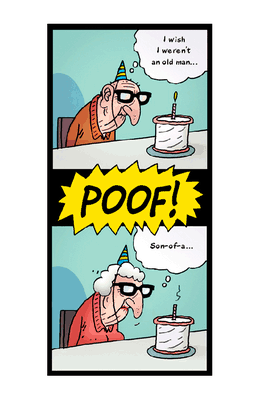
I had the odd experience yesterday of suddenly feeling remarkably young and healthy. I decided recently to go looking for a new primary care physician and, as long as I was doctor shopping, to seek out a geriatrician. After all, I'm a geezer now. It made sense to go looking for a physician who specializes in taking care of old people. People can try to put a positive spin on aging, make ridiculous statements like 60 is the new 50, and talk like they're going to live forever, but the reality is that once you hit your 60s you can no longer claim to be "middle-aged." You're old.
And you start feeling old. You wake up some days with assorted aches and pains and you haven't even done anything yet. You get nervous when you have to get up on a step stool to get something off a high shelf because the idea of falling is getting scarier and scarier. You can feel yourself sliding into that broken hip demographic. It's hitting you more and more than you're not just old, you're elderly. And then you walk into the waiting room at the geriatrician's office.
Holy wah, I'm young again. No walker, no cane, no oxygen bottle in tow, no one hovering by my side making sure I don't fall over . . . suddenly I am apparently the healthiest person in the room. It felt . . . odd.
As for why I went seeking a new PCP, among other things the doctor I had been seeing had mentioned that she's not happy with the weather here on the tundra. I got the distinct impression that as soon as her contract with the local clinic is up, she was going to disappear over the horizon to a warmer climate. I was due for an annual check-up so decided it was a good time to make the switch. I've got to drive farther, but I think it's going to be worth it.
The doctor, incidentally, affirmed I am in good shape in general, although (no surprise) I should establish a formal exercise routine. I figure that if I've gotten to the age I am now without incorporating a formal exercise routine into my daily schedule, it's not likely to happen in the future, but you never know.
And you start feeling old. You wake up some days with assorted aches and pains and you haven't even done anything yet. You get nervous when you have to get up on a step stool to get something off a high shelf because the idea of falling is getting scarier and scarier. You can feel yourself sliding into that broken hip demographic. It's hitting you more and more than you're not just old, you're elderly. And then you walk into the waiting room at the geriatrician's office.
Holy wah, I'm young again. No walker, no cane, no oxygen bottle in tow, no one hovering by my side making sure I don't fall over . . . suddenly I am apparently the healthiest person in the room. It felt . . . odd.
As for why I went seeking a new PCP, among other things the doctor I had been seeing had mentioned that she's not happy with the weather here on the tundra. I got the distinct impression that as soon as her contract with the local clinic is up, she was going to disappear over the horizon to a warmer climate. I was due for an annual check-up so decided it was a good time to make the switch. I've got to drive farther, but I think it's going to be worth it.
The doctor, incidentally, affirmed I am in good shape in general, although (no surprise) I should establish a formal exercise routine. I figure that if I've gotten to the age I am now without incorporating a formal exercise routine into my daily schedule, it's not likely to happen in the future, but you never know.
Sunday, December 7, 2014
Be careful what you wish for
It hit me the other day that there's another way to look at President Obama's executive action on immigration and deportation. Part of the proposed policy is that certain categories of currently undocumented aliens would be eligible for "deferred action." That is, they could apply for permission to stay in this country temporarily. There would be a three-year period where those previously undocumented persons could come out of the woodwork, get legal jobs, pay taxes, and generally be productive members of society. During those 3 years they would be free from the threat of deportation. That's the positive spin.
On the other hand, the deferred action on deportation is not a permanent deferral -- it's a 3-year breathing space. So what's the point of it? Someone who is here illegally will have had a chance to briefly live without fear of Immigration and Customs Enforcement (ICE) hauling him or her off to a deportation center, but what happens when the 3 years is up? Does anyone seriously believe Congress will come up with a path to citizenship or a general amnesty any time in the next couple of years? What will people who apply for that deferred action have achieved?
Well, among other things, they'll have gotten their names on a list of people who are (were?) undocumented aliens. They'll have gone from living in the shadows and wondering if ICE knows who they are to having their names in a register and guaranteeing that la migra not only knows who they are but also has a photograph, a street address, cell phone number, names of various relatives, and everything else they'll need to track their mojado asses down and stick them on a bus to Neuvo Laredo or Mexicali the instant that 3-year grace period is up.
I wonder how many undocumented persons are having similar thoughts? Are they reading the information on the White House and Department of Homeland Security web sites and doing the happy dance? Or are they kind of pausing and thinking about arm bands and yellow stars? President Obama has already set a record for number of deportations annually compared to any previous administration. If I was here illegally, I'd be thinking long and hard about whether or not the short term gain of a deferred deportation is worth the long term risk of drawing attention to myself. It's going to be interesting to see how all this plays out over the next couple of years.
On the other hand, the deferred action on deportation is not a permanent deferral -- it's a 3-year breathing space. So what's the point of it? Someone who is here illegally will have had a chance to briefly live without fear of Immigration and Customs Enforcement (ICE) hauling him or her off to a deportation center, but what happens when the 3 years is up? Does anyone seriously believe Congress will come up with a path to citizenship or a general amnesty any time in the next couple of years? What will people who apply for that deferred action have achieved?
Well, among other things, they'll have gotten their names on a list of people who are (were?) undocumented aliens. They'll have gone from living in the shadows and wondering if ICE knows who they are to having their names in a register and guaranteeing that la migra not only knows who they are but also has a photograph, a street address, cell phone number, names of various relatives, and everything else they'll need to track their mojado asses down and stick them on a bus to Neuvo Laredo or Mexicali the instant that 3-year grace period is up.
I wonder how many undocumented persons are having similar thoughts? Are they reading the information on the White House and Department of Homeland Security web sites and doing the happy dance? Or are they kind of pausing and thinking about arm bands and yellow stars? President Obama has already set a record for number of deportations annually compared to any previous administration. If I was here illegally, I'd be thinking long and hard about whether or not the short term gain of a deferred deportation is worth the long term risk of drawing attention to myself. It's going to be interesting to see how all this plays out over the next couple of years.
Saturday, December 6, 2014
The stupid runs deep
I've been catching tidbits of news lately. I try not to listen to any of it for too long because so much is profoundly depressing, but there are exceptions. The anti-Obama rhetoric Republicans are indulging in over immigration is more amusing than anything else. I'm not exactly sure just what the appropriate reaction is -- laughter or pity? -- when the idiots in Congress start bloviating about cutting off funding to Homeland Security to prevent Obama's executive action regarding immigration enforcement from taking effect. Once again Ted Cruz and his ilk are displaying all the careful thought processes of a typical two year old throwing a tantrum in the aisle of a local Safeway. I'd ask just how stupid are these guys, but I'm a little afraid of the answer.
First, and most obvious, what has Cruz et al. so worked up was President Obama saying that he was going to direct immigration officials to narrow their focus when it comes to deportations. That is, instead of casting a broad net that sweeps up everyone, concentrate instead on the undocumented aliens who have committed crimes, i.e., go after actual felons and gangbangers instead of harassing the dishwashers at Olive Garden. Somehow saying that Immigration and Customs Enforcement (an agency within the Department of Homeland Security) should be more focused in its efforts gets translated by the right into an unconstitutional power grab by the President. WTF? President Obama says, in effect, "do your job more efficiently" and suddenly he's a tyrant? Give me a break.
In any case, just what effect do the right-wingers think cutting off funding to Homeland Security will have? They're upset because the President has directed an agency that's part of the executive branch of government to NOT do something for a short period of time. This may come as a shock to some people, but NOT doing something doesn't cost any money. If anything, it saves some. So, if you cut off funding to the agency that's already been told not to do something, what's the net effect? Well, you've just made it a lot harder for that agency to do the stuff you actually want it to do (border patrol, for example) and you've had absolutely no effect on the thing that pissed you off. Does that make any sense whatsoever? I didn't think so.
Because border patrol, airport security, and other functions of Homeland Security are considered essential services of the government, none of those things will actually stop if Congress does try to withhold funding. All that will happen is the poor saps working for those agencies will see their paychecks stop while they're expected to continue working with the expectation they'll get paid eventually. It'll be a mess, a fair number of people will quit, and in the end it'll cost the government (which is another way of saying us, the taxpayers) a lot more money than if the Republicans had just had the basic smarts (and balls) to get serious about immigration reform on their own.
I'm not even going to get into just how blazingly, unbelievably stupid it is for border states that bitch constantly about porous borders to now turn around and sue the President over an executive order that directs ICE to improve border enforcement. Not surprisingly, Texas (ground zero for stupidity in this country) is leading the pack.
The stupid, it burns.
First, and most obvious, what has Cruz et al. so worked up was President Obama saying that he was going to direct immigration officials to narrow their focus when it comes to deportations. That is, instead of casting a broad net that sweeps up everyone, concentrate instead on the undocumented aliens who have committed crimes, i.e., go after actual felons and gangbangers instead of harassing the dishwashers at Olive Garden. Somehow saying that Immigration and Customs Enforcement (an agency within the Department of Homeland Security) should be more focused in its efforts gets translated by the right into an unconstitutional power grab by the President. WTF? President Obama says, in effect, "do your job more efficiently" and suddenly he's a tyrant? Give me a break.
In any case, just what effect do the right-wingers think cutting off funding to Homeland Security will have? They're upset because the President has directed an agency that's part of the executive branch of government to NOT do something for a short period of time. This may come as a shock to some people, but NOT doing something doesn't cost any money. If anything, it saves some. So, if you cut off funding to the agency that's already been told not to do something, what's the net effect? Well, you've just made it a lot harder for that agency to do the stuff you actually want it to do (border patrol, for example) and you've had absolutely no effect on the thing that pissed you off. Does that make any sense whatsoever? I didn't think so.
Because border patrol, airport security, and other functions of Homeland Security are considered essential services of the government, none of those things will actually stop if Congress does try to withhold funding. All that will happen is the poor saps working for those agencies will see their paychecks stop while they're expected to continue working with the expectation they'll get paid eventually. It'll be a mess, a fair number of people will quit, and in the end it'll cost the government (which is another way of saying us, the taxpayers) a lot more money than if the Republicans had just had the basic smarts (and balls) to get serious about immigration reform on their own.
I'm not even going to get into just how blazingly, unbelievably stupid it is for border states that bitch constantly about porous borders to now turn around and sue the President over an executive order that directs ICE to improve border enforcement. Not surprisingly, Texas (ground zero for stupidity in this country) is leading the pack.
The stupid, it burns.
Wednesday, December 3, 2014
Thanks for making me hate Christmas
It has begun. It started a little later than in previous years, but the deluge of "Don't say Happy Holidays!" and "Keep Christ in Christmas" messages landing in my In Box and showing up on Facebook is now in full flow. And as the annual rhetoric about the nonexistent war on Christmas heats up, once again I find myself thinking Jehovah's Witnesses just might have the right idea. They look at the historical origins of the holiday we all call Christmas; note that it is not in the Bible in any way, shape, or form; pronounce it (as it most certainly is) a Pagan Holiday; and choose to ignore it.
I wonder if they get as annoyed by all the annual stupidity over the mythical war on Christmas as I do? I've never been able to figure out how anyone with even two brain cells to rub together would believe the garbage that the rabble rousers on Fox spew each year about Christmas being under attack, but apparently a fair number of people fall for the nonsense. How anyone could believe there's a "war on Christmas" when stores start putting out Christmas merchandise right after Labor Day, every city in the country spends money on holiday decorations -- and let's get real; no municipality is going to bother with lighting displays just to celebrate the winter solstice (although it would be nice if they would; maybe some of the decorations would end up slightly less tacky) -- and over 80% of the population of the United States self-identifies as Christian is beyond me. How do you persecute a majority? It's logically impossible.
So what does it say when people start whining and bitching about other people saying "Happy holidays" instead of "Merry Christmas" or go off on a rant when they see "Xmas" instead of "Christmas"? To me it says they're mean-spirited ignoramuses who like sucking all the joy out of the season. Someone wishes you well by saying "Happy holidays" and you respond by bitching at them? You're making the Grinch look good.
I used to sort of look forward to the holiday season. Christmas isn't my favorite holiday, but I liked having an excuse to bake gum drop cakes, do some specialized crafting, and put up a few decorations. It helped brighten the darkest time of the year. Not anymore. Now I find myself bracing for the first of the sanctimonious missives -- or worse, an in my face rant -- from one of my idiot cousins (and I've got several to pick from, unfortunately) and praying for January to get here fast.
So thank you, all you warriors in the battle to defend Christmas, for doing a stellar job of killing what it is you claim you're trying to save. You're doing a great job of turning a cheerful time of year into one that people dread.
I wonder if they get as annoyed by all the annual stupidity over the mythical war on Christmas as I do? I've never been able to figure out how anyone with even two brain cells to rub together would believe the garbage that the rabble rousers on Fox spew each year about Christmas being under attack, but apparently a fair number of people fall for the nonsense. How anyone could believe there's a "war on Christmas" when stores start putting out Christmas merchandise right after Labor Day, every city in the country spends money on holiday decorations -- and let's get real; no municipality is going to bother with lighting displays just to celebrate the winter solstice (although it would be nice if they would; maybe some of the decorations would end up slightly less tacky) -- and over 80% of the population of the United States self-identifies as Christian is beyond me. How do you persecute a majority? It's logically impossible.
So what does it say when people start whining and bitching about other people saying "Happy holidays" instead of "Merry Christmas" or go off on a rant when they see "Xmas" instead of "Christmas"? To me it says they're mean-spirited ignoramuses who like sucking all the joy out of the season. Someone wishes you well by saying "Happy holidays" and you respond by bitching at them? You're making the Grinch look good.
I used to sort of look forward to the holiday season. Christmas isn't my favorite holiday, but I liked having an excuse to bake gum drop cakes, do some specialized crafting, and put up a few decorations. It helped brighten the darkest time of the year. Not anymore. Now I find myself bracing for the first of the sanctimonious missives -- or worse, an in my face rant -- from one of my idiot cousins (and I've got several to pick from, unfortunately) and praying for January to get here fast.
So thank you, all you warriors in the battle to defend Christmas, for doing a stellar job of killing what it is you claim you're trying to save. You're doing a great job of turning a cheerful time of year into one that people dread.
Friday, November 28, 2014
Pulitzer Project: The Town
Like most of the books I've read as part of my Pulitzer project, The Town was a book I'd never heard of written by an author whose name sounded vaguely familiar but with whose work I was completely unfamiliar. I had a faint recollection of having seen books by Conrad Richter on library shelves but I was reasonably sure I'd never read any of them. If The Town is typical of his work, I may be feeling relieved.
That's actually an odd thing to say because The Town was definitely readable. I picked it up at the library on Tuesday and finished it last night: three evenings' worth of reading comes close to dropping into mind candy territory. Unlike some of the other "classics" I've had to struggle through, The Town did not feel like work. It just felt . . . lame.
I'll explain, but first a brief overview of the book. The Town is the final installment in a trilogy that included The Trees and The Fields. The three books chronicle the lives of a pioneer family that left the eastern United States at about the time of the American Revolution and settled in Ohio. The first book apparently details their arrival in the wilderness, the second one gets into their efforts at farming, and by book three civilization has arrived. The little settlement that began with just one family progresses from being a village to a town to an actual city and the county seat. The Town is told through the perspective of three members of the Wheeler family: Sayward Wheeler, the middle-aged wife of an attorney (Portius Wheeler), their youngest child, Chancey Wheeler, and Rosa Tench, the illegitimate daughter of Portius Wheeler. Chancey and Rosa are approximately the same age. It doesn't take a whole lot of imagination for the reader to figure out where that particular story line is going to lead, especially when neither child seems to be particularly grounded in reality. There's a lot of tiptoeing around and dropping of various hints, but no adult seems to have brains enough to simply say in plain English, hey, young idiots, you're brother and sister. Naturally, by the time anyone does come right out and tell them why they shouldn't be hanging out together and acting like they're courting, the damage has been done and the inevitable tragedy results.
Of course, if anyone had bothered to be blunt with Chancey and Rosa when they were still young, the book would have been a lot shorter.
In addition to spending multiple chapters hinting at the risk of an incestuous love affair, the book looks at life from the perspective of Sayward Wheeler, the self-styled "woodsy" girl who likes to think of herself as a simple pioneer but ends up being the richest person in town as well as mother of the governor of the state. She's annoyed when her husband talks her into selling off pieces of the farmland she inherited from her parents so that the town can grow and a canal can be built, and she's also annoyed when Portius insists they build a good brick house and move out of the simple log cabin she'd spent most of her life in. When the book begins, Sayward has hit menopause. She's borne nine children and, at the ancient age of approximately 40, is wondering if she's going to live long enough to see her youngest and frailest son, Chancey, survive past childhood. She does, of course. She doesn't die until the eve of the Civil War. Along the way she finds her sister who had been lost in the woods decades earlier and had been presumed dead, sees one of her daughters end up married to an English aristocrat, and watches most of her other children grow up to be successful adults who marry and provide her with grandchildren.
Conrad Richter reportedly engaged in exhaustive research while writing this book and the others in the trilogy. He reviewed hundreds of documents to get a sense for the speech patterns and dialects of the early 19th century. His work has been praised for the accuracy of its portrayals of frontier life and folkways.
So why, if the book was well-researched and decently written, was I left with an overall impression of "meh"? Maybe it was the totally cliched incest subplot. Maybe it was the folksy way Sayward expressed herself -- maybe it was accurate, but it also came across as twee. Not as bad as some books that lay the colorful dialect on with a trowel, but still not quite believable. It was just a tad too cute. Or maybe it was all the weird names too many of the characters have. Did people back in early 19th century Ohio really pick names every bit as odd as some of the brain-dead names we see today? A couple of the Wheeler kids have normal names but "Sooth" and "Dezia" aren't among them. I can accept that some names were just misspelled versions of common names -- Jary instead of Gerry or Jerry, for example -- but there are limits.
Okay. Where do I rank this one? Right in the middle of the pack. It didn't stink, it was quite readable, and it wasn't work. On the other hand, it also didn't particularly impress me. On a scale of 1 to 10, it's probably a 5. Would I recommend it to other readers? Not really. I'd have to throw in a bunch of qualifiers. You know, "It's easy reading but it's too cliched." "It's easy reading but the characters aren't really believable." Etc.
Next up on the list: The Caine Mutiny by Herman Wouk. That is a book I have heard of. In fact, the book is so well-known that I was sure the L'Anse Public Library would have it in its collection. Nope. All those Danielle Steeles must take up too much shelf space because this is still another novel I have to order through Interlibrary Loan. I am happy to have a local public library, but, holy wah, there's a lot of low quality dreck taking up way too much space on its shelves.
That's actually an odd thing to say because The Town was definitely readable. I picked it up at the library on Tuesday and finished it last night: three evenings' worth of reading comes close to dropping into mind candy territory. Unlike some of the other "classics" I've had to struggle through, The Town did not feel like work. It just felt . . . lame.
I'll explain, but first a brief overview of the book. The Town is the final installment in a trilogy that included The Trees and The Fields. The three books chronicle the lives of a pioneer family that left the eastern United States at about the time of the American Revolution and settled in Ohio. The first book apparently details their arrival in the wilderness, the second one gets into their efforts at farming, and by book three civilization has arrived. The little settlement that began with just one family progresses from being a village to a town to an actual city and the county seat. The Town is told through the perspective of three members of the Wheeler family: Sayward Wheeler, the middle-aged wife of an attorney (Portius Wheeler), their youngest child, Chancey Wheeler, and Rosa Tench, the illegitimate daughter of Portius Wheeler. Chancey and Rosa are approximately the same age. It doesn't take a whole lot of imagination for the reader to figure out where that particular story line is going to lead, especially when neither child seems to be particularly grounded in reality. There's a lot of tiptoeing around and dropping of various hints, but no adult seems to have brains enough to simply say in plain English, hey, young idiots, you're brother and sister. Naturally, by the time anyone does come right out and tell them why they shouldn't be hanging out together and acting like they're courting, the damage has been done and the inevitable tragedy results.
Of course, if anyone had bothered to be blunt with Chancey and Rosa when they were still young, the book would have been a lot shorter.
In addition to spending multiple chapters hinting at the risk of an incestuous love affair, the book looks at life from the perspective of Sayward Wheeler, the self-styled "woodsy" girl who likes to think of herself as a simple pioneer but ends up being the richest person in town as well as mother of the governor of the state. She's annoyed when her husband talks her into selling off pieces of the farmland she inherited from her parents so that the town can grow and a canal can be built, and she's also annoyed when Portius insists they build a good brick house and move out of the simple log cabin she'd spent most of her life in. When the book begins, Sayward has hit menopause. She's borne nine children and, at the ancient age of approximately 40, is wondering if she's going to live long enough to see her youngest and frailest son, Chancey, survive past childhood. She does, of course. She doesn't die until the eve of the Civil War. Along the way she finds her sister who had been lost in the woods decades earlier and had been presumed dead, sees one of her daughters end up married to an English aristocrat, and watches most of her other children grow up to be successful adults who marry and provide her with grandchildren.
Conrad Richter reportedly engaged in exhaustive research while writing this book and the others in the trilogy. He reviewed hundreds of documents to get a sense for the speech patterns and dialects of the early 19th century. His work has been praised for the accuracy of its portrayals of frontier life and folkways.
So why, if the book was well-researched and decently written, was I left with an overall impression of "meh"? Maybe it was the totally cliched incest subplot. Maybe it was the folksy way Sayward expressed herself -- maybe it was accurate, but it also came across as twee. Not as bad as some books that lay the colorful dialect on with a trowel, but still not quite believable. It was just a tad too cute. Or maybe it was all the weird names too many of the characters have. Did people back in early 19th century Ohio really pick names every bit as odd as some of the brain-dead names we see today? A couple of the Wheeler kids have normal names but "Sooth" and "Dezia" aren't among them. I can accept that some names were just misspelled versions of common names -- Jary instead of Gerry or Jerry, for example -- but there are limits.
Okay. Where do I rank this one? Right in the middle of the pack. It didn't stink, it was quite readable, and it wasn't work. On the other hand, it also didn't particularly impress me. On a scale of 1 to 10, it's probably a 5. Would I recommend it to other readers? Not really. I'd have to throw in a bunch of qualifiers. You know, "It's easy reading but it's too cliched." "It's easy reading but the characters aren't really believable." Etc.
Next up on the list: The Caine Mutiny by Herman Wouk. That is a book I have heard of. In fact, the book is so well-known that I was sure the L'Anse Public Library would have it in its collection. Nope. All those Danielle Steeles must take up too much shelf space because this is still another novel I have to order through Interlibrary Loan. I am happy to have a local public library, but, holy wah, there's a lot of low quality dreck taking up way too much space on its shelves.
Thursday, November 27, 2014
Another reason to never visit India
India used to be close to the top of my "when I win the lottery" travel list. It's a huge diverse country with amazing historical sites and a fascinating history. I have a friend who teaches south Asian art history and I've occasionally envied him for the time he got to spend in Pakistan and India. Not anymore.
I knew the cities are crowded, dirty, and probably reek, but in the back of my mind there was still a vague "I'd like to go there someday" feeling. Even watching contestants on "Amazing Race" trying to turn cow shit into fuel didn't really discourage me. Everyone knows India is a country of strange contrasts: congested urban centers with modern skyscrapers and cows being milked in alleys, crowded buses and taxis jostling for driving space with ox carts, incredible wealth right next door to appalling poverty. Then I started seeing an occasional article about the public hygiene problems. Turns out the streets of Mumbai and Kolkata aren't just filled with cow shit. There's also plenty of the human kind. For a country that is becoming a global economic powerhouse, India suffers from an astounding lack of toilets. The public pissoirs and water closets that are easy to find in most industrialized countries are astoundingly rare in India. It is apparently a common sight on city streets to see men casually step up to the side of a building to urinate. Any building. I've heard people complain that city streets in New York can smell like piss. I have a hunch you haven't really smelled human urine until you've been to India.
Okay, if the men are pissing against the sides of buildings, just where are people defecating? You got it. In the streets. Maybe not quite as publicly as the dudes marking their territory on the sides of buildings, but pretty damn close to it. Apparently most people wait for the cover of darkness to go out and squat in the gutters, but not all. So the fragrance of India consists of the smell of rotting human waste on top of the cow shit and miscellaneous other animals' crap. I suppose I could live with that, especially as a tourist. It couldn't be any worse than living downwind from a hog farm (or driving through Iowa). Tolerable, if not particularly enjoyable.
And then I read an article about the complete lack of women's rest rooms. Men get to piss against buildings. Women get to hold it. Even workplaces, the factories, office buildings, and call centers where women work have very few toilets. One article described a textile factory that employed hundreds of women but had no restrooms. The women were expected to just refrain from pissing for the entire length of their shift. Unreal. People bitch in this country about being expected to just hold it until their coffee break or lunch, but can you imagine having to wait 8, 9, or 10 hours? Not surprisingly, this lack of places to pee is causing significant health problems for Indian women. It's also contributing to the rape crisis: over half the population of India still lives in housing that lacks indoor plumbing. The women have to leave their homes to relieve themselves and then are victimized when they try to use one of the local toilets or go out to piss or crap in the gutters once it's dark.
It is so bizarre. How can a country that has nuclear weapons also be so fucking primitive that there aren't enough toilets to go around? I can understand a lack of toilets in underdeveloped nations that are suffering from a lack of money or have been wracked by decades of civil unrest, like the Congo, but India? India is the home of a gazillion call centers and is also noted for exporting engineers and doctors to the rest of the world. Then again, maybe that explains why my primary care physician is now living here in Baraga County instead of back in her home country. She's not too thrilled with the long winters here, but at least there's never a problem finding a toilet.
No doubt as a tourist I would be carefully sheltered from the realities of life in India. For sure the hotel rooms would all have bathrooms, so a casual traveler might never really notice the lack of facilities elsewhere. Still, when the lottery winnings roll in, I think I'll plan to visit someplace like Iceland instead. If nothing else, it's cool enough there that if people are pissing in the streets the smell won't be as noticeable.
I knew the cities are crowded, dirty, and probably reek, but in the back of my mind there was still a vague "I'd like to go there someday" feeling. Even watching contestants on "Amazing Race" trying to turn cow shit into fuel didn't really discourage me. Everyone knows India is a country of strange contrasts: congested urban centers with modern skyscrapers and cows being milked in alleys, crowded buses and taxis jostling for driving space with ox carts, incredible wealth right next door to appalling poverty. Then I started seeing an occasional article about the public hygiene problems. Turns out the streets of Mumbai and Kolkata aren't just filled with cow shit. There's also plenty of the human kind. For a country that is becoming a global economic powerhouse, India suffers from an astounding lack of toilets. The public pissoirs and water closets that are easy to find in most industrialized countries are astoundingly rare in India. It is apparently a common sight on city streets to see men casually step up to the side of a building to urinate. Any building. I've heard people complain that city streets in New York can smell like piss. I have a hunch you haven't really smelled human urine until you've been to India.
Okay, if the men are pissing against the sides of buildings, just where are people defecating? You got it. In the streets. Maybe not quite as publicly as the dudes marking their territory on the sides of buildings, but pretty damn close to it. Apparently most people wait for the cover of darkness to go out and squat in the gutters, but not all. So the fragrance of India consists of the smell of rotting human waste on top of the cow shit and miscellaneous other animals' crap. I suppose I could live with that, especially as a tourist. It couldn't be any worse than living downwind from a hog farm (or driving through Iowa). Tolerable, if not particularly enjoyable.
And then I read an article about the complete lack of women's rest rooms. Men get to piss against buildings. Women get to hold it. Even workplaces, the factories, office buildings, and call centers where women work have very few toilets. One article described a textile factory that employed hundreds of women but had no restrooms. The women were expected to just refrain from pissing for the entire length of their shift. Unreal. People bitch in this country about being expected to just hold it until their coffee break or lunch, but can you imagine having to wait 8, 9, or 10 hours? Not surprisingly, this lack of places to pee is causing significant health problems for Indian women. It's also contributing to the rape crisis: over half the population of India still lives in housing that lacks indoor plumbing. The women have to leave their homes to relieve themselves and then are victimized when they try to use one of the local toilets or go out to piss or crap in the gutters once it's dark.
It is so bizarre. How can a country that has nuclear weapons also be so fucking primitive that there aren't enough toilets to go around? I can understand a lack of toilets in underdeveloped nations that are suffering from a lack of money or have been wracked by decades of civil unrest, like the Congo, but India? India is the home of a gazillion call centers and is also noted for exporting engineers and doctors to the rest of the world. Then again, maybe that explains why my primary care physician is now living here in Baraga County instead of back in her home country. She's not too thrilled with the long winters here, but at least there's never a problem finding a toilet.
No doubt as a tourist I would be carefully sheltered from the realities of life in India. For sure the hotel rooms would all have bathrooms, so a casual traveler might never really notice the lack of facilities elsewhere. Still, when the lottery winnings roll in, I think I'll plan to visit someplace like Iceland instead. If nothing else, it's cool enough there that if people are pissing in the streets the smell won't be as noticeable.
Subscribe to:
Posts (Atom)