Monday, April 4, 2022

So how's your Spring Break going?

It's been one of those weeks. I have thoughts, but they're not particularly coherent. It doesn't help that the Mud Season has arrived in all its glory. Our driveway is that interesting U.P. spring mix of mud and slush. Yesterday temps got up into the 40s, the sun was shining, and life seemed reasonably good. Today it's not as warm, it's gray outside, and there's a dusting of new snow. I was going to wander up to the Woman Cave to do some sewing, but am having a hard time working up the ambition to put on boots. 

My mood is not improved by the knowledge that the Original Plan for today was to pack. We were supposed to be heading south tomorrow, going down to Arkansas to visit the Younger Daughter and to scope out RV parks in the Hot Springs area just in case we decide we'd like to winter down there, but Life Interfered. Before we left we were going to gift our currently car-less Older Daughter with our old F150, which we refer to as Silver. The vehicle spent the winter buried in snow but started with no issues last week. It did take some shovel work and a tow with our plow truck to drag Silver out of the snowbank but we weren't worried about any mechanical issues. After all, it ran when we parked it. 

Famous last words. I got tasked with steering while the S.O. towed. I noticed the brake pedal felt soft. You know, soft as when I stepped on it the pedal sank gracefully and swiftly to the floorboards with zero resistance. "Sort of like stepping on a plum." This was not good. The S.O. did some checking. Turned out one of the ancient brakelines had rusted through. Why is a mystery -- the truck is barely 22 years old. Why would anything on it be rusted? Okay, slight delay in truck delivery. Had to make a run to the parts store for a new line and fittings, but it's mechanically a simple fix. The work gets done, everything seems good, the S.O. takes the truck for a test drive. 

He figures that's when he blew out an other brake line, the flexible rubber one. It's not as common a part as the metal brake lines. We checked online to see if Auto Zone had the line in stock at the closest store. Nope. We would have had to drive to Rhinelander, Wisconsin. This morning he called the local parts store in Baraga. They claim they'll have it by this afternoon. I'm not holding my breath. Once he gets the part, then he gets to do the installation . . . and we get to wait a bit to find out what will go wrong after that. 

I shouldn't complain. I'm not the one who gets to crawl under a truck that's parked outdoors on melting snow and try to loosen and tighten fittings in just barely above freezing temperatures.   


Rest in peace, C. W. McCall. Ever since hearing the song I've wanted to go over Wolf Creek Pass. 

Sunday, March 27, 2022

Provenance

The old stove

I just went up to the Woman Cave to get a fire going in the new-to-me wood stove. Theoretically after it's burning for awhile it'll get warm enough in the WoCave for me to be able to do some sewing without wearing mittens. The only question now is how long it'll take. It was still below freezing in the building when I wandered back down the driveway in search of a hot cup of coffee. I do like the way my current stove looks but if I'm going to be honest, it does not draw nearly as well as its predecessor and does seem to take a lot longer to get things warm. 

The old stove, long time readers (all two of you) may recall, was a homemade box stove. It would probably have given an insurance agent nightmares, but once it got going it burned really well. I liked to compare its appetite for consuming wood to a wino's grabbing for bottles of Ripple. I once decided to ask the S.O. about the actual history of that stove. As I suspected but wasn't sure about, the stove was created locally. Charles B. Dantes (aka Young Charlie) built the stove in his garage/shop in beautiful downtown Herman. I do not know (and doubt if the S.O. knows either and I forgot to ask if he did) if Young Charlie built it meaning to use it in his garage or if it was purpose-built for where it went: the Waiting Shack, the small building the Herman kids hung out in while waiting for the school bus in the morning. 

Why was there a Waiting Shack? Because the full-size school bus couldn't navigate the side roads, or at least not the one that probably had the most kids living on it. The bridge over Dault's Creek (which is always referred to as the Herman Creek when you live in Herman but is Dault's on the maps) for the Summit Road was considered unsafe for the buses. The fact fully loaded logging trucks ran over it all the time was apparently irrelevant. It's one thing to chance dropping multiple tons of pulpwood into the creek, risking a busload of school kids is a different story. The school board dealt with the bridge issue by contracting with someone to drive a feeder bus, i.e., an ordinary car, out to the kids who lived on the various dead end roads that fan out from beautiful downtown Herman. (In retrospect, that car was like a rolling human sardine can, way more bodies crammed into it than it had been designed to hold, all sans seatbelts. Then again, nothing had seat belts back then. In a family sedan mom's lap was presumed to be the baby seat.) 

It is also possible the bridge wasn't an issue at all. The fact the back roads were pure shit may have been more of a factor, but I like the bridge story. 

The feeder bus would go up Lystila Road to pick up the kids from there, drop them at the Waiting Shack, and then go out the Summit Road to pick up kids, back to the Waiting Shack, out the Nestoria Road, and back, until all the kids were waiting for the big bus. Whoever drove the feeder bus got a fire started in the Waiting Shack before the first run out.  The kids who got dropped off would then toss additional logs on the fire if necessary while waiting for the rest of their colleagues to arrive. 

I'm not sure when the system with the Waiting Shack started. I never thought to ask my mother. She mentioned riding a school bus into L'Anse for high school in the 1930's but before that, i.e., first through 8th grades, she and her siblings either walked or skied to the Herman School. (That school closed around the time World War II began; the building is still standing, which is a real tribute to the guys who built it considering how long it's been sitting vacant.)

Anyway, back to stove history. At some point, the S.O.'s uncle Waino bought the stove. I'm not sure when the Waiting Shack stopped being used -- they were still using a feeder bus system the last time our kids were in the L'Anse schools, which was past the time when we acquired the stove, but apparently if the shack was still there it wasn't being heated anymore.

Waiting shack, Herman School in background
Not sure why the S.O.'s uncle bought the stove, but we acquired it from him in the late 1970's. We got it set up in what was then the back porch for the Shoebox (a mobile home) and it hasn't moved since. We did try to do it reasonably safely. As noted in other posts, we started covering the wall with a sheet of asbestos, which kind of shattered while being handled so it never really got all the way up. We also put an asbestos-backed metal pad under the stove. (Asbestos really was everywhere at one point. I'm always amazed there aren't more people dropping from mesothelioma. Check out an old Girl Scout handbook sometime: there are craft projects described in pre-1970's manuals that used loose asbestos fiber to mold candle holders.)

We got the old stove out of the WoCave last summer. We debated doing something with it, like turning it into a legal incinerator. Michigan now has a law stating that if you burn trash outdoors it has to be in an incinerator that includes a chimney. No more using a basic burn barrel or pretending we're in Texas or Missouri and burning trash in ditches. We've got some old brick we could have made a pad with so it wouldn't sink out of sight immediately. In the end, though, it went up to the field (or what used to be a field) to reside on the scrap iron pile. It's probably going to be in that location for a long, long time. It is made from really thick plate steel and isn't going to rust into nothingness any time soon. Does it count as a historic object? Now that it's on the scrap iron pile, knowing the provenance becomes kind of irrelevant.

Tuesday, March 22, 2022

Once again, people are focusing on the wrong thing

I have been thinking about the rising price of gasoline lately -- not because I particularly want to, but because the media and social media are obsessed with it. As usual, it's occurred to me that as the meme suggests the problem really isn't that the prices are climbing. The problem is that too many people are getting paid shit wages. If you're on the low end of the income scale and living pay day to pay day even a minor bump up in your expenses is going to cause pain. 

I say "as usual" because every time the price of gas goes up enough to be noticeable I start hearing complaints from people that they're going to have a hard time keeping the tank filled so they can get to work or they're going to have to figure out what food item they can do without. I tend to believe that if paying $5 or $10 more to be able to get to work is going to destroy your budget you are either (a) incredibly bad at budgeting or (b) severely underpaid. 

Using myself as an example and being a person who doesn't drive a gas hog, I figured that if I was still working at my old job, the one with maybe a 5-mile round trip if I decided to drive to the salt mine instead of taking the MARTA bus, I'd end having to fill the gas tank every 12 or 13 days or so. The Focus has a 13-gallon tank, maybe. Think the most it's ever required at one feeding was about 12 gallons after the little low fuel warning lit up on the dashboard. So maybe my commute wasn't typical of the usual urbanite, so let's double the numbers. (I see people whining about long commutes if the drive takes more than 15 minutes, so one assumes most people don't actually have to drive much farther than I did.) Thinking big, maybe instead of only needing about 24 gallons per month for getting to work and running errands, I needed 48. Because I can be weirdly obsessive about some things, I took the time to do back through our credit union statements and found how much I paid a year ago and compared it with what I'm paying now. 


The numbers: rounding for the sake of ease of playing with this particular word problem, a year ago it cost me $20 to fill up the car. Yesterday it cost me $30. One does not need to be Ada Lovelace to recognize this is a 50 percent increase. So if I was still working, I'd be paying about $60 a month instead of $40, a $20 jump that would annoy me but not have me freaking out and coming up with conspiracy theories blaming whoever the current occupant of the White House happened to be. On the other hand, when I was working as a government office drone I made a decent (if not spectacular) salary so I might not even notice the increase very much. But if I were one of the poor saps working for the legal minimum wage, that added $20 expense really might mean opting for more creative ways to make pasta appetizing instead of being able to indulge in some decent protein. 

Or maybe it's just being old enough to remember when gas prices were also higher than anyone liked, 14 years ago when Bush the Younger was in office. It's hard to be upset by something when you've already seen worse. 

However, on the gripping hand, what would have me wondering and perhaps doing mini-rants about corporate greed would be noticing that two gas stations on one side of Keweenaw Bay were selling regular gasoline for $4.29 per gallon while on the other side of the bay two stations had regular priced at $4.06 (23 cents cheaper) and station number 3 had regular for $3.86. That's a 43 cent difference. Why? I can understand prices differing by a few cents, but 43? For what it's worth, the lower-priced station is locally owned; the more expensive ones are corporate. 

Anyway, circling back to a point I meant to make a couple paragraphs ago, maybe instead of bitching about how much gas costs and proposing truly stupid ideas like eliminating gas taxes for awhile (right, like that's really going to help fix the potholes or keep bridges from falling down) there should be an emphasis on paying people more. People who earned a living wage wouldn't have to compare brands of ramen looking for the least expensive option.  

Thursday, March 10, 2022

Do camels get a spa day?

I have been doing a fair amount of knitting lately and have begun thinking about non-acrylic yarns. For years I've been too cheap to work with most natural fibers, including even basic wools like the stuff that comes from sheep. Among other things, acrylic yarns are easily cleaned. When I knit stuff like afghans for infants or sweaters and mittens for kids, I want the garment to be machine washable. I might fondle the wool yarns in the store, but I'm usually unlikely to actually buy it. Some of it is basic cheapness -- if a sweater takes five large skeins of yarn to make, and each of those skeins is a natural fiber, a person can easily drop $100 just on yarn. Then when you add in the possibility that the resulting sweater would be one that shrinks to Barbie size and turns into felt if the owner foolishly throws it into a washing machine. . . acrylic seems like the logical choice for most of my projects. 

This winter, though, I've been doing small stuff. Socks. I am actually working with a sock yarn that's got a high wool content. Not a cheap yarn, by my standards, but one pair of socks doesn't actually require much yarn. Then a few weeks ago there was a discussion online among several virtual friends about hemp and hemp fiber. I did some musing about hemp yarn. I've never seen any, but have seen hemp cloth. I have a tee-shirt made from hemp that is lasting forever. The Michigan Tech chapter of NORML sold them back during one of the years I taught at Michigan's Toughest University, which means the shirt is now probably 25 years old. It still looks good. 

Anyway, I figured if a hemp tee-shirt was that durable, hemp yarn would probably stand up to a lot of abuse, too. It would probably make decent socks. So I went looking online for hemp yarn. Turns out there's a lot of it out there. Multiple companies have figured out industrial hemp can yield decent fiber. The hemp plant, the stuff planted in fields that makes it obvious hemp grown for fiber is actually pretty much of shrub, has two layers in the stem.One layer makes good fiber for weaving; the other layer is good for things like paper. Given that hemp is processed in a way similar to flax (source of linen), just on a bigger scale,  one has to assume it didn't take entrepreneurs long to find equipment and start processing hemp again.  So, lots of hemp yarn in a variety of weights/wraps/plies -- there are multiple ways of defining yarn. I'm happily comparing hemp yarns when suddenly a suggestion for something slightly different comes up.

Camel. 

Camel? Somehow I've never thought of camel as a fiber for knitting. Granted, there are things referred to as camel hair coats but it never occurred to me they might be made from actual camel hair.

The push for the camel hair yarn described it as being carefully obtained from Bactrian camels in Mongolia. The hair comes from combing the camels once a year, not shearing them, and is available in two natural colors: a tannish brown and a brownish gray. The price per skein is reasonable. I'm intrigued, but I was having trouble imagining the weight and feel of the yarn. I don't think of camels as having much in the way of hair. When I visualize a camel, it's always a dromedary, the one-humped Arabian camel, the ones zoos have for camel rides for kids. They've never struck me as having much in the way of hair -- they seem to have a fairly short coat. 

So I consulted my sister, the fiber expert. She has llamas, she spins, she weaves, she knows lot of people who mess around with various fibers. And llamas are distant relatives of camels. It turns out she does have experience with camel hair, but has never actually seen commercially produced camel hair yarn. She did a fiber arts project with kids once that involved hair from a camel ride camel. The camel hair was used to demonstrate felting. She said the kids had fun, but the hair was super dirty so things got kind of muddy. 

This raises an interesting question. Do they bathe the camels before they comb them? You know, do the Mongolian camel herders set up a day spa for the Bactrian camels and do the equivalent of a shampoo and blow dry before doing a comb out to get the hair? Or do they wash the mud off afterwards? And how dirty would the camels be when much of Mongolia is desert? Shouldn't the sand just shake out? It would be nice if the camels actually did get a spa day where they got to hang out, gossip over drinks, and get a nice massage and a pedicure in addition to the comb out. Nerf tells me that combing is a plus; it means they'd be getting the soft undercoat and not the much stiffer guard hairs.

Bactrian camels do have a lot of hair. They're much shaggier looking than dromedaries. It might be a really strong yarn. It could also be both fine and soft. According to Google, which as we all know is never wrong, some fibers that get marketed as cashmere are actually camel and not kashmiri goat. That makes the idea of buying camel hair yarn rather tempting.

On the other hand, the incredibly irritating hair shirts medieval monks and other religious ascetics wore as an act of penance were made from camel hair, so who knows? 

Tuesday, March 8, 2022

Let the whining begin

I saw the most bizarre post on Facebook this morning. A retired university professor, a dude who has a pretty generous pension and doesn't exactly live in penury, shared the fact he was going to stop driving his Dodge Ram truck and switch to using his car for running errands. The dude is a nice guy but I swear he does have moments when he's completely clueless. The urge to type something truly snarky in the comments almost overwhelmed me. I had to literally step away from the computer until the compulsion to type "Jeez, I didn't realize the state pension plan sucked that badly" passed.

It definitely does fall into a out of touch with reality upper middle class problem when you have to decide which of your two vehicles you're going to drive because it's going to cost you an extra $10 or $20 a month if you stick with your pickup truck. I can understand the people who live on extremely tight budgets now worrying about gas going back up to where it was under George W. Bush (the most expensive gasoline I've ever seen advertised was in October 2008), especially if you're commuting to work with a car, but a geezer with a comfortable retirement income? Not to mention having a spare car sitting in the driveway? And just how much driving does the typical retiree have to do in any case? The S.O. and I are retired; we both have places we go occasionally, but we don't put a whole lot of miles on our vehicle in a typical month. I joke about wanting to drive my 2009 Focus to the moon before it's completely consumed by rust, but at the slow pace the odometer is changing the rust is going to win.

On the other hand, I will confess I'm not looking forward to the next time we need to put fuel in our F350 pickup. It doesn't get used much -- we bought it to use primarily as a tow vehicle for our travel trailer -- but when it does get driven the mileage is not spectacular and the tank is apparently bottomless. 

Total digression: I keep looking at that jacked up pickup in the meme and wondering why anyone wants to drive trucks that have that much of a lift on them. What is the point? Do they think they're going to wander into an accidental mud bogging competition?

Saturday, March 5, 2022

History repeats itself

One of the more depressing side effects of aging is being stuck watching history repeat itself right down to the illogical rationalizations used to justify doing something horrific. Russia's invasion of Ukraine is no exception. From Putin's bizarre propaganda efforts before the war began to the spin he's trying to use with news now, I find myself thinking "We've seen this shit before."  

I found myself remembering that classic quote from the Vietnam war: "We had to destroy the village to save it." Turns out, when I went looking for a graphic to use as an illustration, the actual historic statement was slightly different, but the basic point is the same. In the case of Vietnam, it was we're going to incinerate you with napalm. In Ukraine it's we're going to bomb nuclear power plants because, hey, if a reactor melts down the fallout is more likely to hit Belarus than it is to drift far into Mother Russia. The invasion from the beginning definitely fell into the destroying something to save it category.

Then, in Putin's distorted world view, after the Russian army finishes turning cities into rubble, making farmland unusable with toxic waste and land mines, and slaughtering civilians Putin will expect the surviving Ukrainians to hold parades where they welcome him as a savior while showering Russian troops with flowers. 

From everything I've read lately, it's quite likely the Russians will achieve a military victory. Like the cockroach field marshal, to Putin it doesn't matter how many Russian troops die. He's got plenty of additional draftees to shove to the front. (Maybe. At least one article hinted that the troop strength is actually pretty weak, and the Russian equipment is basically shit.) Of course, once they've achieved that military victory, they'll get to learn what Pyrrhic means.

Tuesday, February 22, 2022

Science fiction or fantasy?

My most recent reading material is Andy Weir's Project Hail Mary. Weir has a fair amount of expertise in science and engineering and it shows in his work. His first book, The Martian, got all the technical stuff right. Everything that happened in the novel matched up neatly with reality; there wasn't anything that wasn't conceivably possible just by extending current technology out a bit further: sending a manned mission to Mars, having various devices working, and sufficient dramatic elements to keep a reader interested in seeing The Hero manage to survive on a diet of potatoes far longer than one would think possible. The book was readable. I enjoyed it, but had zero interest in watching the movie. 

Project Hail Mary is similar in that all the technology and science seems plausible. No violations of known laws of physics (e.g., no sudden discoveries of a faster-than-light drive or wormhole technology), for example. It does include the discovery of a life form that seems to be impossible given the conditions where it was found, but it's not totally implausible. Scientists have found marine life at depths where the water pressure should flatten them and thriving in thermal tubes where they should be getting cooked instead of breeding. So I'm willing to accept Weir's invention of 'astrophage.' 

In short, the book should be easily classifiable as hard core, old-fashioned science fiction. There's only one small problem. The plot centers around the need to Save the Planet, a classic trope in speculative fiction. An imminent threat is discovered, more or less by accident, that has the ability to turn Earth into an ice-covered lifeless rock. And it's a threat with a short timeline. If a solution isn't found within a few years it'll be too late. This is where the book steps away from being science fiction and turns into fantasy.

Humanity's response (or at least politicians' responses) is pure wishful thinking. Elves and orcs are more grounded in reality than Weir's vision. The governments of the world throw themselves into cooperating with the effort. The Chinese, Russians, Swedes, you name it, are all united in supporting Project Hail Mary. I can slide easily into a willful suspension of disbelief when it comes to accepting a lot of things authors do -- time travel, multiple universes, you name it and I probably won't quibble -- but a united Earth? That's the proverbial bridge too far. I'd be cruising along in the book, enjoying the various things The Hero has to cope with, and then there'd be a dip into governments worldwide giving the project's administrator a blank check. No, no, no. We humans would rather die a miserable, post-apocalyptic death while shivering over a dumpster fire and cooking rats than we could ever manage to get two countries, let alone the whole world, to agree on something that everyone needs. Don't agree? Just take a look at the stellar job we're all doing on agreeing on actions to slow climate change. 

Despite the fantasy element, the book is a good read. The management of the project pops up occasionally and has me muttering, but fortunately most of the novel just focuses on The Hero and the problems he personally is trying to solve. I'm actually not quite done with it -- I read another section that had the project manager bulldozing her way through bureaucracies and enjoyable though it was to see someone ream desk monkeys it got me thinking about how thoroughly unrealistic that plot element appears to be. Which is a shame, because it really would be nice to have a Project Manager for the whole planet.   

Monday, February 21, 2022

Very shakey moral high ground

 Listening to '1-A' on NPR this morning and thinking, not surprisingly, that the United States has a really short memory when it comes to history. As a society we're really good at shoving unpleasant facts deep into the memory hole. The topic of the hour is Chinese mistreatment of the Uyghur minority within China. It is undoubtedly a horrible situation. The Chinese have established "re-education" centers, moved Uyghurs from their traditional homeland and forced them to take jobs elsewhere, they've tried to prevent Uyghurs from speaking their native language and separated children from their parents. Where, one asks, could they have possibly gotten inspiration for such mass indoctrination and attempted acculturation?

Genocide of native peoples? Indoctrination efforts? Boarding schools for the children? Persecution for practicing their traditional religion? Relocation to areas far from home to work in factories? Locked in internment camps as a possible threat to national security? The irony runs deep. 

One of the news items earlier in the morning was a brief report on the Secretary of Interior explaining the latest (as in, the immediate future; Biden still has to sign the bill) addition to the National Parks system, a site in Colorado that during World War II served as a concentration camp for Japanese-Americans. Amache National Historic Site is located in southeastern Colorado near the town of Granada. It is only one of multiple sites around the nation where Japanese-Americans were imprisoned during the war. We were at war with Germany, too, but I don't recall ever hearing about German-Americans being forced to leave their homes in Milwaukee, St. Louis, and elsewhere after being given barely enough time to pack a suitcase, but maybe no one in government wanted to risk losing breweries.  

A slight digression. The bill to designate the internment camp as a national historic site met with almost zero opposition. It was one of those rare examples of Congress coming close to passing a bill unanimously. One loud exception: Mike Lee, the asshole Republican Senator from Utah. He wants absolutely no land added to the National Parks (or maybe to the Department of Interior in general) so had said the only way he'd vote for it was if Interior agreed to put an equivalent amount of land, something like 1 square mile, up for sale to private ownership. Amache was already in public ownership; it was simply being transferred from state to federal management. Of course, Lee is still seething over President Biden restoring the boundaries for Bears Ears National Monument in Utah (also all public land, both before and after the boundaries got modified, because everything included in both versions of Bears Ears was owned by the Bureau of Land Management). Lee caved after the senior Senator from Colorado leaned on him.

In any case, I could see the U.S. lecturing China on human rights and suppressing indigenous and minority peoples if it was couched as "We did something similar and we realize now it was a huge honking mistake, a major blot on our legacy, and one we've learned to regret," but, nope. It's more like that whole demonizing the Japanese never happened. Almost 80 years after the fact the country is now willing to preserve a few crumbling buildings and put up a few books on sticks, but it's not going to get mentioned in policy discussions or lecturing other nations on proper behavior.

Ditto the re-education efforts, the removal of children from their homes, and all the other efforts to change the Uyghurs. If a person is thinking about it all pretty quickly calls to mind phrases like "Indian boarding schools." The book pictured above, The Ledgerbook of Thomas Blue Eagle, is both one of the most beautiful illustrated kids' books a person can read and one of the most heartbreaking. Thomas Blue Eagle is a teenager removed from his home on the reservation in South Dakota and sent to the Carlisle Indian Industrial School in Pennsylvania. The book is the boy's journal. He's homesick, he misses his family, he gets punished whenever he forgets and speaks his native language, the school cuts his hair and changes his name, and in general they try to get him to forget he's Lakota. But he copes, he adjusts, and he looks forward to being able to go home for a visit soon. And then he dies from tuberculosis, as did massive numbers of other students in the boarding schools. It's definitely one of those keep the box of Kleenex close when you get toward the end books.   

More recently, there was the Urban Relocation Act in 1956. . . I know people who got persuaded to leave their rural homes and move to Chicago, Los Angeles, Minneapolis, or other cities in search of a better life. Native Americans were assigned social workers in the cities who would help newcomers find a place to stay and businesses that were hiring. Fred Dakota, former tribal chairman for the Keweenaw Bay Indian Community, told a story about going down to Chicago in the late 1950s and getting hired by a company that made sporting goods like bows and arrows. He'd get pointed out to plant visitors as being "a real Indian" as if he possessed some special expertise when it came to manufacturing arrows. (He didn't last long in the city. He came home to Baraga County, became active in Native politics, and is remembered now as the father of Indian gaming. The Chinese government had better hope the Uyghurs don't have a Fred Dakota because the Uyghurs will eventually end up owning the country.)

In any case, the goal of urban relocation wasn't to end rural poverty or lack of opportunity; the implicit goal was to separate people from the reservations, get them to become embedded in a dominant white culture, and gradually depopulate Native communities, thus relieving the burden on the Bureau of Indian Affairs and treaty obligations. Granted, no one was forcibly removed from their home and told they now worked in a factory a thousand miles away, but is financially coerced cultural assimilation that much better morally than forced assimilation?

You know, when an ethically dubious government program happened recently enough that people who participated in it are around to talk about it, that's not exactly ancient history. You don't have to be real smart to recognize why the Chinese consider American hand wringing and lectures about human rights to be rather meaningless.

Saturday, February 19, 2022

Feeling a bit weirded out

 Retail display fixtures definitely can slide over into totally weird and creepy pretty quickly. I've been wandering around the intertubes searching for clothing display equipment for the museum. We have a distinct lack of decent mannequins and other fixtures for exhibits that involve clothing of any sort. 

We have a couple torsos, including two dudes that have heads and arms but stop at about crotch level, which means pants are going to hang kind of loose on them. We have one complete female mannequin (head and torso, arms, and legs -- the top half and bottom join at the waist) but she's in sad shape with a smashed skull (sort of taped together and hidden with a wig when she's used) and a mangled arm. And we have a couple dress maker's dummies. When we did a World War I exhibit we resorted to using a rather busty dressmaker's dummy to display a man's uniform -- we just put it on the dummy backwards and positioned it so the lumps in its back weren't too noticeable. 

I have been pricing good mannequins for awhile now. They're not cheap. If we went all out and ordered from a museum supplies catalog there'd be a comma in the price tag for just one mannequin. The only way we'll ever order a museum quality conservation mannequin will be when/if the museum gets a very generous grant for mounting an exhibit and finds itself desperate to spend it all. Even an ordinary store display mannequin can cost several hundred dollars. 

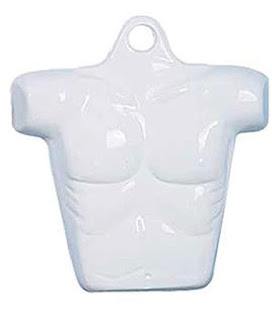
Anyway, knowing actual mannequins currently qualify as fantasy items, I went searching for shaped hangers, something that I could hang a uniform on and then display on a wall. The ideal hanger would be shaped enough to fill out the uniform jacket a bit instead of it just laying flat as well as having rounded shoulders to prevent creases forming in the material. 

You know, there really is a remarkable variety of molded plastic body parts out there. I did find the torso hangers I was looking for. They come in a variety of genders and age ranges -- you can get flat-back children, women, men. And they're cheap, which is good. I ordered four dudes, which means I can do at least two drum corps uniforms, maybe three, and then will use the fourth one to add a Vietnam era U.S. military jacket to the military exhibit.   

I did step away, figuratively speaking, from the search with just one question: why was there such a huge variety of men's "swimsuit" forms? There were a gazillion, all with a bulge to indicate that yes, this particular piece of molded plastic is male. And they were like snowflakes. When it came to the package, no two were alike. Some of the plastic men were obviously extremely well endowed; others must have jumped into a very cold lake. It was weird. None, however, resembled a piece of a Ken doll. 

I also found myself remembering an old Toivo and Eino joke ("the potato goes in front"), but ethnic humor is frowned upon these days.