|
| Sequoyah apparently searching the sky for inspiration while working on his syllabary. |
After the S.O. and I decided we'd take the long way home through Oklahoma, I checked to see what points of interest might fall close to US-259/US-59. There were several possibilities, but the two that struck me as most intriguing were
Spiro Mounds and
Sequoyah's Cabin, both of which are state historic parks. Given a choice between the two, I opted for the latter. I've seen lots and lots of piles of dirt, and, yes, it's interesting that various mound building cultures built mounds, and, yes, the artifacts looted from those mounds and now displayed in on-site museums are interesting, too, but it's always rather impersonal and vague. Sequoyah, on the other hand, was an actual person, someone with a known history and compelling narrative.
 |
| Structure built by the WPA in the 1930s to protect Sequoyah's cabin |
Sequoyah, who was also known as George Gist or George Guess, was born sometime between 1770 and 1776 in eastern Tennessee near what is now the city of Knoxville. Much of his early life is unknown; his mother was Cherokee, and, depending on the source, his father was either a British fur trader, a Scotsman, or the half-Indian son of a fur trader or Scotsman. Similarly, the source of Sequoyah's disability is unclear. He was lame in one leg, but whether this was the result of a birth defect or an early childhood injury is not known. The lameness is, however, probably the reason for the unnatural position Sequoyah has assumed in the sculpture shown above: it's the artist's attempt at indicating one leg was weaker than the other.
 |
| Sequoyah's cabin |
When I was in elementary school, I read a book about Great Indian Leaders. It was, in retrospect, a thoroughly sanitized version of their lives, but I do remember being fascinated by Sequoyah. He was, of course, presented in heroic terms first for overcoming his handicap (the bad leg) to become a skilled silversmith and then for his invention of an "alphabet" for the Cherokee. I'm not sure just how much of a handicap the bad leg actually was -- Sequoyah was a veteran of the War of 1812; he served as a warrior in the Cherokee Regiment at the Battle of Horseshoe Bend -- but creation of the Cherokee syllabary was indeed a remarkable invention.
 |
| Interior, Sequoyah's cabin. The spinning wheel supposedly was made by Sequoyah. |
A syllabary is a system of writing that uses a unique symbol for each sound in a language. Once you learn the symbols, you can sound out any document written in Cherokee phonetically and, if you speak Cherokee, know immediately what it means. This puts the Cherokee "alphabet" into a different category than the Roman alphabet we use for English writing. English has numerous combinations of letters in words that can look similar but sound differently -- tough, though, and through spring immediately to mind. Theoretically, that can't happen in Cherokee. Not having any first-hand knowledge of it myself, I don't know what type of possibilities for confusion lurk in Sequoyah's syllabary, but it would appear to be a much easier written language to learn than English is.
 |
| Typewriter with Cherokee keys donated to the State Historical Society. |
Sequoyah's invention of the syllabary was greeted with skepticism initially, but once he convinced a few influential leaders that it worked and that anyone could learn it, it spread quickly. In 1828, the
Cherokee Phoenix, a newspaper, began publishing using the syllabary, and the syllabary remains in wide use today. The existence of a written language has been credited as helping to maintain the ethnic and cultural cohesion of the Cherokee nation.
Sequoyah's Cabin state historic park was, not surprisingly, a WPA project. After Sequoyah died around 1844 (the exact date is not known), his farm was sold to a family named Blair. Sequoyah had built the cabin shortly after moving to Oklahoma; the Blairs added on to the original cabin after they bought the farm. In 1936 the Blair family transferred the property to the State of Oklahoma. To protect the cabin, the State Historical Society used WPA funding to construct a building around it. The cabin is on its original site, but is now completely enclosed by another building. This is a preservation approach I have real mixed feelings about -- it's saving the structure by putting it in a bubble, but it's significantly altering the context.
 |
| Visitor Center, Sequoyah's Cabin |
The addition built by the Blairs was removed and rehabilitated for use as the Visitor Center at the park. Considering its remarkably good condition after being subject to the elements for over 70 years, I have even more mixed feelings about the stone bubble around Sequoyah's Cabin.
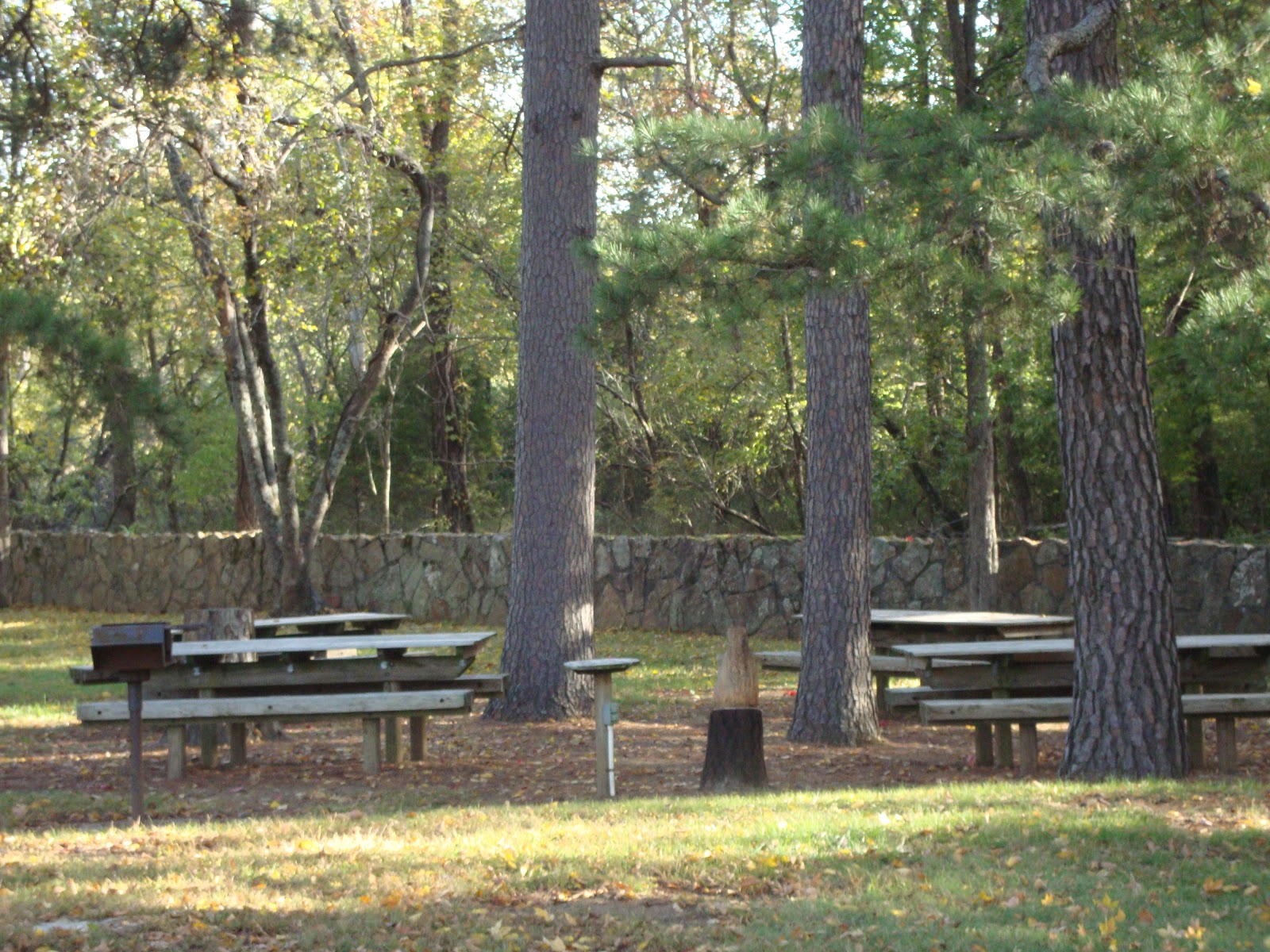
In addition to the stone bubble, the WPA workers built some nice stone walkways, a wall enclosing the park, and some other structures. Overall, it's a nice little park, beautifully maintained, and with a pleasant picnic area (something you don't always see at historic sites). Going by the number of signatures in the Guest Book, the site doesn't get many visitors, which is a shame. It's an interesting place and does a nice job of describing Sequoyah's life and the importance of his syllabary.
 |
| Stump carved into a bear in the picnic area. |
Admission to the park is free, but there is the usual donation box. Given the sad state of park budgets everywhere these days (the Oklahoma state parks website warns visitors to call ahead to make sure a park is actually open because limited funds can mean hours of operation can get cut back unexpectedly), if you do go, be generous. Sequoyah's Cabin is located about 10 miles northeast of the city of Sallisaw on state highway 101.