Showing posts with label roadside attractions. Show all posts

Tuesday, September 5, 2017

Michigan's highest and most crowded parking lot

Benchmark at the top of the hill
The S.O. and I finally got around to playing tourist in our own backyard. We went in search of the peak of Mount Arvon, Michigan's highest point. As state high points go, Mount Arvon kind of falls in the middle of the pack in terms of both height and difficulty of access. You know if you go looking for the highest point in a state like Florida you're not going to be scaling an alpine peak -- you'll be doing good to find something that actually qualifies as a hill.

On the other hand, if you're out in Colorado or Wyoming, it's a given there's going to be some serious climbing involved -- no short, easy hikes or driving up to paved a parking lot or discovering benches waiting for you at the top. Wikipedia notes that anyone planning to bag the Wyoming high point should plan on a 4 to 6 day hiking trip; it's considered a difficult ascent.

So where does Mount Arvon fall? Well, it's not as easy to get to as the state high points that are also state parks, like in Alabama. No nicely paved road culminating in a large, paved parking lot. Still, there is a road, sort of, that does end in a parking area.

Not that we were able to park in said lot: it was crammed full of ORVs. Those machines are like snowmobiles, apparently genetically engineers to always travel in packs. You know, I get the attraction of being the lead dog in one of those ORV caravans: you get to see the trail in all its splendor, you're the first one through the mudholes, you don't eat anyone's dust. But if you're the last in line when there are several dozen ORVS ahead of you, all kicking up rocks and splattering everyone with mud, what is the point? (Actually, I know what the point is -- ORV trails, just like snowmobile trails that often follow the same routes, are always conveniently located to loop past watering holes with malt beverages on tap. It's not the time on the trail people crave; it's the time at the bar.)

Back to Mount Arvon. The road is dirt, and the last 400 feet or so were not something I'd particularly want to go over in a low-clearance vehicle, but it is a road. You go from well-maintained two lane gravel to more like single lane gravel that winds a bit to something that's one step above a two track. The route ambles through mature hardwood forest, some of which is currently being harvested -- saw a  John Deere forwarder in action that has to be one of the niftiest machines I've seen in awhile (the rotating cab has to be one of the coolest features of all time) -- and is pretty typical U.P. backwoods, although no doubt more well traveled than most. There is a way to get to Mount Arvon from where we live that would involve only backwoods roads but we opted for the tourist brochure drive.

The route is clearly marked -- each time we were confronted with a choice of routes, there was signage to indicate turns. Dito when we got to the top of the mountain: there was a large sign in the parking area showing the layout: there's a short hiking trail that loops from the parking lot to the high point, from the high point down to an overlook that on a truly clear day would probably let you see right over Point Abbaye to the Keweenaw, and from the overlook back to the parking lot. There's a bench and picnic table at the high point; there's another bench at the overlook. There's also the obligatory logbook so you can record your name and the date.

I was never quite sure what to tell tourists when they asked at the museum about the drive out to Mount Arvon. Now I know: don't do it in low-slung car, at least not all the way. Watch for logging trucks. And if you're really lucky, you'll get to see something like this in action:


Monday, January 20, 2014

Neon

I need to start carrying a tripod along when we go anywhere at night. I've been wanting to get a night shot of the sign for Bingo's Motel and Bar for years, but it's hard to take a good photo of neon with a hand held camera.

I'm not sure how many years the motel has been in business or how long the sign's be there -- the fact it highlights the availability of TV suggests it's been quite a few years -- but every time we drive by I wonder how they manage to stay in business. Maybe it's the time of day we're passing by, but there are rarely any cars parked by any of the units. The establishment appears well maintained, though, so obviously they do have customers.

In fact, they had customers when we stopped so I could take a photo. Snowmobilers had checked in; there was a pickup with a humongous trailer in the lot.

The Bingo's complex also includes a service station, or it used to. I haven't been paying enough attention recently to know if the garage is still open or if they still sell gasoline. If it does, this would indeed be a good place for snowmobilers to stay. Spitting distance from the trail system, and everything they want (beer and fuel) close at hand.

I went looking for information about the motel online. I was hoping to find a review or two, and I sort of did, although it was more in praise of the bar. Apparently beer is $2.50, which the person posting the comment viewed as being a good deal. I drink beer so rarely that I no longer know what the average cost is, so I'll take his word for it.

Monday, October 21, 2013

Another nice Upper Peninsula museum: Jake Menghini

This past Saturday the S.O. and I drove down to Norway, Michigan, to attend a meeting of the Northland Consortium. The consortium is a loose organization of local historical societies and museums located in the central and western U.P. and northern Wisconsin. Meetings rotate around the region and generally feature a couple speakers in the morning and a field trip to the host museum after lunch. The morning meetings can turn kind of strange -- at this year's meeting I was treated to a lecture about how local historical societies and museums can't manage to do web sites or have Facebook pages because we geezers are all too technologically illiterate to figure out how the Intertubes work -- but the field trip part of the day is usually fun.
The Jake Menghini Museum in Norway began the way a lot of small town museums did: the core collection came from a hoarder collector who kept his stash in an old log building that he eventually referred to as a museum. At some point the city of Norway acquired the collection and decided to build a new museum on the edge of town at what had been the Anton O'Dill farm.
Francis turbine from the city of Norway hydroelectric plant. The museum director said it just showed up in front of the museum one day. She said one of the drawbacks of being owned by the city is that city workers will occasionally drop objects off with very little advance warning. She's lucky if it's just city workers: we have odd objects dropped off by the general public all the time with no advance warning and it's rarely anything as nifty as a reaction turbine. 
The museum is fairly new building and is large enough to have multiple life-size dioramas. I had some quibbles about some of the displays, but then I always do. 
For example, the room shown below cries out for a different presentation of the basket casket. I'd have placed it on a table and had a mannequin laid out in it so you'd know immediately what it was instead of kind of wondering just what the oversize object standing in the corner is. 
On the other hand, none of the spaces is very big. If they had actually placed it on a table, there wouldn't have been much open floor space left. I did, of course, suffer some serious object envy over that basket casket. As far as I can tell, the only things the local funeral homes have given the Baraga County museum are a notebook listing all the funerals held there over a 50-year time period and a couple vases. 
There was, of course, the obligatory space filled with miscellaneous clutter: sad irons, various cooking gadgets, odds and ends of tools, and what to me looks like the scariest juicer I've ever seen. The thing looks like a prop out of an early episode of Dr. Who. The museum is lucky enough to have a fair amount of land so has plenty of space for outdoor exhibits, including their latest acquisition, a sawmill:
The S.O. immediately began waxing nostalgic. He's familiar with this type of sawmill. He worked at a sawmill that used this same type of set up. He pointed out one mistake they've made in setting it up. If they wanted to be truly accurate, they need to add more track to the left of the saw in the photo above. 
The museum volunteers were making a verbal mistake, too, when they talked about the sawmill. They kept referring to it as "steam powered." Well, I'm not much of a mechanic, but when a device is labeled "diesel," I tend to believe that's what it is. Perhaps the original power source was a steam engine, in which case the volunteers need to make that clear in their descriptions. 
The museum does plan to put a pavilion over the sawmill to protect it from the elements. The other structure at the museum is a restored farmhouse. It's set up as a house museum, i.e., it's relatively uncluttered and an effort has been made to have it look as though people are still living there. The overall impression is early 20th century, but it hasn't been strictly curated to limit it to any particular decade. The kitchen, for example, includes a number of items that are clearly mid-20th century or later, but that's another minor quibble. Overall it's very nicely done and well worth visiting if a person happens to be passing through Norway on a day when they're open. Like most of the U.P. museums, they're only open in the summer and then only three days a week. And, despite the face*palm moment at the morning meeting when the subject of having an online presence came up, the Jake Menghini Museum does have a website:  http://www.norwaymuseum.org/. 

Monday, September 30, 2013

Local attractions: Covington Historical Museum


Yesterday I finally got around to checking out one of the other museums in Baraga County, the Covington Township Historical Museum located -- where else? -- in Covington. It's housed in the former township hall, a building that dates back to the early 1930s. They were holding their annual end of the season fall festival; they won't be open again until next summer except by appointment. As a person who thinks a lot about the National Register of Historic Places, I walked into the building and thought, holy cow, why isn't this place listed?! Other than stuffing the museum into it, I don't think the building's changed a whole lot since its original construction.
There have been some minor modifications to the building, but nothing major. The biggest change to the interior was the addition of the balcony along one side after the museum was established in the late 1990s. It was built to provide additional exhibit space, but is the type of modification that falls into the "adaptive re-use" category and no one really cares about anyway. The National Register gate keepers obsess about exterior appearances; having an unchanged interior is basically a bonus. Of course, the building isn't going to remain eligible much longer: township supervisors plan to do vinyl siding and replacement windows in fiscal year 2014. No doubt the window replacement job will include blocking a few off, too, in the name of energy efficiency. The historical society itself seems split on the issue: one fellow told me he'd really like to see the building listed and is opposed to the window replacement as currently planned; another member said she doesn't care as long because what counts is what's in the building and not what it looks like on the outside. An understandable sentiment, although not one I necessarily agree with. I did tell her that vinyl is really poor choice for a lot of reasons -- if they're going to do new siding, they need to go with a material that doesn't burn -- but in the end, it's up to the township board. They still own the building. 
In any case, on the main floor under the balcony the Covington Historical Society has set up spaces with specific themes: there's a workshop space with various tools on display, an office/school space, and a kitchen/dining space. There is the usual incredible clutter, the embarrassment of riches, many small local museums suffer from: people give you things so you feel obligated to display it all, which results in a space that doesn't really represent any specific era and can be a little confusing. The stove top shown above, for example has at least three meat grinders, two different types of irons, an old lunch pail, a double boiler, and a meatball maker all kind of jumbled together. A professional curator would probably suggest some selective editing was in order. On the other hand, most of the items are tagged: they have labels with the item's name and where it came from, i.e., "Donated by . . . ." People with roots in the Covington area can walk in and go, wow, there's my grandmother's rolling pin. We do something similar at the museum in Baraga, but it was pretty clear the Covington folks have a much better handle on inventory and keeping track of who gave what than we do. I was more than a tad envious of their organizational skills. 
I am moderately astounded I didn't spot the strange green thing when I was taking photographs; it's pretty bizarre as a partial object. Is it a lamp? An objet d'art? Who knows. . . but it looks like it should glow in the dark.  
Up on the balcony, the space is also organized loosely by themes. There's a nursery space, a living room, an area devoted to sports, and a space that is primarily bridal: there were multiple wedding gowns spanning about 80 years of Covington history. The oldest dress appeared to be a flower girl's dress from the 1920s; the oldest bridal gown was from 1940. 
The Covington museum is also blessed with a full basement. The building has a high foundation, so there's good natural light. They have a number of large items displayed down there, including the laundry equipment shown above. I have a minor quibble with the display: I'd have set it up in chronological order so you could see the progression from the copper boiler on the stove to wash tubs on a stand with a wringer to that amazing wringer washer with attached rinse tub to the more modern wringer to a 1990s washer, but maybe that's just my OCD kicking in. 
There is also, of course, a display of logging tools that includes these ancient power saws. Once again a little bit of museum envy crept in. Our county museum has a zillion buck saws and cross cut saws, but no one has seen fit (yet!) to donate a decent antique chain saw. Then again, we don't have one of these either:
The Covington museum is open seasonally, June through September, and is located one block west of US-141 in downtown Covington, Michigan. 

Friday, October 26, 2012

Sequoyah's Cabin

Sequoyah apparently searching the sky for inspiration while working on his syllabary.
After the S.O. and I decided we'd take the long way home through Oklahoma, I checked to see what points of interest might fall close to US-259/US-59. There were several possibilities, but the two that struck me as most intriguing were Spiro Mounds and Sequoyah's Cabin, both of which are state historic parks. Given a choice between the two, I opted for the latter. I've seen lots and lots of piles of dirt, and, yes, it's interesting that various mound building cultures built mounds, and, yes, the artifacts looted from those mounds and now displayed in on-site museums are interesting, too, but it's always rather impersonal and vague. Sequoyah, on the other hand, was an actual person, someone with a known history and compelling narrative.
Structure built by the WPA in the 1930s to protect Sequoyah's cabin
Sequoyah, who was also known as George Gist or George Guess, was born sometime between 1770 and 1776 in eastern Tennessee near what is now the city of Knoxville. Much of his early life is unknown; his mother was Cherokee, and, depending on the source, his father was either a British fur trader, a Scotsman, or the half-Indian son of a fur trader or Scotsman. Similarly, the source of Sequoyah's disability is unclear. He was lame in one leg, but whether this was the result of a birth defect or an early childhood injury is not known. The lameness is, however, probably the reason for the unnatural position Sequoyah has assumed in the sculpture shown above: it's the artist's attempt at indicating one leg was weaker than the other.

Sequoyah's cabin
When I was in elementary school, I read a book about Great Indian Leaders. It was, in retrospect, a thoroughly sanitized version of their lives, but I do remember being fascinated by Sequoyah. He was, of course, presented in heroic terms first for overcoming his handicap (the bad leg) to become a skilled silversmith and then for his invention of an "alphabet" for the Cherokee. I'm not sure just how much of a handicap the bad leg actually was -- Sequoyah was a veteran of the War of 1812; he served as a warrior in the Cherokee Regiment at the Battle of Horseshoe Bend -- but creation of the Cherokee syllabary was indeed a remarkable invention.
Interior, Sequoyah's cabin. The spinning wheel supposedly was made by Sequoyah.
A syllabary is a system of writing that uses a unique symbol for each sound in a language. Once you learn the symbols, you can sound out any document written in Cherokee phonetically and, if you speak Cherokee, know immediately what it means. This puts the Cherokee "alphabet" into a different category than the Roman alphabet we use for English writing. English has numerous combinations of letters in words that can look similar but sound differently -- tough, though, and through spring immediately to mind. Theoretically, that can't happen in Cherokee. Not having any first-hand knowledge of it myself, I don't know what type of possibilities for confusion lurk in Sequoyah's syllabary, but it would appear to be a much easier written language to learn than English is.
Typewriter with Cherokee keys donated to the State Historical Society. 
Sequoyah's invention of the syllabary was greeted with skepticism initially, but once he convinced a few influential leaders that it worked and that anyone could learn it, it spread quickly. In 1828, the Cherokee Phoenix, a newspaper, began publishing using the syllabary, and the syllabary remains in wide use today. The existence of a written language has been credited as helping to maintain the ethnic and cultural cohesion of the Cherokee nation.
Sequoyah's Cabin state historic park was, not surprisingly, a WPA project. After Sequoyah died around 1844 (the exact date is not known), his farm was sold to a family named Blair. Sequoyah had built the cabin shortly after moving to Oklahoma; the Blairs added on to the original cabin after they bought the farm. In 1936 the Blair family transferred the property to the State of Oklahoma. To protect the cabin, the State Historical Society used WPA funding to construct a building around it. The cabin is on its original site, but is now completely enclosed by another building. This is a preservation approach I have real mixed feelings about -- it's saving the structure by putting it in a bubble, but it's significantly altering the context.
Visitor Center, Sequoyah's Cabin 
The addition built by the Blairs was removed and rehabilitated for use as the Visitor Center at the park. Considering its remarkably good condition after being subject to the elements for over 70 years, I have even more mixed feelings about the stone bubble around Sequoyah's Cabin.
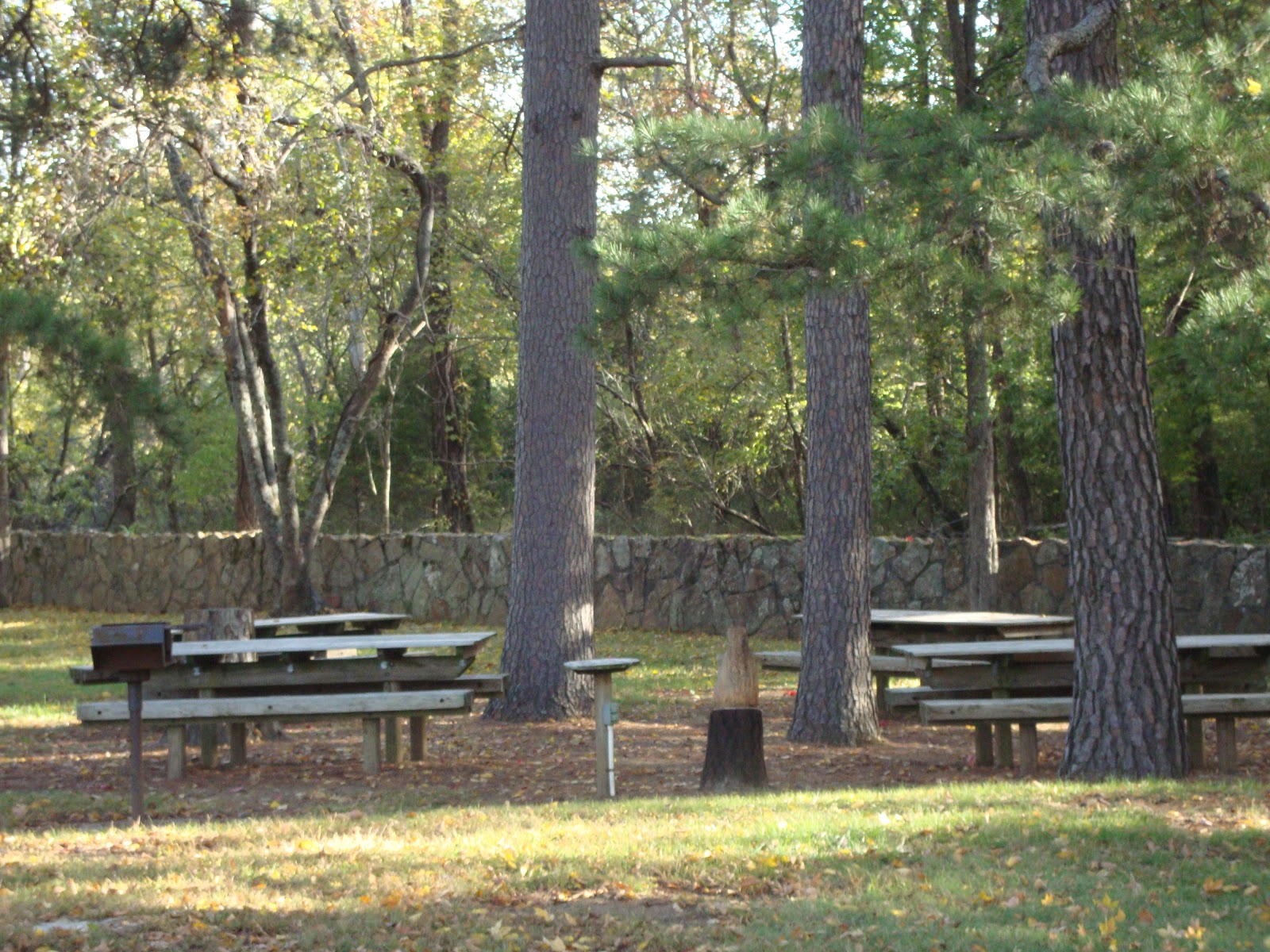
In addition to the stone bubble, the WPA workers built some nice stone walkways, a wall enclosing the park, and some other structures. Overall, it's a nice little park, beautifully maintained, and with a pleasant picnic area (something you don't always see at historic sites). Going by the number of signatures in the Guest Book, the site doesn't get many visitors, which is a shame. It's an interesting place and does a nice job of describing Sequoyah's life and the importance of his syllabary.
Stump carved into a bear in the picnic area.
Admission to the park is free, but there is the usual donation box. Given the sad state of park budgets everywhere these days (the Oklahoma state parks website warns visitors to call ahead to make sure a park is actually open because limited funds can mean hours of operation can get cut back unexpectedly), if you do go, be generous. Sequoyah's Cabin is located about 10 miles northeast of the city of Sallisaw on state highway 101.

Thursday, July 26, 2012

Some northwoods fiberglass

Located next to the visitor information center on Wisconsin Highway 70 in St. Germain, Wisconsin. I could not find an ID tag on him so don't know if he's a F.A.S.T. product or not. I am assuming he's fairly old, probably late '50s or early 1960s, because the level of detail and the overall finish isn't as good as on more recent products.
According to various sources, there never was an actual Chief St. Germain. The statue is supposedly a tribute to the Native American heritage of the area, or at least that's the current explanation. The reality is that if it really were a tribute (or if the local Ojibwe had been consulted), Chief St. Germain would probably be wearing a shirt instead of looking like a stereotype straight out of a 1950s Saturday matinee Western.

Thursday, May 31, 2012

Kromers

Back when the Younger Daughter was in about 4th grade, she really, really wanted a Kromer. For some reason, the hats were the headgear of choice for her contemporaries. I don't think she ever got one. Apparently Ironwood, Michigan, is now the Kromer Capital of the World. This was news to me. I thought it always had been because the western U.P. is the only place I've ever seen anyone wearing a classic Stormy  Kromer. I was wrong -- they used to be manufactured in Milwaukee. Live and learn.

Saturday, March 24, 2012

Happy Camper?

My life is complete. I have seen Andy Williams' Christmas sweater.

The sweater resides in the Ralph Foster Museum on the College of the Ozarks campus in Hollister, Missouri. The campus is lovely. The museum is. . . interesting. It bills itself as "the Smithsonian of the Ozarks." If a person thinks of the Smithsonian as an oddly curated collection of whatchamacallits and thingamabobs, maybe they're right. Gems in the collection include:
That's not the world's largest bracket fungi with a painting on it. It's an African elephant ear. With a painting of an African elephant on it. That is so wrong on so many levels. . . 

On the other hand, if a person thinks of a museum as a place where collections are curated and exhibits scripted to actually impart some useful information to the public, the Ralph Foster Museum is definitely hit or miss. Ralph Foster was apparently a rich guy (he made his money in radio) who collected all sorts of odds and ends; he donated the whole mess to the college and established the museum. If he'd been less wealthy, he'd have turned up on "Hoarders;" as it was, there's now a three story building full of his tchotchkes. Cabinet after cabinet full of, for example, "collectible" china with no information provided other than who donated it is pretty meaningless on any level other than "look at the pretty vases." Not that it was a total bust; some exhibits did do what a good museum exhibit should do -- there was obviously an underlying script, things were arranged in a logical order, and the exhibit as a whole told you something you didn't know before. 

Besides, the musuem does have one thing going for it that no other museum can boast:

For a mere $10, you can have your photo taken while sitting in the original Beverly Hillbillies vehicle. 

Sunday, February 27, 2011

The slide show continues: Alligator Farm

Having mentioned this place in a couple of posts, some explication might be in order.

The Alligator Farm has been a tourist attraction in the St. Augustine area since sometime in the 1890s. It started off in one location, then moved to its current site in the 1930s. It began as one of those typical cheesy roadside attraction places -- get your picture taken with a 'gator! -- but at some point the owners figured out they needed a raison d'etre that was a little more high-class than simply the desire to part tourists from their dollars.  
The Alligator Farm decided to transition into being not just a tourist trap, but an educational facility dedicated to the study and preservation of members of the order Crocodilia. The management cooperates with National Geographic, conservation organizations, and universities on research and preservation projects, and the live animal collection now includes representatives of all 21 members of the order Crocodilia, including some really strange looking ones, like gharials from India.
What they have the most of, of course, are American alligators, including albino 'gators:
The Alligator Farm has a few other critters in its collection, like some remarkably ugly birds from Africa, various snakes (e.g., a king cobra), a komodo dragon, and Galapagos tortoises.
The park is nicely done. It's laid out in a way that means you never have to backtrack (unless it's by choice), the interpretive signage is quite good, and it really is more than just alligators, although the Crocodilian theme is everywhere:  in the art, the signage, benches, even door handles:

The doors, incidentally, lead into a building where a humongous stuffed New Guinea crocodile (Gomek) is on display. The beast was captured in New Guinea in the 1980s and sold to a private collector, who then sold him to the Alligator Farm. Gomek was apparently quite docile for a salt-water crocodile (all crocodiles are more aggressive than the typical alligator, and salt-water crocodiles especially so) so keepers were able to get quite close to him to do feeding demonstrations. Park visitors loved it. Gomek died of old age at a length of over 17 feet -- I watched the video tape of Gomek being handed nutrias and decided the keeper was flatout insane to be on the same side of the fence. But then I thought the keeper in the alligator pen busy handing out dead white rats was pretty crazy, too. 

Then again, he was pretty careful about not turning his back on the ones that were closest to him. The enclosure had a total of about 50 large alligators; ten of them each get tossed a rat when they do the shows, which means they're all guaranteed some fur and bone to crunch on a couple times per week, but their normal diet consists of alligator chow -- a mix of various ingredients that's been developed to include all the nutrients 'gators require and that apparently comes in bars about the size of motel-room soaps.

Another part of the park has a boardwalk over water filled with gators -- there are dispensers where for a quarter you get a small handful of alligator chow pellets you can toss at the beasts. I had no real interest in watching 'gators gathering like koi to wait for a handout, but that definitely wasn't true of all park visitors. The beasts have gotten so used to the handouts that if you pause to lean on the railing and just contemplate the view, pretty quickly there's a whole herd of 'gators in the water below, all doing the reptilian equivalent of a "feed me, feed me" dance. 
All in all, I thought the place gave good value for the cost of admission. Don't know if I'd go back unless I happened to have one of the grandkids in tow, but I'll recommend it to anyone else heading for St. Augustine for a weekend.

Tuesday, December 7, 2010

Some F.A.S.T. fiberglass

In front of the Pioneer Restaurant in Westfield, Wisconsin


Both the restaurant and the "pioneer" have been around for as long as I can remember.  The parking lot used to be accessible directly from US-51, which is now I-39. 


Birth certificate located in the groin area.  
 Photos taken October 2010.

Restaurant was packed when we stopped for lunch.  Service is fast, menu is loaded with high carb, high calorie, nicely greasy comfort food (meat loaf sandwiches, fried chicken, "barbecue" [which is actually sloppy joes]), and prices are low.

Monday, June 7, 2010

The quintessential cheesehead

Cheese in one hand, kielbasa in the other, and standing next to a place that sells beer.  The only thing missing is a Packers tee-shirt.  Like so many other oversized fiberglass dudes, he was born in Sparta, Wisconsin, a relative of Muffler Men and Happy Chefs, if not quite cast from the same mold.  I could not tell year of birth as the ID plate on the back of his leg has been painted over one too many times.

Located near the interchange for Interstates I-90/94 and I-39 on state highway 78 on the way to the Merrimac ferry. Photos taken May 26, 2010.