Showing posts with label travel. Show all posts

Thursday, December 22, 2022

Stuff you don't expect to say more than once in a lifetime

 "A drive shaft makes a really interesting noise when it falls out of a moving vehicle."
Okay, so this time it wasn't actually the drive shaft hitting the pavement that made the really interesting (and definitely scary) noise. It was the transfer case eating itself followed by the sound of metal hitting the asphalt. 

My friend Kaylyn is probably going to tell me that losing a second drive shaft is a strong hint that we shouldn't drive Fords. The Guppy was built on an E350 chassis; our current (sitting wistfully waiting for parts) tow vehicle is a 4-wheel drive diesel F350. I don't think the brand is an issue. The S.O. and I have been driving Fords for decades and have only lost two drive shafts in the past forty or fifty years. . . and given just how marginal some of those Fords have been but still managed to keep moving, I'm not inclined to assume the Ford name is a problem.

On the other hand, when a person is sitting on the shoulder of a highway in rural Missouri waiting for a tow truck, the jokes about FORD standing for Found On Road Dead hit a little close to home. 

The transfer case decided to cannibalize itself when we were about two thirds of the way to Hot Springs. As planned in the revised itinerary, we'd spent a night in Portage, Wisconsin, a second incredibly cold night at a KOA in Newton, Iowa (cornfields do not provide much of a wind break once the corn's been harvested), and were looking forward to checking out Pomme de Terre State Park in Missouri. The truck died about 3 hours short of that goal.

What made our situation slightly tricky, of course, was the fact we were towing a 5th wheel trailer. Fortunately, Magee is small for a travel trailer. As it turned out, the towing company that rescued us had space behind its garage for storing Magee while the truck is being repaired another shop in Trenton.

How long and how expensive will that repair be? It's the holiday season. That alone is going to slow the process down. Before we'd even talked with a mechanic I was guesstimating a minimum of 3 weeks, and that was assuming no glitches in the supply chain. Even if the transmission wasn't damaged (unknown at this point; it's possible the housing got cracked but the repair shop didn't know that yet when the S.O. talked with them yesterday) and the transfer case is repairable (probably not) for sure they have to order one new drive shaft. One of the drive shafts stayed attached and dragged; the other one escaped and rolled off into the wilderness. 

One good thing that came out of this mini-disaster was being reminded (again) that most people are basically nice. We coasted to a stop not far from the end of someone's driveway. It was rural Missouri, houses along the highway were relatively far apart, but we wound up close to one. Cell phone technology meant we didn't have to go ask for help, but after we'd sat there for awhile the homeowner came out to ask if we needed any assistance. We told him not to worry; we'd called AAA and a tow truck would be there soon. 

When that "soon" turned into multiple hours, he came out again to ask if we'd like to come into the house and get warmed up. We went in, were served hot chocolate, and thawed out. It was incredibly cold outside so the chocolate was much appreciated. As time went by, it became clear there was a problem with the towing company. When I called AAA a second time to find out what the delay was, they gave me the name and number of the local business. The homeowner then called them to ask what the problem was and found out the idiot owner of that business (Precision Auto in Brookfield, Missouri, if anyone wants to make a note about who NOT to call in that part of the state) hadn't believed it was an actual AAA dispatcher talking to him, wrote the call off as a hoax, and never sent a truck out. He then hung up on the guy who was helping us. [My suspicion is that the AAA dispatcher had an urban accent -- the two I talked with while asking for roadside assistance definitely sounded black -- and Precision Auto's rural racism kicked in.] 

So the homeowner contacted the owner of a towing company in Trenton and got the promise of a truck being out there fast. His wife then called a hotel in Trenton to find out if they had any vacancies, explained our situation, and asked them to hold a room for us. While we waited for the tow truck (that we now knew for sure was on its way) they fed us dinner. It hit me that the hotel might not allow pets, so we called to find out for sure. And they were a No Pets facility. So then these incredibly nice people offered to cat sit Bubba -- they had a mud room so could confine him to a small space. They were a multiple pet household (dog, cats, college age sons) and assured me Bubba would be no trouble at all. He wound up being there for two nights and apparently behaved himself. 

After the tow truck arrived, one of the college age sons played chauffeur for us: drove us to the tow shop so we could deal with the paperwork there and then got us checked into the hotel. His father insisted we take their phone number and emphasized that if we needed more help, like a ride to whatever garage would do the actual repair work, to call them. As it turned out, we didn't need to bother them again, but it was reassuring to know there was someone with local knowledge and contacts we could contact if we needed to.

We're now in Hot Springs. The Younger Daughter took two weeks of vacation so she'd be off work when we first got here. She didn't think that vacation would include an 8-hour drive north to pick us up, but stuff happens. The truck broke down on Sunday, Tammi got to Trenton late Monday afternoon, Tuesday morning we went over to where Magee is stored and removed everything that was perishable or would be damaged by freezing along with enough clothes to last me and the S.O. for a couple weeks, got checked out of the hotel, picked up Bubba, and here we are. 

I do have to say everyone we met or dealt with in Trenton was super nice: the homeowners who helped us, the tow truck guy, the people at the hotel, the mechanic who's going to work on our truck, the Missouri state trooper who spent an hour standing in the cold directing traffic and making sure no one ran into the back end of Magee. . . Which isn't actually that surprising. Given the opportunity, most people want to do the decent thing. It can be hard to remember at times because the jerks can make so much noise, but the cold, selfish assholes really are a minority of the population. 

Wednesday, April 22, 2020

Pu'ukohola Heiau National Historic Site

Everyone who visits the Big Island of Hawai'i tends to visit the National Park, the one with the active volcano. I always wonder how many tourists also get to the three smaller units of the National Park system that cluster along the coast, two north of where we were staying in Kailua-Kona and one that is south. They're all different and they're all interesting.

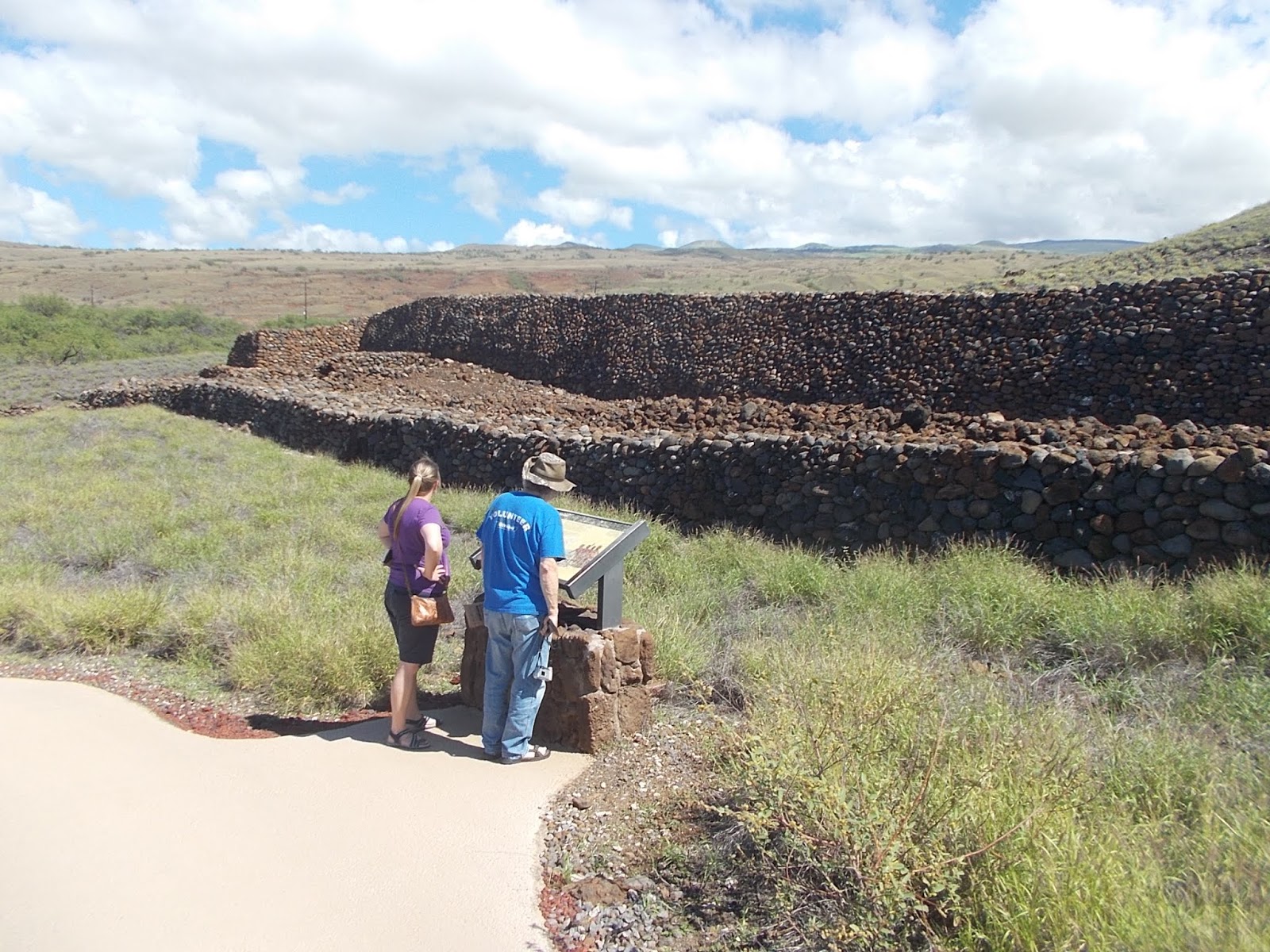
Pu'ukohola Heiau NHS is on the northwest side of Hawai'i near the modern town of Kawaihae. It is the site of the last traditional Hawaiian temple built and was constructed by Kamehameha I after hearing a prophecy that if he built a temple to the war god on Whale Hill he would succeed in uniting the islands under one leader, himself.

The temple is constructed of loose laid volcanic stone, no mortar. According to records -- and there was actual documentation from multiple sources; by the time Kamehameha was building the temple Europeans were visiting the islands -- the rock was moved from where it was quarried (collected) many miles away by a human chain of warriors loyal to Kamehameha. One gets the impression from the descriptions that it was similar to a bucket brigade. One guy would pick up a rock, carry it a short distance and then hand it off to the next dude in line. Like a relay race of sorts, except instead of batons they were passing along boulders.

The temple platform is huge, a massive structure on top of the hill. Unfortunately, on the day we visited the trail that leads to the top of the platform was closed. We were disappointed, of course, as the view from up there must be amazing. Other tourists were also disappointed and complained rather loudly about missing out on whale watching. The site is known as Whale Hill because it has always been a great location for seeing whales (humpbacks and others) come in fairly close to shore. Humpback whales apparently migrate to the area around Hawaii, Molokai, and Lanai every winter to give birth. We saw no whales from a vantage point along the trail that parallels the shore, but then we didn't stop at the park expecting to.

The Visitor Center at the park struck me as being a distinctly Mission 66 architectural style. I could be wrong. Both the Center and the restrooms building were built using volcanic rock, which makes perfect sense considering the stuff is everywhere. The Visitor Center is quite nice and, despite being fairly small, has an interesting display area with information on Hawaiian history. The restrooms building was closed for repairs/renovations/something, which definitely was not good. The porta-johns meant to substitute for it were, to put it mildly, disgusting. The contractor was apparently failing to keep them pumped out as often as they required.

We discovered after the fact that we missed one nifty feature of the park: the John Young home. Young was an Englishman who was shipwrecked in the islands and became a good friend and adviser to King Kamehameha I. He married the king's niece, became governor of the island of Hawaii, and his granddaughter, Emma, became Queen when she married Kamehameha IV. His home was the oldest European style building in the islands; today the site is basically a ruin with interpretive signage. It's located on the other side of the highway from the entrance to the main part of the park. We managed to miss signage for it as we continued on our way north. Moral of story: always read the entire park brochure before leaving the park. 

Saturday, April 11, 2020

Sometimes you dodge a bullet

Along with the usual reasons for wanting to spend part of the winter in Arizona -- avoiding snow, seeking sunlight, visiting friends and relatives, expanding one's mental horizons through travel -- The Kid had made plans for a family vacation elsewhere. She had decided to be generous and once again used her time share resort plan points to book a week in mid-February in Hawai'i.

The first time she shoved us on to an airplane back in 2016 it was just me and the S.O. This time she was able to find a two-bedroom suite in Kona so all three of us could go. At the time, there was some talk on the news about a novel virus affecting a region in China, but it didn't really register with us. We weren't going to China. We were going to Kailua-Kona. Mai tais, ahi ahi, palm trees, tacky shirts. People dropping dead from pneumonia half a world away did not affect us.

Except of course it could have. We traveled through two major airports, both with a lot of international travelers, going to Hawai'i and coming back -- Phoenix and Honolulu. Honolulu especially processes hordes of tourists and business people traveling to and from various Asian destinations. We saw numerous Asian travelers all wearing face masks. It did not register. If anything, we all assumed it was the typical notorious Japanese/Korean/Chinese germaphobia and industrial pollutants fear. It's been pretty common in China for many years for people to wear face masks outdoors because the industrial pollution is so bad. In retrospect, thank you numerous Asian travelers for wearing masks that may have protected some of us naifs from pathogens you were unknowingly exhaling.

[Blogger just did an interesting hiccough. Screen went blank and my draft post wound up published. Very strange. I will continue editing and eventually this may all seem a bit less unfinished. There may even be photos.]

In any case, we had a good time on the Big Island, wandered around playing tourist and doing some of the obligatory stuff (a luau, which turned out to actually be worth what it cost). I stumbled across a promotion being sponsored by local quilt shops -- an island shop hop in which each participating shop gave visitors a free pattern based on traditional Hawaiian petroglyphs -- and The Kid and I also found a decent book store. We dined at a restaurant we found out later is rated as one of the best in Hawaii, not just on one island, and we dined at low budget eateries that served traditional plate lunches. We visited Hawaiian Volcanoes National Park. I wondered again why anyone would want to live within 50 miles of an active volcano, let alone within spitting distance of one. We even lounged by the pool, all in blissful ignorance, cheerfully believing novel coronaviruses were a Chinese problem.

Ferns trying to grow in an old lava flow
That blissful ignorance persisted for several weeks after getting home. Heard occasional news about the virus being found in this country, but, hey, a couple of cases, no big deal. The CDC and the state health departments will handle it. No problem. As a former CDC employee I knew the agency had been worried about outbreaks and national coordination and snuffing stuff before it could spread for a long time. Back in the waning days of the Bush administration I edited the final draft of the National Biosurveillance Strategic Plan that laid out some of the problems and made suggestions for future action. The Obama administration took the issues seriously; a specific office within the CDC was created to address preventing epidemics from turning into pandemics. I was optimistic.

I did not know then that the Moron in the White House in his bizarre eagerness to do as much damage as humanly possible in the shortest amount of time had eliminated that office. I did know he had slashed the CDC budget, but how much of an idiot do you have to be to get rid of an office designed to prevent something that could make The Walking Dead look like a reality show?  Whatever that level is, Trump apparently has achieved it multiple times.

I found myself hoping recently that Trump had managed to French kiss Boris Johnson sometime in the past few weeks, but no such luck.

More thoughts in a day or two.

Wednesday, December 7, 2016

Just another day in Paradise

Ke'e beach on Kauai's north shore
A couple years ago the S.O. and I were sort of kicking around the idea of a trip to Hawaii. He'd spent a few weeks on Oahu back when he was a migrant aircraft mechanic, but I'd never been to the islands. At some point the Younger Daughter decided to coerce us into using her reward points for a week at aWyndham resort on Kauai.

I confess The Garden Island wasn't on the original itinerary. We'd actually put the Big Island at the top of the list. I didn't even know that Kauai existed. If someone had asked me to name the Islands I might have been able to rattle off four and Kauai wasn't one of them (Oahu, Hawaii, Molokai, . . . okay. Three islands). But a little research revealed that Kauai had its charms. No National parks but lots of state ones. Amazing beaches. Botanical gardens. Plus all the usual Hawaiian tourist attractions like luaus, helicopter tours, guided snorkeling trips, none of which have ever made a list of things I'd actually want to do. Heights terrify me, I can't swim, and we're too damn cheap to pay $100 each for an all you can eat buffet even if it includes unlimited mai tais and hula dancers playing with fire. So it was going to be beaches, botanical gardens, and some hiking. Oh, and the Kilauea lighthouse.

Kilauea Lighthouse. When it was built, there was no road access.
The light station is now part of a National Wildlife Refuge. Right after we got to the resort we attended an orientation session that included information on local attractions, warnings about being careful at the beaches (pay attention to the lifeguards, don't swim unless there is a lifeguard, etc.), and sales pitches from people trying to sell us on the idea of helicopter tours or high dollar luaus. That's when we got told that supposedly there was an albatross rookery that the public wass actually allowed to get close to, which is definitely not the norm. Usually when birds are nesting there's a huge buffer zone between them and gawkers. The info about the rookery turned out to be tour operator hype -- you need binoculars to see the birds' nesting area -- but it was interesting seeing the lighthouse. That sucker has a humongous Fresnel lens of a type I'd never seen before: a clamshell.
Nene geese

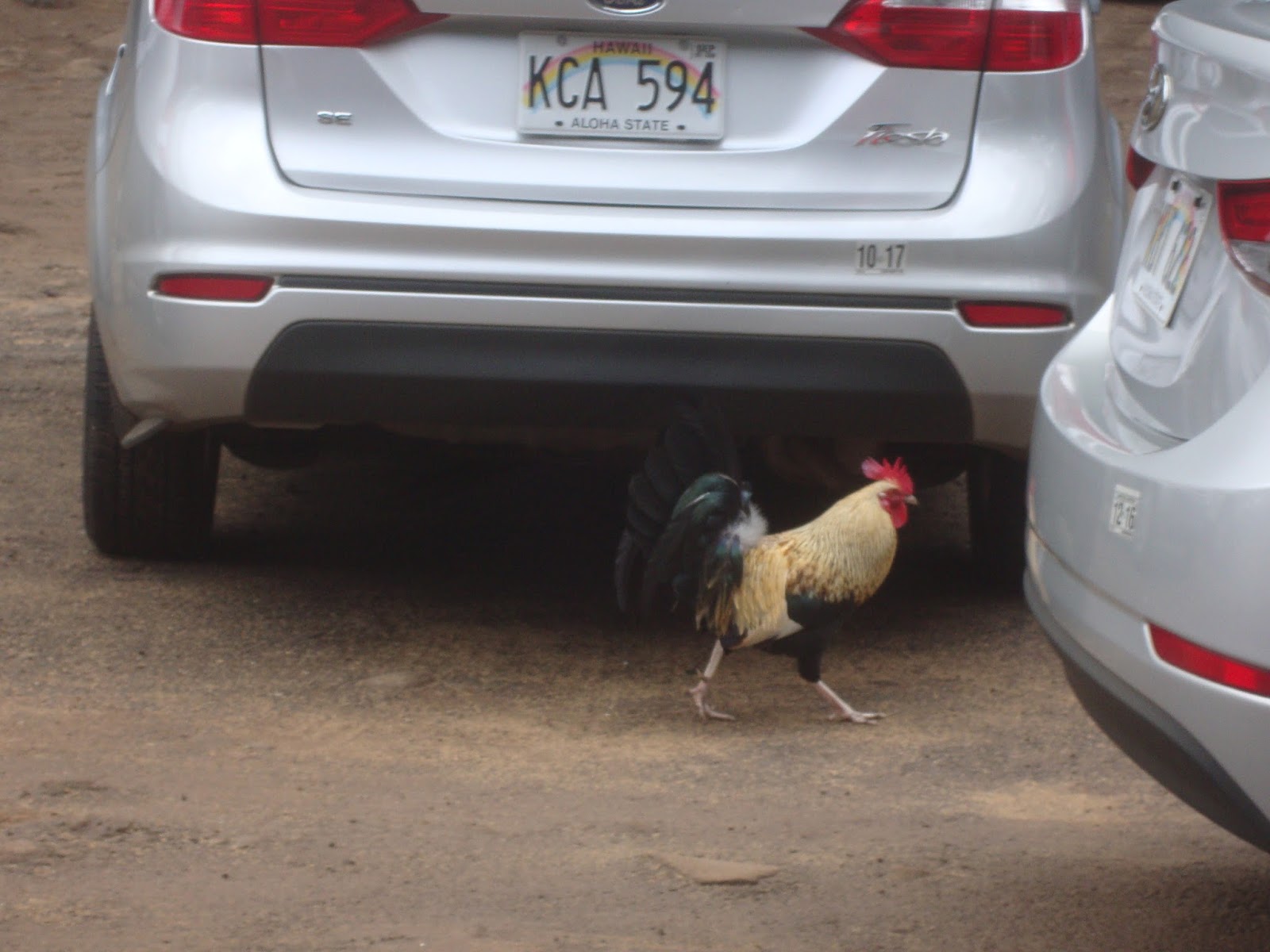
But, speaking of birds, if I recall correctly, the state bird of Hawaii is the nene goose. The goose is endangered. I find myself thinking that they got it wrong. The state bird should be the chicken. Feral chickens are every where. I started drafting this while we were still on Kauai. As I tried typing, kind of experimenting with doing a blog post using the smart phone, I was being serenaded by multiple roosters. Yesterday I heard an odd noise right outside the door. Turned out to be a hen with four or five half grown chicks. We went looking for a Kmart Sunday afternoon. Turned out to be part of a good sized shopping center. We had lunch in the food court. The chickens outnumbered the pigeons.

One of several roosters in the parking area for Ke'e beach
We were staying at a nice resort -- Wyndham's Ka eo Kai in Princeville -- but there were chickens wandering around there. There were chickens near the airport, chickens wandering the right of way along the highway, chickens at the beaches, chickens in the state parks. Every time we stopped at a scenic overlook for  Waimea Canyon there were chickens. Occasionally there were signs up reminding people not to feed the feral chickens or cats, but not often.

I have to say that for feral birds they were remarkably good looking chickens. Chickens apparently found an ecological niche to exploit in the Islands after arriving with the Polynesians a millennia or two ago and are thriving despite the cats and rats that must dine on eggs and chicks. I'm guessing those two predators are what keep chicken numbers low enough that although the chickens are numerous, they haven't totally overrun the Islands. I never saw a hen with more than 2 or 3 chicks at the most, and I know chickens are capable of having much bigger broods than that.

Sleeping Giant (aka Nounou Mountain)
So how was our brief expedition to Kauai in general? Not bad. The scenery was spectacular, of course. That's a given when you go to Hawaii -- all those volcanic peaks make for some dramatic backdrops, which is why the Islands have long been popular with filmmakers. The north shore of Kauai shows up in the film "South Pacific" as they approach Bali Hai, and one of the more dramatic waterfalls and the Na Pali coast (also the north shore) are highlighted in "Jurassic Park." The opening sequence for "Fantasy Island" included a shot of waterfalls on Kauai. The north and east sides of the island are the windward sides so get huge amounts of rain (the wettest spot on earth is supposedly on Kauai); there's a lot of lush tropical growth. When you drive south and west, things turn drier. You go from rain forest to cactus in just a few miles.

The resort we stayed at was one of the older ones in Princeville. According to Wikipedia, up until the 1960s, the area was a cattle ranch. In 1968 it was sold for development and became a planned community of condominiums, upscale resorts, and definitely not cheap single family homes. And golf courses. Lots of golf courses. The resort we stayed at, Ka eo Kai, was originally named The Ranch. I'm guessing, based on construction style and general layout, that it was built in the 1980s. It's been updated and is quite nice, but you can tell it's Not New. The unit we stayed in, for example, was a studio. I'd be willing to be that when the resort was built, the designers planned the square footage based on full-size beds being used in the bedrooms. When they updated, times having definitely changed in what people's expectations are, they put in a queen. The square footage didn't change, though, so the end result was a room that now felt a bit on the small side considering what  the average cost per night runs. On the other hand, the bathroom was humongous -- I think we could have parked the Guppy in there.

We did sample some local cuisine. The S.O. tried the loco moko, which involves two hamburger patties, two eggs fried sunny side up, and gravy. It looked odd, but he said it wasn't bad. It must have been edible -- he ate all of it. It's apparently popular -- we noticed most of the patronized by the locals eateries had it on the menu. I was curious about the saiman with spam (another item that was on a lot of menus) but ran out of time. Spam is popular in Hawaii, possibly because it's comparatively cheap, and saiman (a noodle soup) even more so. I did not know so many varieties of Spam existed until we shopped at the Princeville Foodland. And it was such a good price on Spam (it was one of the few cheap grocery items I spotted) that I came really close to buying a few cans to bring home. (Money saving tip for anyone traveling to Hawaii: Foodland will give you the sales prices without you having their shopping club card if you just give them your phone number. You don't need to sign up for the actual card unless you plan on being there long enough that you actually want the various other perks that come with it.)

One thing that struck me while we were in Hawaii, given the recent election results and some of the truly vile racist stuff that's emerged while President Obama has been in office, was that Hawaiian society encapsulates everything racist whites fear. The population is incredibly diverse, whites are a minority, and the overall attitude is laid back and very much "live and let live." No wonder so many of them insisted President Obama wasn't a U.S. citizen. To them, Hawaii would indeed feel like a foreign country.

Sunday, March 20, 2016

Getting ready to hit the road

12 inches of fresh snow on St. Patrick's Day
We had a few days of exceptionally warm weather last week so we decided to pull the tarp off the Guppy and move it down close to the house. We hadn't bothered moving it last year when we left in February, but I decided I didn't feel like either having to carry everything several hundred feet or waiting until the last minute when it got moved so we could load the car on to the tow dolly. Turned out it was a good thing I was feeling a tad lazy.
When we pulled the tarp off, the S.O. discovered one of the ceiling vent covers was broken. Don't know if it shattered from the weight of snow on the tarp or if it broke from a combination of deterioration from cold weather and exposure to UV rays over the years, but it was definitely broken and needed to be replaced before we went anywhere. Our first thought was, "Oh, crap. We need to make a special trip to Ishpeming to Hilltop RV." Then we remembered Amazon. Amazon sells everything. I placed the order on Saturday; Tuesday afternoon we had a new vent cover. Actually, we had two. This is the second time we've had to replace one and have figured out they're made from such flimsy plastic that it would be a good idea to always have a spare on hand. (And, as long as I was busy spending money online, I also got two insulators/sun shields that can be placed on the inside of the vents. We now have a way to blackout the light from the ceiling if we ever spend a night in a Walmart parking lot again.)

Timing was on our side again, too, because the day after the S.O. replaced the shattered vent cover, a snowstorm rolled through that dumped over a foot of wet sloppy snow on us. The S.O. had covered the broken vent with plastic sheeting, but I don't think it would have done as good a job of keeping water out of the Guppy as the actual vent cover did.

The S.O. has done one significant repair and some minor tweaking to the interior in preparation for leaving. The significant repair was replacing the charger for the RV battery. The original equipment one had stopped recognizing when the battery was charged so would kept cranking out too much voltage. It wanted to boil the battery as well as fry ceiling lights. We got a new charger last month; it seems to work exactly the way it's supposed to. The minor stuff includes installing a radio/CD player in one of the cabinets in the dining/living area so we don't have to rely on the radio in the cab if we want tunes. That radio works okay, but it's awkward to get at and there's an issue with the volume. If it's loud enough for us to hear it okay while sitting in the living area, it's also loud enough for the camp sites next to us to hear it, which isn't good. The way the thing was installed there are speakers in the bedroom and there are speakers in the cab, but there was nothing in between. I suppose the S.O. could have figured out a way to wire in another set of speakers, but that wouldn't have eliminated the awkward part of getting at the controls. . . so he put in a new radio. Problem solved.

Other minor tweaks included installing latches to prevent the refrigerator doors from popping open while the Guppy is moving, which means no more worries about flying ketchup bottles, and converting the space where Cleo's litter box lived into usable storage. Now all I have to do is figure out what, if anything, to store there. The Guppy actually has more storage space than we need -- it's just not configured in a particularly handy way. Sometimes I really wonder just what the designers of RVs are thinking about when they come up with the configurations for cabinets and cubbyholes and what they laughingly call "closets." There are a lot of dead spots, places where you can shove stuff but you can't really see into very easily. I can stash a lot of stuff in the bedroom, but in order to access some of it I end up having to mimic a snake, crawling on the floor on my belly trying to reach the Rubbermaid totes that got shoved (or slid) all the way to the back.

All that storage space strikes me as a bit weird, too. After all, the Guppy is a recreational vehicle. Theoretically no one was planning to live in it permanently. Just how much stuff did the designers think the typical family was going to want to take with them on a family vacation? Keep in mind that in addition to the storage in the living area, there's also a ton of storage space underneath the thing -- multiple compartments for stashing lawn chairs and barbecue grills and sun shades and patio rugs.

In any case, now that the S.O. is done with his minor fixes and improvements, I can start loading clothes, books, my sewing and knitting stuff, and the groceries that won't be bothered by a few freezing nights before we leave. If all goes well, the only things left to load the morning we pull out will be canned goods and our toothbrushes.

Monday, September 28, 2015

Boondocking

Ever since we started thinking about buying an RV, we'd been hearing about "boondocking at Walmart." Until we decided to invest in a motorhome, we didn't worry much about the details that boondocking might entail, although we did notice an occasional travel trailer or motorhome positioned at the edges of parking lots at the Evil Empire. Once we acquired the Guppy, though, the notion of finding places where it would be possible to spend a night for Free moved way up the interest scale. So I researched it online, looked at various blogs to see what other RV-ers had to say on the subject, and more or less decided it would be doable on an occasional basis, like while in transit from home to Missouri. 

Boondocking, for the uninitiated, refers to camping where there are no amenities such as electricity, running water, or a sewer hookup. Until I started hearing about spending the night at Walmart or in an Eagles Club parking lot, I tended to think of boondocking as heading out into a national forest or some other remote area. You know, doing basic camping. Rustic camping. Not pulling into a huge parking lot and sleeping there. A Walmart parking lot definitely strikes me as being the antithesis of the boondocks.

Anyway, I did the research, checked out the various web sites that explained the protocol for boondocking at Walmart, and then looked at the lists of Walmarts that do or do not allow the practice. I noticed in my online wanderings that some people seemed to believe you can park at any Walmart. Not true. There are whole bunches that say No to boondocking. However, there are also whole bunches that say Yes.

There are established protocols, of course. If you want to boondock, even if there are other RVs already parked on the periphery of the parking lot, you should go to the service desk to confirm that it's okay. If they say yes, you park in the area the service desk tells you to. You live with your RV being lopsided -- no putting out jacks or dropping landing gear to level the trailer or motorhome. If your equipment has slide-outs, they stay slid in. No digging out the lawn chairs and rolling out an awning, no setting up the barbecue grill. In short, no camping behavior.

 We got directed to the far side of the parking lot, about as far as possible from the entrance doors, which meant it was the part of the parking lot that would naturally have the fewest cars wanting to park there. Because we had a vehicle in tow, we had to straddle a row of angle parking spaces on the west edge of the lot. This particular Walmart is one that also welcomes semis (not all stores do); if you look in the background in the photo to the right, you can see two of them lined up in the background. There was a third semi parked to the east of us. There was also a large sign on every light pole saying no truck parking allowed, which was an interesting contradiction.

There were also a couple other RVs in the lot, one pretty close to us and one that was far enough away that we figured that either they were just passing through (i.e., not planning to spend the night) or not familiar with the rules. It didn't surprise me that other RVs were in the same general class as the Guppy, which is a polite way of saying sliding into Randy Quaid territory and appreciating a low budget space.

So what was our first boondocking experience actually like? Well, among other things we figured out that we need to get a ceiling vent cover. We'd been talking about it anyway -- getting a vent cover that would help keep the Guppy warmer in cold weather -- but realized Saturday night that it would also be nice to be able to block the glare from parking lot lights. I could read a book by the light from those parking lot lights; they did not make it easy to sleep. We have good blackout curtains on the bedroom windows; I never thought about doing a blackout for the ceiling vent, too.

Besides the parking lot lights, the other annoyance turned out to be the Illinois Central Railroad. We knew there'd be some noise in the evening -- we were spitting distance from a Taco Bell, close to a highway, and it was Saturday night -- but figured once it got to be after midnight, things would be quiet. We were wrong. I don't know how many trains Illinois Central runs, but it did seem like the noise from one set of cars would just be fading away when we'd hear the locomotive whistle from another train. I like trains, but there are limits.

In any case, it was a good experience even if it wasn't the most restful night we've spent in the Guppy. Live and learn -- I worried about parking lot noise; it never occurred to us to worry about trains.

Explain to me again how the Obama presidency has ruined the country

Back in 2008, the final year of the George W. Bush administration, the S.O. and I did a road trip. We traveled from, if memory serves me correctly, from Atlanta, Georgia, to Hemphill, Texas, where we picked up Charlie the Snowbird Dog, and then north to the Upper Peninsula. Gasoline prices were, by contemporary standards, horrific. They hovered right around $4 per gallon, with a Petro station in Rochelle, Illinois, topping the charts at something like $4.39 a gallon. I could be wrong about the reasons for the trip or the direction we were traveling, but for sure it was Rochelle, Illinois, in 2008.

Well, we stopped in Rochelle on Saturday. We had our initiation into boondocking in a Walmart parking lot there -- something I may elaborate on in a different post -- and then Sunday morning refueled the Guppy and continued southward. Gasoline was $2.32 per gallon. It's been over 7 years since we paid that $4.39, and we have never seen gas prices as high at that $4.39 again. In fact, for a while gas was going for less than $2 per gallon -- I have vague memories of paying something like $1.59 here in Missouri in March (and we noticed it's under $2 at some local stations now). The most we paid on the trip down here, the 745 miles from our place to the Younger Daughter's, was $2.44 in central Wisconsin. And, given that the Guppy guzzles gasoline as fast as the proverbial wino sucking down Ripple we had lots of opportunity to compare prices along the way. Most expensive gas was in Wisconsin, least expensive here in Missouri.

Which brings me back to my original question, more or less. If Obama's been so bad for the country, why are we able to refuel the Guppy so cheaply? 

Saturday, November 8, 2014

Home, sweet snow-covered home

We've been home for a few days now. Travel was uneventful, although coming up through Illinois we had a pretty good tailwind and actually got the Guppy up to around 9 miles per gallon. That was exciting, just cruising along and not seeing the needle gas gauge plummet as soon as we pulled away from the pump. Even better was seeing the prices plummet, although the lowest price we saw -- $2.54 -- didn't help us at all at the time. We know we'd get better mileage if we weren't dragging a car behind us on a tow dolly, but we're not willing to give up that anchor yet.

The weirdest part with watching the gas prices was realizing that gas was selling for more in Wisconsin than in Illinois. Usually the reverse is true. And of course Missouri is always much, much cheaper than any of the other states -- I have no idea why, although it probably has to do with state sales taxes and fees. Missouri makes up for having cheap gas, though, by taxing food. That definitely startled me the first time we grocery-shopped. Granted, the sales tax on food is lower than the sales tax on nonedible items, but even so. . . taxing food always feels wrong to me. But, as usual, I digress.

We're home. It feels good to be home, back in a truly warm house with a large, dry bed. After a month in that 3/4 size bed in the Guppy, it feels good to be able to sprawl again. Sprawl, heck. It feels good just to be able to turn over in the bed without worrying about either falling out or nailing the S.O. with an elbow or a knee. It also feels good to be able to walk around the house like a normal person with no sidling sideways like a crab to negotiate tiny spaces. I don't know how people who are full-time RV-ers do it. Not everyone who's given up living in a real house to be on the road permanently has a Class A leviathan or a 5th wheel 40 feet long with multiple slide-outs. Does all that sidling eventually start to feel normal? I don't know. . .  I do know that right about the time we finally seemed to have figured things out and had more or less adapted to life in a small space, our month at the park ended.

Now that we're home, I need to get back into my usual routine of spending a couple days a week at the museum sorting through the mystery boxes in the attic and the storage building and then cataloging the good stuff. I have found some nifty things over the past year or two. Of course, I've also found some truly weird and useless items, which isn't surprising. Too often people will donate stuff that's actually pretty useless, like stacks of ancient magazines. I tend to joke that we get the stuff that people are stuck with after the estate sale is over. It's old, it's not worth anything, and the St. Vincent de Paul store won't take it. But, hey, it's OLD, so you know the museum is going to want it. Besides, the museum won't charge a garbage disposal fee like Waste Management or Arvon Trash and Transit do.

You know, a few old Life or McCall's magazines are nice to have. If nothing else, they can be used as part of exhibits that highlight a specific time period, e.g., a 1953 Saturday Evening Post might be interesting as part of a display about the Eisenhower era. But there are limits, especially when there are duplicates. On the other hand, when someone does show up with boxes of old magazines, we can't just say no because you never know what gems might be hiding in the trash. This open-handed acceptance policy would not have been a bad thing if someone had been sorting through all the boxes as they came in, but apparently no one was. Too much came in too fast when the museum first opened. Box after box got shoved up in the attic or out into the storage building, all without much in the way of labeling. I can understand why it happened, much as I might wish it hadn't. End result? A gazillion mystery boxes.

Or worse. One of the little gems I found the last time I went up the ships ladder to the attic was a box labeled "Curwood books for resale." The box did indeed contain a couple dozen books by James Oliver Curwood. I could be wrong, but my instinct is that it's real hard to re-sell anything when it's hiding under a pile of other stuff in an attic instead of being shelved in the used book section of the gift shop. I'd call it a head*desk moment, but I'm not sure that term applies when you're not actually sitting at the desk. Would those books have sold if they'd been sitting in the gift shop for the past 20 years instead of up in the attic? Who knows, but for sure they were never going to sell where they were.

Besides getting back into some sort of routine at the museum, I need to get this winter's quilt project(s) started. For the first time in many years, I have no quilts in progress. Nada. That feels weird. Usually I've got at least one project going, even if it's just at the cutting pieces stage. Right now I haven't even picked out a pattern for whatever is next. I do have other sewing to do -- I'm making new curtains for the Guppy -- but that's not quite the same. I need to pick a quilt pattern and start cutting pieces soon.  

There are other things I need to do, too, like locate The Hat. I have a cap I knitted many, many years ago (acrylic yarn lasts forever) that still drives my kids crazy. It can't be winter unless I'm wearing The Hat. Along with locating The Hat, I should also track down mittens, scarves, and other items necessary now that temperatures have dropped below freezing and there's sloppy white stuff (about two inches as of this morning) on the ground. And the S.O. needs to remember where we stashed some snow shovels. There's two inches of slush on the front porch at the moment and nothing handy to remove it with.

The S.O. claimed he wanted to spend most of the winter here on the tundra so he could watch snow slide off the barn's new metal roof. If today's weather is any indication, he's going to have a lot of opportunities to do that.

Monday, September 29, 2014

On the road again

The Guppy has now been thoroughly road-tested. We loaded it up a couple days ago and hit the road. The trickiest part in loading things up turned out to be something we'd never considered in the past: emptying the refrigerator in the house. We've had two refrigerators get fried by power surges in the past two years so even though there is now surge protection on the outlet, we decided not to take any chances. We did not want to come home in a few weeks to a freezer full of melted ice cubes and fermenting condiments. It's amazing how much stuff can be in a refrigerator even when it's is a small one.

The Guppy performed about as expected, right down to producing a number of annoying or mysterious noises. A few things that we didn't expect to slide around did, stuff we were worried about shifting stayed right where it had to been stashed weeks ago. I did figure out we need to invest in another roll of nonslip shelf liner. It worked great in the cabinets, but I think I want some for padding between things like the pizza pan and a cookie sheet. Metal pans aren't going to break if they bounce around, but they definitely made a lot of noise when the Guppy was rolling over rough pavement. Other than odd bangings and clankings from the kitchen area, though, the only worrisome noise seemed to come from the right front tire. The S.O. thinks that tire might be permanently out of round, i.e., it's got a flat spot because the Guppy spends so much time just sitting in one spot. He's going to swap that tire with the spare and see if the noise goes away. That's assuming the spare still holds air, of course.
Heading south on US-45 south of Bruce Crossing, Michigan

In any case, we've been talking about tires in general being an issue since we bought the Guppy last year. The tread still looks good on all of them, but we also know they're all real old. The previous owner put so few miles on the Guppy that he never felt the need to replace any tires; he put less than 1,000 miles on it in six years. Our concern, of course, is that even though the tires look good there's dry rot. We're not seeing any, but you never know.

Until we hit the road, we weren't real sure just how terrible the fuel economy would be. It was, as it turned out, every bit as bad as predicted. Dragging my car behind no doubt hurt. We did not stop at every gas station we passed, but it was beginning to feel that way. It probably didn't help that I'm used to doing long drives in the Focus. Its fuel tank is about 1/3 the size of the one on the Guppy but it can go about three times as far on that one-third the fuel. Every time we had to stop to refuel, I'd have a "What?! But we just did that!" reaction.

On I-39 near Mendota, Illinois
And now we're in Missouri spending a few days annoying the Younger Daughter.We start our first campground hosting gig on Wednesday. It should be interesting, although from what the Kid says, the most interesting part might be just getting to the park. I've driven the roads in Missouri, I've been fairly close to where Montauk State Park is located, I know that in general Missouri has remarkably good roads, but the Kid keeps looking at the Guppy and making dubious noises. She's making state highway 32 sound like a goat trail barely wide enough for a Vespa to handle. We shall see. . . .

I do not know how much time I'll spend in the blogosphere once we're at the park. I'm hoping hosting duties keep me busy enough that I can ignore the Internet a lot more than I do now.

And, yes, for those of you who worry, we will check all the gas fittings before turning on the propane when we reach the park. From the way things were bouncing around on the way down here, it's easy to see how fittings could work their way loose over not many miles on the road.

Wednesday, November 13, 2013

Thoughts while traveling

When the coffee urns in the breakfast area of a motel are labeled Regular, Regular, and Double Strength, odds are the parking lot provides plenty of space for semis.

Okay, so that's only one thought, but who's counting?

Friday, October 26, 2012

Sequoyah's Cabin

Sequoyah apparently searching the sky for inspiration while working on his syllabary.
After the S.O. and I decided we'd take the long way home through Oklahoma, I checked to see what points of interest might fall close to US-259/US-59. There were several possibilities, but the two that struck me as most intriguing were Spiro Mounds and Sequoyah's Cabin, both of which are state historic parks. Given a choice between the two, I opted for the latter. I've seen lots and lots of piles of dirt, and, yes, it's interesting that various mound building cultures built mounds, and, yes, the artifacts looted from those mounds and now displayed in on-site museums are interesting, too, but it's always rather impersonal and vague. Sequoyah, on the other hand, was an actual person, someone with a known history and compelling narrative.
Structure built by the WPA in the 1930s to protect Sequoyah's cabin
Sequoyah, who was also known as George Gist or George Guess, was born sometime between 1770 and 1776 in eastern Tennessee near what is now the city of Knoxville. Much of his early life is unknown; his mother was Cherokee, and, depending on the source, his father was either a British fur trader, a Scotsman, or the half-Indian son of a fur trader or Scotsman. Similarly, the source of Sequoyah's disability is unclear. He was lame in one leg, but whether this was the result of a birth defect or an early childhood injury is not known. The lameness is, however, probably the reason for the unnatural position Sequoyah has assumed in the sculpture shown above: it's the artist's attempt at indicating one leg was weaker than the other.

Sequoyah's cabin
When I was in elementary school, I read a book about Great Indian Leaders. It was, in retrospect, a thoroughly sanitized version of their lives, but I do remember being fascinated by Sequoyah. He was, of course, presented in heroic terms first for overcoming his handicap (the bad leg) to become a skilled silversmith and then for his invention of an "alphabet" for the Cherokee. I'm not sure just how much of a handicap the bad leg actually was -- Sequoyah was a veteran of the War of 1812; he served as a warrior in the Cherokee Regiment at the Battle of Horseshoe Bend -- but creation of the Cherokee syllabary was indeed a remarkable invention.
Interior, Sequoyah's cabin. The spinning wheel supposedly was made by Sequoyah.
A syllabary is a system of writing that uses a unique symbol for each sound in a language. Once you learn the symbols, you can sound out any document written in Cherokee phonetically and, if you speak Cherokee, know immediately what it means. This puts the Cherokee "alphabet" into a different category than the Roman alphabet we use for English writing. English has numerous combinations of letters in words that can look similar but sound differently -- tough, though, and through spring immediately to mind. Theoretically, that can't happen in Cherokee. Not having any first-hand knowledge of it myself, I don't know what type of possibilities for confusion lurk in Sequoyah's syllabary, but it would appear to be a much easier written language to learn than English is.
Typewriter with Cherokee keys donated to the State Historical Society. 
Sequoyah's invention of the syllabary was greeted with skepticism initially, but once he convinced a few influential leaders that it worked and that anyone could learn it, it spread quickly. In 1828, the Cherokee Phoenix, a newspaper, began publishing using the syllabary, and the syllabary remains in wide use today. The existence of a written language has been credited as helping to maintain the ethnic and cultural cohesion of the Cherokee nation.
Sequoyah's Cabin state historic park was, not surprisingly, a WPA project. After Sequoyah died around 1844 (the exact date is not known), his farm was sold to a family named Blair. Sequoyah had built the cabin shortly after moving to Oklahoma; the Blairs added on to the original cabin after they bought the farm. In 1936 the Blair family transferred the property to the State of Oklahoma. To protect the cabin, the State Historical Society used WPA funding to construct a building around it. The cabin is on its original site, but is now completely enclosed by another building. This is a preservation approach I have real mixed feelings about -- it's saving the structure by putting it in a bubble, but it's significantly altering the context.
Visitor Center, Sequoyah's Cabin 
The addition built by the Blairs was removed and rehabilitated for use as the Visitor Center at the park. Considering its remarkably good condition after being subject to the elements for over 70 years, I have even more mixed feelings about the stone bubble around Sequoyah's Cabin.
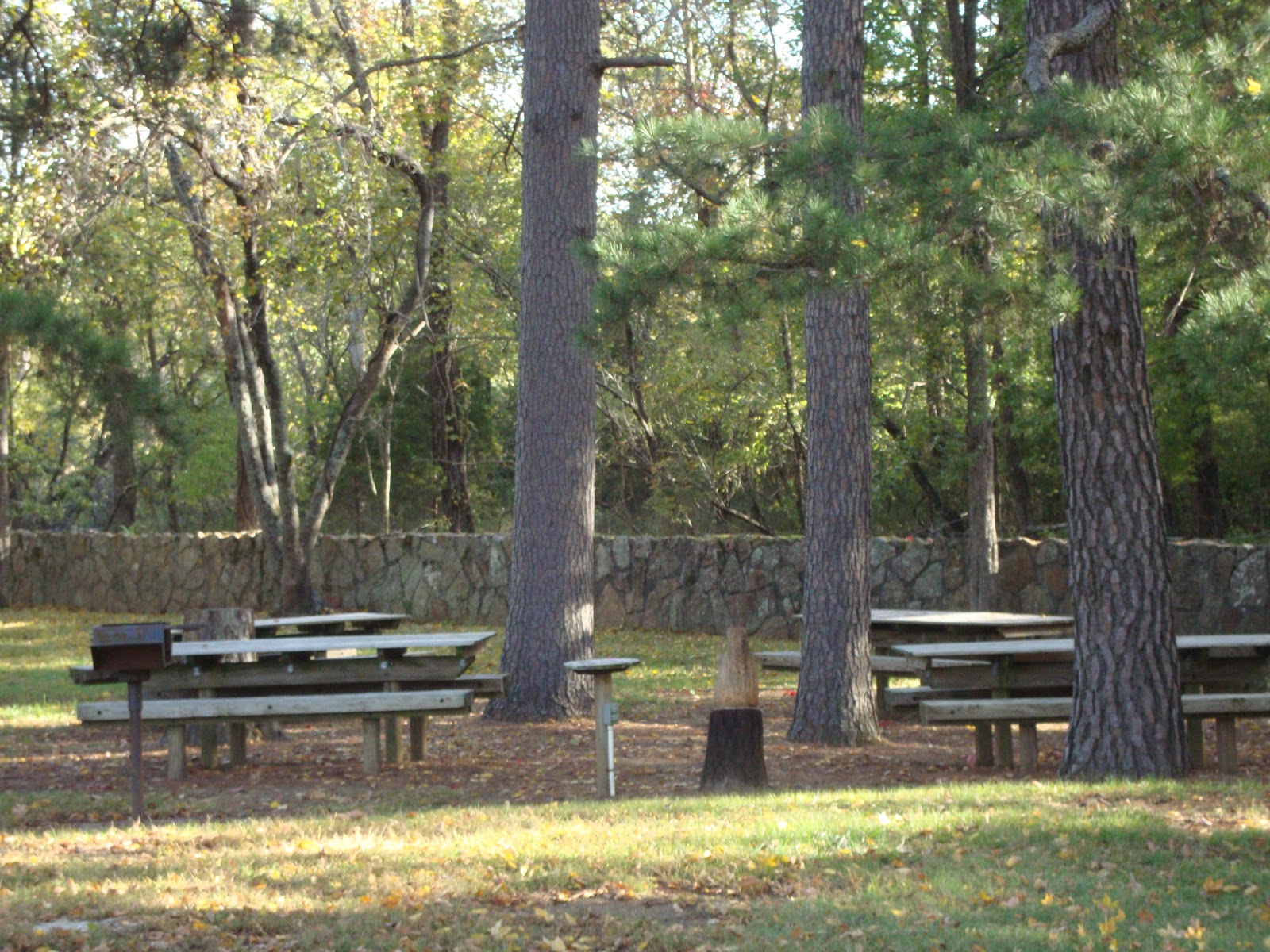
In addition to the stone bubble, the WPA workers built some nice stone walkways, a wall enclosing the park, and some other structures. Overall, it's a nice little park, beautifully maintained, and with a pleasant picnic area (something you don't always see at historic sites). Going by the number of signatures in the Guest Book, the site doesn't get many visitors, which is a shame. It's an interesting place and does a nice job of describing Sequoyah's life and the importance of his syllabary.
Stump carved into a bear in the picnic area.
Admission to the park is free, but there is the usual donation box. Given the sad state of park budgets everywhere these days (the Oklahoma state parks website warns visitors to call ahead to make sure a park is actually open because limited funds can mean hours of operation can get cut back unexpectedly), if you do go, be generous. Sequoyah's Cabin is located about 10 miles northeast of the city of Sallisaw on state highway 101.

Tuesday, September 6, 2011

Travel tip of the day

If you decide to do a weekend getaway to a hotel that's high and dry and well removed from nasty weather, and you see on the Weather Channel that a slow-moving tropical storm has plans to meander through the area between that high and dry hotel and the city where you live, it might be a good idea to spring for an extra night instead of convincing yourself it's real important to get home on schedule . . . just to give aforementioned tropical storm another day or two to move on down the road.

Driving through Birmingham, Alabama, yesterday while the city was getting slammed by tropical storm Lee is not one of the smarter things I have done.

[Photo from a news report from Birmingham from right about the time I was being dumb enough to try to turn my car into an amphibious vehicle yesterday.]

Tuesday, May 4, 2010

Good writing

I've been reading one of Paul Theroux's travel books, Ghost Train to the Eastern Star, and once again am struck by what a skilled writer the man is.  Theroux is one of those writers whose work I've been reading off and on for years, both his travel books and his fiction, and I've yet to hit one of his works that wasn't beautifully crafted.  Theroux is one of those wordsmiths who is incredibly adept at getting the small things right.  He has an eye for people and detail that far too many would-be authors lack.  I don't always like what he's written, but I've yet to read anything by Theroux where I wasn't blown away by his craftsmanship.    

One thing that struck me while reading Ghost Train was Theroux's ability to focus on his writing wherever he happens to be and whatever might be going on around him.  The train may be crowded, smelly, and uncomfortable but he keeps right on quietly taking notes the old-fashioned way (with a paper notebook and pencil) that will eventually become the book, while at the same time (or at least as part of the same trip) he's also working on short stories and novels.  He provides one of the most vivid examples of one of the best pieces of advice I was ever given about writing:  always have more than one project in progress.  It doesn't matter if a person works in fiction or nonfiction, you should never put all the cliched eggs in one hackneyed basket.

I'm also having my usual reaction to a Theroux travel book:  fighting the urge to book a train trip somewhere -- anywhere! -- ASAP.  It's a bit odd.  Even when Theroux is describing the lavatories as "unspeakable" and the conductors as surly, I find myself wanting to go rattling through Uzbekistan on a train that's seen better days, too.      

Thursday, March 18, 2010

Back from vacation

Will eventually get around to doing a post with all the boring details.

Thursday, February 4, 2010

Odd dreams

I had an odd dream last night.  In it I was living in New York City, right in Manhattan.  It was a typical dream in some ways (in dreams I'm almost always younger than in reality), but unusual in others.  For a start, I woke up remembering it fairly vividly.  Usually no matter how interesting the dream, when I wake up all I can remember is that I was dreaming and not many details of the dream itself.

I don't know why I'd dream about New York.  Maybe I've watched a few too many episodes of "Cash Cab." The only times I've been to the city it's been as a transient.  I've flown out of La Guardia after visiting friends in New Jersey, transferred from one bus to another in the Port Authority bus station, driven through on the interstate, and sat in a train on Amtrak while traveling from Boston to Washington, DC, and vice versa.  None of those experiences ever gave me the feeling that the one thing I'd like to do in life is live in New York City.  If anything, they had the opposite effect.

The Port Authority in particular stands out for its ability to evoke a "dear God get me out of here fast!" frame of mind.  Maybe I shouldn't be so harsh on a location when I was probably seeing it at the worst of times, right around the holidays (Thanksgiving weekend, if I recall correctly) when more people than usual were traveling.  It also did not help that the bus from Boston was late getting into New York (traffic on the interstate was moving at a crawl for many miles) so I missed the connection I wanted to D.C. I had to spend several hours waiting for the next one so had plenty of time to soak up the negative energy and be appalled by the ambience.

The place was packed with humanity, most of whom seemed to be using black plastic Hefty bags as luggage.  I found myself thinking that the fact I had an actual suitcase instead of a trash bag or battered cardboard carton was going to mark me as "affluent" for every potential thief or pickpocket in the place.  I kept expecting to see someone leading a goat or carrying a crate of chickens on to a bus.  It wouldn't have surprised me a bit to see a bus driver instructing overflow passengers to sit on the roof -- that evening the Port Authority had a definite Third World aura.  

The weird  thing is that although the place had a seedy, dirty around the edges feeling, there were maintenance people and cleaning crews working constantly. There was no trash on the floors, and every time I turned around I seemed to spot someone with a mop or a broom.  There also weren't any particularly creepy characters around, no persons who could be readily identified as definite sleazeballs.  In general, security seemed to be good.  There were no panhandlers or obvious crazies, no one homeless sleeping on the floor of the women's restroom, although there were periodic announcements over the public address system to be careful when one left the building for the streets of New York.  If there were lowlifes in the vicinity, they were apparently congegrating on the sidewalks outside and not making it past security into the terminal itself.  In short, there was no logical reason why the place should have felt as sad and rundown as it did.  Nonetheless, I'm quite happy to have never had an occasion to repeat entering or leaving New York via Greyhound bus.

[Photo is of La Guardia, obviously.]

Monday, February 16, 2009

Brief update/tease

Spent the weekend in Savannah sans computer. Did not go anywhere near anything bearing Paula Deen's name, also avoided anything overtly connected with Midnight in the Garden of Good and Evil (much as I loved the book) other than Bonaventure Cemetery. Did add to my NPS life list. Details to follow, both here and over at I See Dead People.