Tuesday, November 11, 2008

Veterans Day

I started off the day in a rather cranky mood. The bubbly people on the morning chat shows were a little too full of good cheer in wishing people a "happy" Veterans Day. I'm old enough to remember when the day was commemorated with a mood of sober reflection -- if it fell on a school day there'd be the moment of silence at 11 a.m. Back in the '60s it was still a day to think seriously about sacrifice and the real costs of war. Now it's a day to go hit Dillard's for a good deal on Ralph Lauren sheets (50% off).

The photo is of my uncle Bill, Wilho Oikarinen. He served in the European theater during World War II as a jeep driver, was at the Battle of the Bulge, had multiple jeeps blown out from under him, came home with a Bronze Star and multiple Purple Hearts -- and never, ever talked about the war. My father once described my uncle Bill as "the bravest man he'd ever known." My dad was in the Navy, trained as an electrician's mate, was in the Pacific theater, and saved his reminiscing for stories about being in Japan after the war ended. I'm kind of glad neither of them is still around now to see their sacrifices being trivialized with linen sales.

Sunday, November 9, 2008

Sunday morning amusements

Grover Norquist on C-SPAN decrying the Chicago-style politics Senator Obama will bring to Washington, the type of cronyism in which government contracts are awarded without competitive bidding to personal friends and/or individuals and companies who have made major financial contributions to the dominant political party.

So what would make that different than the last 8 years?

Friday, November 7, 2008

Slow day at work


It is, as the astute reader could probably guess from the multiple posts today, a slow, slow day at Large Nameless Agency. The Document, the interagency strategic plan over which I've labored for the past three months, went out for another round of comments this past Friday. The deadline for responses back isn't until November 26 so it's probably going to be a slow, slow month.

We have heard back from a couple people already -- but none of the comments have been anything really noteworthy. One person managed to spot an error in the multiple-pages long list of contributors (several hundred people have had their fingers in this government-baked pie), despite that section being in a font so small we're jokingly referring to it as "Enron Beelzebub," but I guess when it's your name that's misspelled it doesn't matter much how tiny it's shrunken you're going to notice the mistake. Another offered the rather vague criticism that the document was "too ambitious." And that's it. Don't know if I should be encouraged by the silence or not.

While I wait for the comments and corrections to come back, I've been going through a hard copy of The Document, catching all the little odd spacing errors and minor typos we missed during the last insane week we worked on it and pieces kept dropping in and out unpredictably depending on which contributor or reviewer talked to the project manager last. Naturally there was a blooper in the first paragraph on the first page, an error in subject/predicate agreement (plural nouns, singular verb). Fortunately, the project manager inserted so much verbiage into the text using such dense bureaucratese that only a member of the Grammar Police (me?) would be likely to untangle any of the sentences enough to catch that particular mistake.

I started off on this project trying to trim that verbiage, but the manager kept putting it back -- she came from the private sector, has a management background, and suffers from a severe addiction to business jargon. Dealing with it has been frustrating, but in the end I came to my usual conclusion when it comes to troublesome editing projects (it's not my name on the by-line)(or its equivalent) -- and as long as they keep issuing the paychecks I can tolerate a temporary manager who doesn't quite seem to understand just what an editor does and who also seems unable to grasp the concept of "version control."

This detail is scheduled to end December 14, one day before the next deadline for The Document. December 15 is the day Version 1.0 is supposed to be done and up on a semi-public web site as well as submitted to the Homeland Security Council. [When I started in August we were at Version 0.2; the Document that's circulating now is V 0.9.] How public the website will be probably depends a lot on what LNA hears from the incoming administration. In an ideal world, it would be fully accessible by the public -- I find it reasurring to learn things like health departments monitor for West Nile virus and/or avian flu by using sentinel chickens (and isn't that a great image? Foghorn Leghorn in uniform, standing guard, patrolling in a Humvee, fearlessly protecting public health)*, but there are always professional paranoics in bureaucracies who want to clamp down on information instead of disseminating it. (Or maybe use the SOP suggested on last night's episode of "Eleventh Hour" that dealt with what LNA euphemistically refers to as "an adverse human health event"** -- lie to the public.)(A really, really bad idea in today's wifi/cell phone/twittering age.)

As thing stand now, I'll be exiting at a good time, although there has been talk of extending the detail. I'd then get to work on a potential nightmare of a document currently referred to as an "implementation plan." I'm still debating whether or not I'm masochistic enough to say yes if they ask me to stay on for another 120 days.

*Sentinel chickens are flocks of chickens state and local public health departments keep in areas where mosquitoes carrying West Nile are likely to appear. Blood samples are taken from the chickens to see if the virus is present. If the virus is present, local health departments warn health care providers to be alert for patients coming in with symptoms associated with West Nile so doctors don't inadvertantly delay treatment thinking the patient's illness is something less serious.
** Aka "public health emergency," like a widespread salmonella outbreak or a derailed freight car leaking toxic fumes.

Putting government back to work

The Federal Page in the Washington Post has an interesting piece today on government workers looking forward to being able to actually do their jobs under an Obama administration. Here's a quote from it:

In numerous agencies, federal civil servants complain that they have been thwarted for months or even years from doing the government jobs they were hired to do. Federal workers have told presidential transition leaders they feel rudderless, their morale impacted by the Bush administration's opposition to industry regulation, steep budget cuts or the departures many months ago of Bush political appointees. Though they fear publicly identifying themselves, numerous federal workers said in interviews that they are down, but also excited about new leadership.

"Many we talk to are weary, but cautiously optimistic that with this change in administrations they will get to do their job again," said Jeff Ruch, of the Public Employees for Environmental Responsibility. "In the environmental agencies we deal with, they weren't allowed to do their jobs because the Bush White House operated on a very centralized basis. The rule was, that which the White House doesn't want to hear shall not be said."

Feeling good about the job

The lastest MMWR Recommendations & Reports issue came out yesterday. I looked at the title (Recommendations for Partner Services Programs for HIV Infection, Syphilis, Gonorrhea, and Chlamydial Infection), opened the PDF out of curiosity, and then thought to myself "This looks vaguely familiar." And then it hit me: six months ago I edited that puppy, or a big chunk of it. At the time I had no idea where the manuscript was eventually going to be published.

I may complain about the vagaries of the bureaucracy occasionally, but I must admit I do get to read some intriguing stuff as part of the job.

Thursday, November 6, 2008

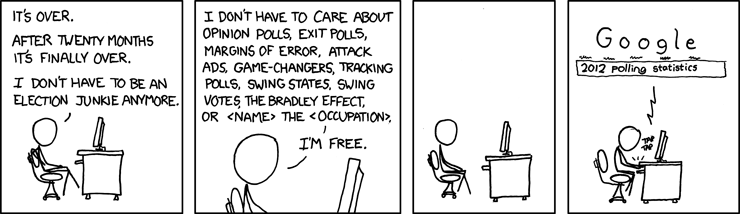
What do I do now?

Click on the cartoon to see the full strip.


Why I voted for Obama

Had a long, long, and at times uncomfortable conversation with co-workers at lunch yesterday. A colleague was moving on to a different position at LNA so our unit treated her to a farewell lunch at a restaurant where the service was, to put it mildly, a tad slow. But it was a chance to be out of the office for awhile, the unit chief was there and as long as he wasn't moving neither was anyone else. Naturally the election results were a major theme at the table.

The two people I happened to be sitting closest to (both of whom are really nice guys with whom I enjoy working but had studiously avoided mentioning anything political to since starting this detail in August) are disappointed McCain supporters, one more so than the other. That wasn't a surprise to me: both fellows are retired military, former Army officers, and one is a graduate of the Citadel. Which is why I never, ever talked politics with them. What would have surprised me would have been to learn that either one of them was a Democrat. One fellow said he was disappointed, but not surprised. He agreed picking Palin was a major blunder on McCain's part. The other guy was still a tad shell shocked. He had truly believed McCain's disaster of a campaign would manage to pull off a miracle.

He did ask me several times why I had supported Obama. I rattled off my usual talking points: the emphasis on community, the "we're all in this together" instead of pandering to individual greed, that great line Obama used ("When did selfishness become a virtue?") in multiple speeches, but then realized it comes down to something even more fundamental, at least for me.

It's okay be smart again. We've had almost 40 years of Republicans glorifying stupidity, starting with Spiro Agnew under Nixon and the beginning of the attacks on the "liberal elite" right through St. Ronnie and into the current (soon to be past) administration. Republicans have mocked intelligence, learning, higher education. Work hard in school, get good grades, and go to Harvard on merit instead of as a legacy student? Well, for the Repugs this wasn't something to praise -- it was something to make fun of, to sneer at. Clinton was enough of a good old boy that they never got any traction with being able to mock him as a policy wonk or the possessor of too much "book larning," but maybe if he hadn't given them so much ammunition to work with due to his weakness for womanizing they would have tried harder. Gore and Kerry, of course, were different stories.

Even worse, of course, was the contempt the Republicans showed for expertise in any field. If the scientists were telling you stuff you didn't want to hear (you know, those awkward things called "facts") instead of looking for solutions the Republican answer was to mock the science, to claim people who had spent 20, 30, or more years researching an issue were just stating opinions, only giving one side of a (usually nonexistent) controversy. Bible bangers uncomfortable with the results of a couple hundred years of research and scholarship in the natural sciences? Well, then, the obvious thing to do was to pander the loud-mouth know-nothing minority with their bizarre fantasy creationist view of the world. Oil and coal industries unhappy about being asked to clean up pollution or do something to slow down global warming? Ignore the geologists, meteorologists, and oceanographers who actually know what they're talking about and trot out a paid shill or two to claim the facts aren't all in yet. People getting sick from toxic exposures? Force public health agencies to edit reports or cover up public health problems (FEMA, CDC, and formaldehyde in trailers is a good example of that). It's a really long and depressing list.

I have been reminded many times that whoever is president doesn't make that much difference, all politicians end up disappointing you, and that all politicians lie. I'll agree with the latter two points, but not the first. The person in the Oval Office sets the tone, who he picks as advisers and cabinet officials do wield a tremendous amount of power, and the President himself can do an awful lot with the stroke of a pen. Both Executive Orders and Presidential Directives can be amazing forces for good, or they can do incredible damage. We've had 8 years of a President noted for his lack of curiosity, his willingness to believe whatever he's told by those close to him, and who has, unfortunately, used a pen to advance a destructive ideological agenda by presidential directive rather than through legislation far more often than most people realize. We're about to get a President who is the opposite: a man who is openly, happily an intellectual, who respects science, who won't mangle the English language and embarrass us all every time he opens his mouth, and who, while still far too cozy with corporate America for my liking, is going to be a whole heckuva lot more transparent in governing than his predecessor.

And, best of all, it's okay be smart again.

Wednesday, November 5, 2008

Doing the Happy Dance at work

I don't think much actual work is going to be accomplished here at LNA today. Colleagues are too elated following yesterday's election. The last few years have been quite demoralizing for the scientists and other staff -- lots of being forced to pander to religious ideologues, editing reports to downplay things that didn't line up with White House beliefs, seeing respected researchers assigned to dead end projects or being forced into early retirements. I'm low enough in the food chain and lucky enough to work in an area where it was never an issue for me, but I've heard the horror stories. And I did occasionally wonder just what I would do if I got asked to write a public web site feature that I knew was garbage, like something claiming condoms don't work in preventing STDs or that having an abortion causes cancer. Fortunately, it never happened.

Wonder when and if the rats will start leaving the ship here? Under the Bush administration a lot of people came in at the Senior Executive Service level -- they get paid whopping salaries for not doing a whole lot -- so it would be nice to see some of that deadwood cleaned out. A lot of us lower level peons are hoping that exodus starts soon.

Tuesday, November 4, 2008

A distraction

Today's the election, it will be in the back of my mind most of the day -- will the Rethuglicans manage to steal another one? How successful will they be with their vote suppression efforts? -- but for now I'm focusing on other issues. Like sizing vintage dresses.

I inherited about a dozen "Lucy" dresses from an aunt. They were stashed in the attic when we cleaned her house out about 12 years -- she put it up for sale after moving into an assisted living place. Most of the clothes and other attic odds and ends went to the Salvation Army, but I took about a dozen dresses that looked to be circa 1955-1960 because I thought they looked kind of neat and they might come in handy for Halloween costumes. Plus, of course, the dresses with full skirts had zillions of yards of material (this striped sleeveless number being a classic example; that skirt has about four yards of material in it) -- and I quilt.

The dresses are great -- I'm willing swear I saw Lucille Ball in one just like a blue linen number that's part of the stash, and, if not Lucy, then for sure it's been in a Doris Day movie. There's a pink polka dot sun dress that would be ideal for anyone who wants to channel her inner Marilyn Monroe (and it's even the same size Marilyn supposedly wore, a 14), and several nice cotton house dresses that just beg for a string of pearls to complete a June Cleaver outfit. Some are brand new, still have the store tags on them -- which is a minor mystery (why buy a new dress at Gimbels and then never wear it?), but not something I'm going to worry about much.

At one point I almost donated the lot to a small museum in the U.P. that has a "fashion through the years" focus. I also thought about donating them to the theater department at a university for use in costuming. Then I started thinking about selling them -- and did, in fact, try one time on E-bay. The E-bay experience was sufficiently horrific (who would have thought an auction for a vintage dress would bring lunatics out of the woodwork?) that I vowed to never go near E-bay again, either as a buyer or a seller.

Then I discovered etsy.com, "your place for all things handmade." Turns out it's also your place for things vintage, both clothing and supplies, so I'm contemplating opening an etsy store. The big question, though, is what size do I call these dresses. Thanks to vanity sizing, a dress that was a size 14 or 16 back in 1959 might be only a 10 now. A 16 is supposedly a size Extra Large in 2008, but looking at these size 14, 15, and 16 dresses I'm guessing they're Mediums at best. Research is called for -- hence, a distraction. Instead of thinking about stolen votes and/or voter intimidation, I can focus on doing web searches for information on converting 1950s sizes to 2008 sizes.

All I have to do is figure out how to describe them in a way that gives an honest approximation of what body type they might fit now. So I'll spend my day worrying about defunct fashion instead of thinking about the many ways ballot boxes can be metaphorically stuffed (or emptied), and maybe one of these days I will actually set up the etsy store.

Update:
It appears vanity sizing is worse than I thought. Several sites have informed me that what was a size 14 for my mother's generation is a size 8 for my daughters. One site had a photo of a model wearing a vintage garment (circa early 1950s) that was a size 12 when originally sold -- the dress appeared to fit quite well, and the model wears a size 2/4 in 21st century clothing. This trend keeps up, who knows? Maybe we'll all be size Zero in the not too distant future.

I guess I'd know this stuff if I ever wore anything other than jeans and souvenir tee-shirts.

Monday, November 3, 2008

Reagan economics

There's a great post up on Brilliant at Breakfast. Here's a taste:

But this is where we are today, thanks to the Bush family and their cronies, who ALWAYS believed that the world was a private fiefdom for the benefit of their family members and friends, to John McCain, who supported policies that fed this notion and became one of those friends so he could benefit, and to spineless Democrats who have been too lazy or too frightened to articulate the reality that Ronald Reagan was wrong -- you can't have everything you want and it's all free if you just give the already wealthy even more.